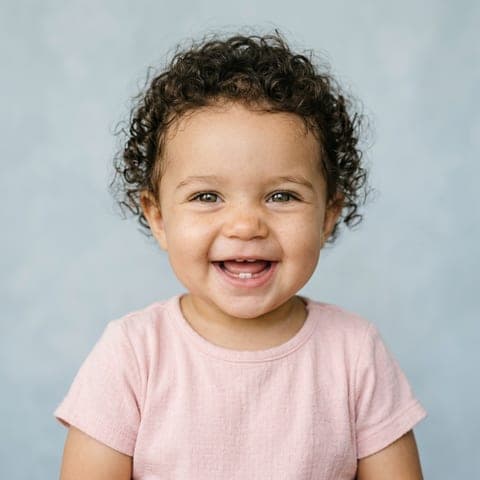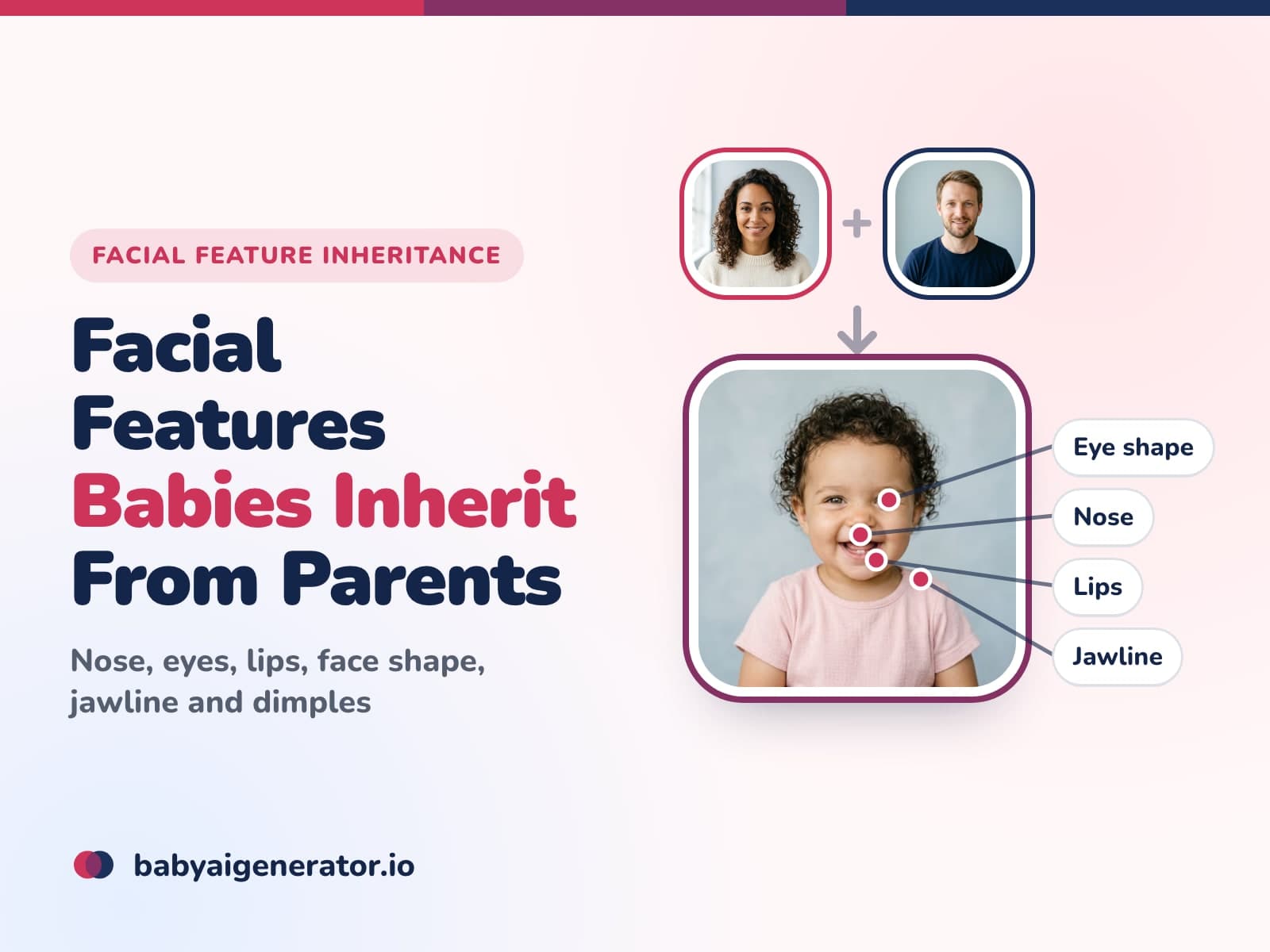
Babies inherit their nose shape, eye shape, lip shape, face shape, jawline and dimples from their parents. Inherited facial features are traits passed through the DNA of both parents, and each child receives a new combination of those traits. Each parent contributes half of the baby's DNA, and many genes work together to shape every facial feature, so facial inheritance is a blend rather than a one-to-one copy.
The nose and the mid-face are among the most heritable parts of the face, and the mother and the father each pass on half of the genes behind a baby's features. A baby never looks exactly like either parent because genetic recombination mixes both parents' DNA in a new way, which raises the question of whether inherited features can be predicted. The AI Baby Generator predicts a baby's face by reading both parents' facial features from photos and blending them.
Parent photos cannot reveal recessive variants hidden in the parents' DNA. Cleft chin, widow's peak, attached earlobes and freckles are classically taught as single-gene facial traits, though modern research links each of them to several genes. A baby's inherited facial features grow clearer over the first year as newborn swelling fades, and they keep developing through childhood and adolescence, so the features a baby inherits from both parents emerge step by step as the child grows.
What Are Inherited Facial Features?
Inherited facial features are physical characteristics of the face that pass from parents to their children through genetic material. Inherited facial features include nose shape, eye shape, lip fullness, face contour, jawline and dimples. Each parent contributes half of the genetic blueprint, with the mother passing genes through the egg and the father through the sperm, and the combination gives each child an individual set of features.
Facial inheritance depends on interactions among many genes that carry instructions for how each facial structure develops. A child can resemble one parent in a single feature, yet the full combination produces an appearance of the child's own. Unlike traits acquired from the environment, inherited facial features set the foundational structure of a person's face for life.
How Do Babies Inherit Facial Features From Parents?
Babies inherit facial features through the genetic material they receive from both parents. Each parent contributes 23 chromosomes, which pair up to form the baby's full set of DNA, and that DNA holds the genes that guide the development of physical characteristics, including the face.
Facial inheritance is a polygenic process, meaning many genes interact to shape each characteristic, such as nose shape, eye form and jawline. A facial feature results from the combined effect of many genetic variants rather than a single gene. Age, sex and environment then influence how the inherited instructions show in the face.
The combination of genes inherited from each parent differs for every child. Genetic recombination explains why siblings can look different from each other and why a child can resemble one parent more than the other, with each facial feature emerging from the joint influence of many genes.
Which Facial Features Do Babies Inherit From Parents?
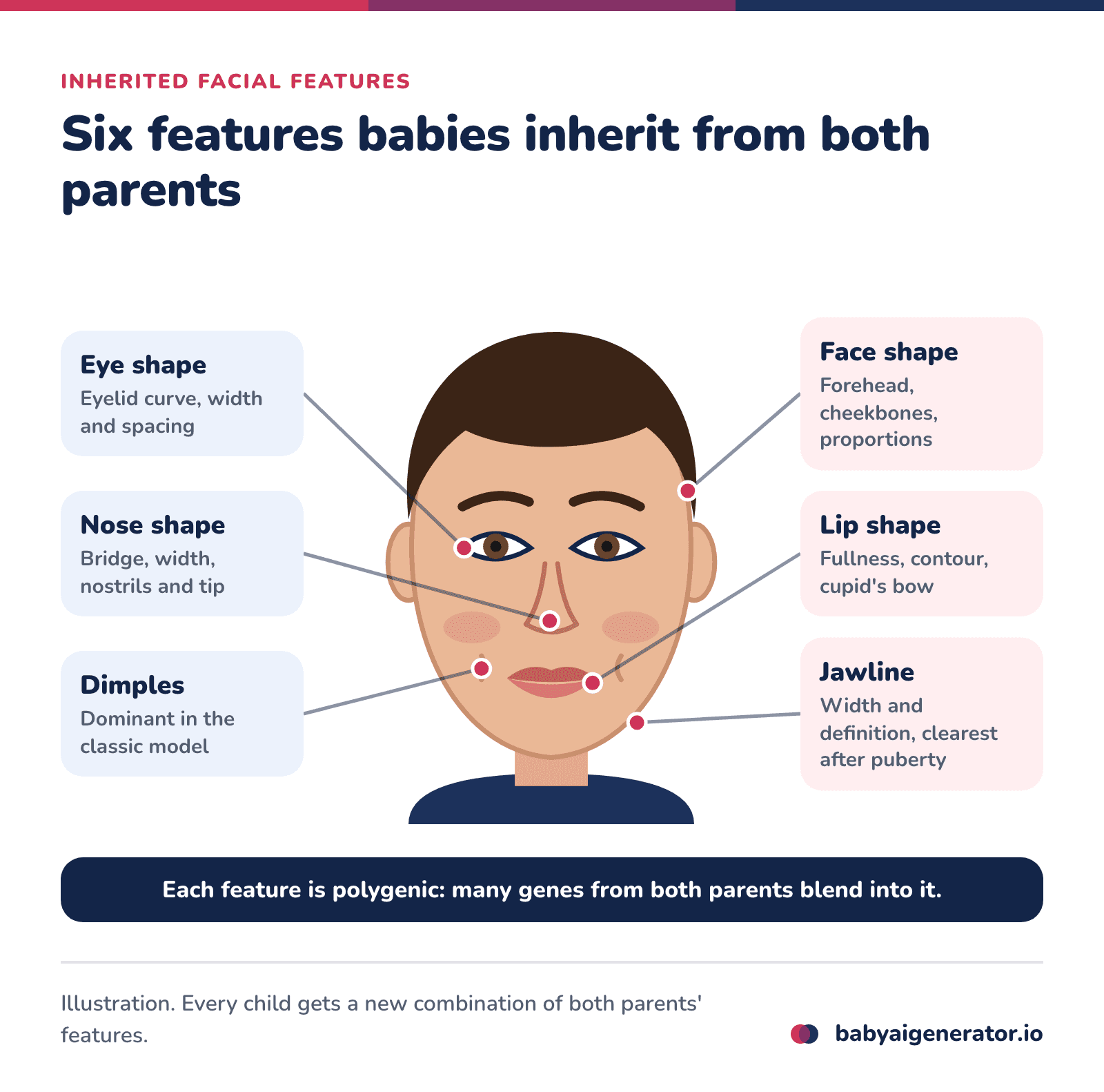
The facial features babies inherit from parents are nose shape, eye shape, lip shape, face shape, jawline and dimples. Each of the inherited features develops through polygenic inheritance, where many genes from both parents interact to set the final appearance, so every child's face is a new blend of parental traits.
Nose Shape
Nose shape is a highly heritable facial feature shaped by many genes from both parents. Nasal genes influence width, bridge height, nostril size and tip projection, and genetic studies describe nose shape as polygenic, with many genetic markers working together to form the final nasal structure. Both parents contribute to the genetic blueprint, and a high nose bridge may follow a dominant pattern, so a parent with a prominent bridge raises the chance of a baby inheriting it. The basic structure of the nose becomes recognizable during the first year of life, and the nose reaches adult proportions during puberty.
Eye Shape
Eye shape is an inherited facial feature set by several genes from both parents. Eye shape genes influence the curvature of the eyelids, the width of the eye opening and the spacing between the eyes, which decide whether eyes look round, almond-shaped or hooded. The polygenic nature of eye shape means a child can inherit a blend of both parents' eye shapes or resemble a relative from an earlier generation.
Eye shape varies widely because many genes interact. Dominant variants can pull a child's eye shape closer to one parent, and growth of the face during infancy changes how eye shape looks over time. A child's eye shape is therefore a combination of both parents' features rather than an exact copy.
Lip Shape
Lip shape is inherited through the interplay of several genes from both parents. Lip genes influence the thickness of the upper and lower lips, how far the lips project and the outer contour of the mouth, and genetic studies have linked several regions of the genome to lip fullness and shape. Full lips often act as a dominant trait, so a parent with full lips raises the chance of a child inheriting full lips. Lip shape is polygenic, so a baby's lips end up as a blend of both parents' contributions. The depth of the philtrum and the definition of the cupid's bow are inherited too and become more pronounced as the baby's face matures.
Face Shape
Face shape is inherited from parents through the interaction of many genes. Face shape genes set the basic structure of the forehead, cheekbones and general facial proportions, and a baby's round, oval, square or heart-shaped face results from the combined genetic input of both parents.
Twin research shows that the skeletal framework of the face is highly heritable. Many genes are involved, so a baby's face shape blends both parents' features, such as a broader forehead from one parent and cheekbone structure from the other. Nutrition and growth then influence how the inherited facial structure shows over time.
Jawline
The jawline is inherited through the interaction of many genes from both parents. Jawline shape, width and prominence are shaped mainly by genetic factors, with many genetic variants working together to decide the final appearance.
Both parents contribute to the genetic blueprint of a baby's jawline, and a strong, defined jaw or a softer, rounded jaw can come from either parent. The final jaw structure blends both parents' features, while nutrition, health and dental development affect jaw growth. The inherited jawline becomes most visible during puberty and early adulthood, when the jaw changes the most.
Dimples
Dimples are inherited as a dominant trait in the classic model, so only one parent needs to pass on the dimple variant for a child to have dimples. Dimples are linked to a variation in the zygomaticus major muscle that creates small indentations in the cheeks when a person smiles. Dimple inheritance is not straightforward, because several genetic factors are involved, so dimples can skip generations and appear unpredictably in a family. Dimples can differ in depth and position even among siblings, and some children are born with dimples that fade as they grow, while others develop dimples later as the face changes.
Which Facial Features Are Most Heritable?
The most heritable facial features are the tip of the nose, the areas above and below the lips, the cheekbones and the inner corners of the eyes. A 2017 King's College London study of about 1,000 twins, "Heritability maps of human face morphology through large-scale automated three-dimensional phenotyping," published in Scientific Reports, used 3D face scans to place the nose tip and the areas around the lips at the top of the heritability ranking.
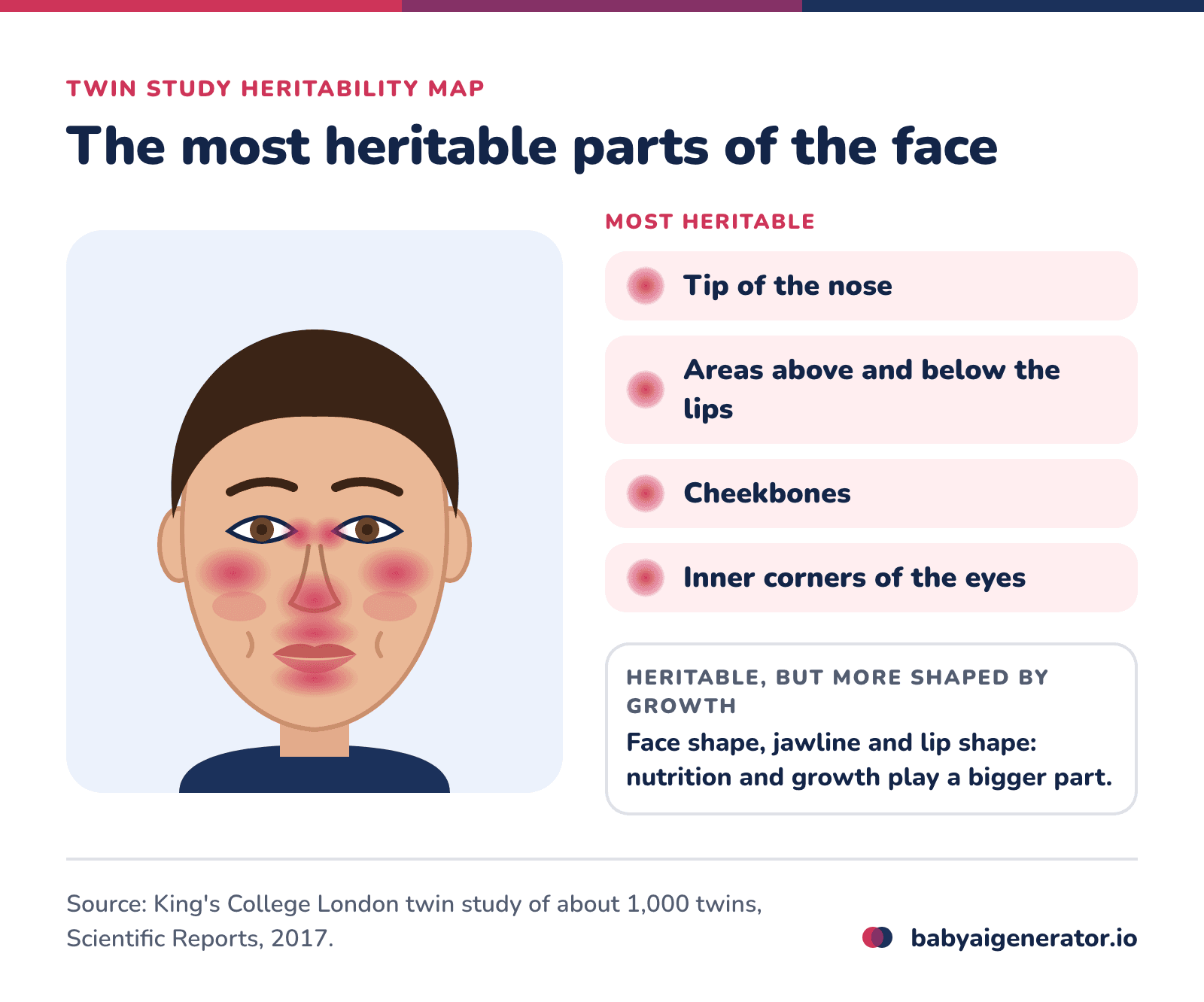
The mid-face region, including eye placement, nasal width and upper lip height, shows the strongest genetic influence in twin research, as Weinberg, Parsons, Marazita and Maher found in "Heritability of face shape in twins: a preliminary study using 3D stereophotogrammetry and geometric morphometrics" (Dentistry 3000, 2013). Face shape, jawline and lip shape are heritable as well, though environmental factors such as growth and nutrition affect them more than the nose and mid-face.
Do Babies Inherit More Facial Features From the Mother or the Father?
No, babies do not inherit more facial features from one parent, since each parent contributes about 50% of the child's DNA, including the genes behind facial characteristics. Chromosomes from the mother and the father pair up to set the child's physical traits.
The genetic contribution from each parent is balanced, but a baby's features can appear to favor one parent because of how dominant and recessive variants are expressed. Dominant variants from either parent are more likely to show in the child's appearance, so a prominent nose or a strong jawline can make a baby resemble one parent more closely even though both parents contributed the same share of DNA.
The belief that babies look more like their fathers at birth is common, but research has not found consistent evidence for it. The random combination and expression of genes create each baby's appearance, which can seem to favor one parent over the other.
Why Do Babies Not Look Exactly Like Either Parent?
Babies do not look exactly like either parent because they inherit a new combination of genetic material from both the mother and the father. Each parent contributes half of the child's DNA, but the alleles, or gene variants, a child receives are chosen at random, so recombination produces a blend of traits rather than a copy of either parent. Most facial features depend on many genes through polygenic inheritance, which widens the range of possible outcomes.
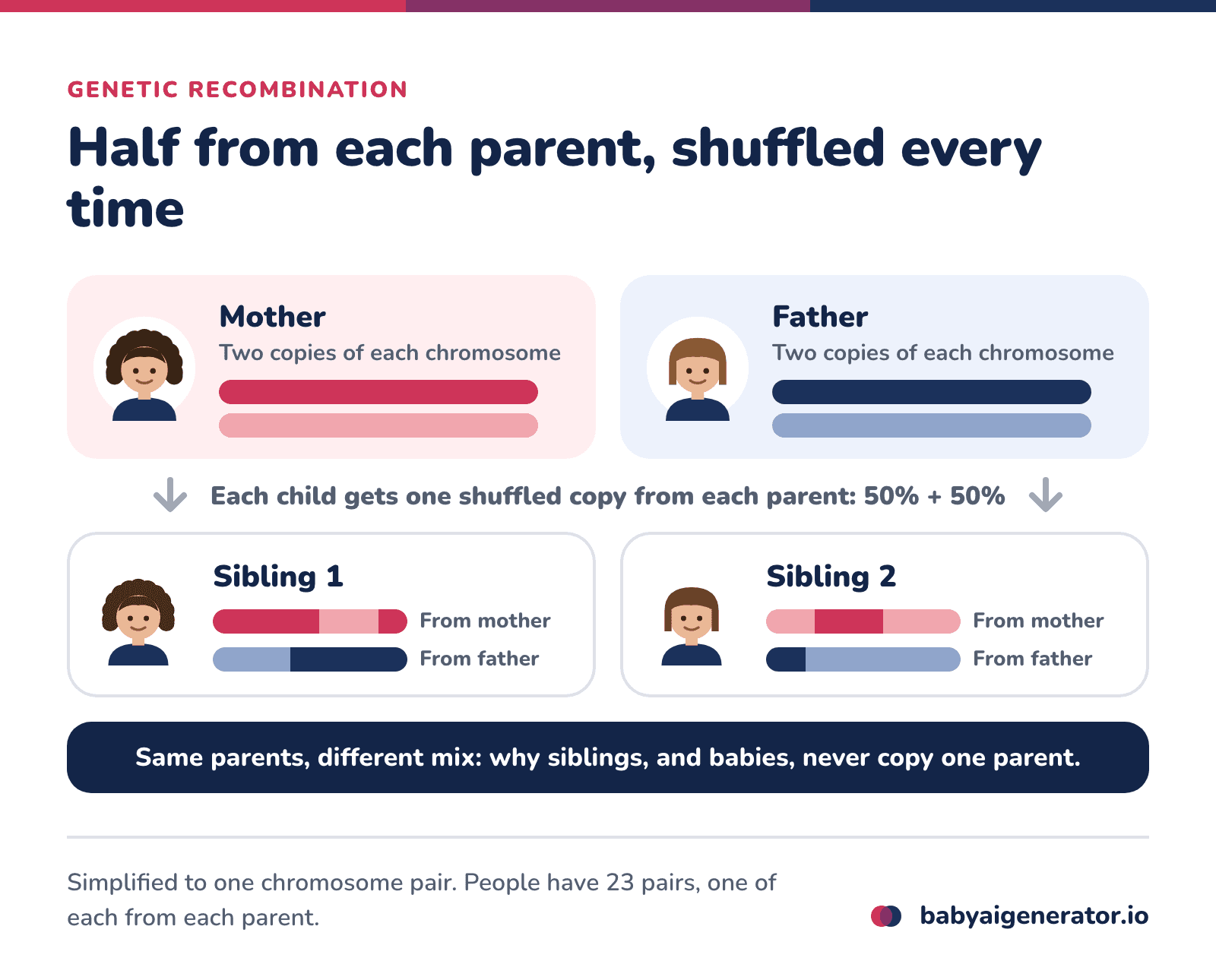
The genetic shuffling during reproduction means siblings with the same parents can look different. Gene expression, which sets how strongly a trait shows, varies from child to child, and some genes interact in unexpected ways to create new combinations of features. Environmental factors during development influence how inherited traits are expressed as well.
The unpredictable mix of parental genes raises the question of whether a baby's facial features can be predicted before birth at all.
Can You Predict Which Facial Features a Baby Will Inherit?
No, you cannot predict which facial features a baby will inherit with complete accuracy. Genetic science has identified many genes linked to facial development, but the interaction of hundreds of genes with environmental factors makes precise prediction impossible, and the combination a baby receives is largely random.
General predictions are possible for traits with simpler inheritance patterns, such as dimples or a cleft chin. For polygenic traits such as nose shape, eye shape and face structure, predictions stay approximate. AI tools such as baby face generators create estimates by blending parental features, which gives a visual approximation of the baby rather than a genetic certainty.
How Does the AI Baby Generator Predict Your Baby's Inherited Facial Features?
The AI Baby Maker predicts a baby's inherited facial features by analyzing photos of both parents. The AI Baby Generator uses facial recognition to identify and map the nose, eyes, lips, face structure and jawline, then blends the parents' features to generate a composite image of the baby's likely appearance.
The prediction relies on facial landmarks detected in the parent photos, including the bridge and tip of the nose, the width and angle of the eyes, the fullness and contour of the lips, the face geometry and the definition of the jawline. The AI Baby Generator turns those landmarks into data points, so the quality and clarity of the parent photos decide how accurate the result is.
Uploading Parent Photos to Predict Inherited Facial Features
Parents get the most accurate prediction of inherited facial features by uploading clear, front-facing photos to the AI Baby Generator. Good parent photos use natural or even lighting, keep the eyes, nose, mouth, jawline and hairline fully visible, and show a neutral expression in sharp focus. Sunglasses, hats, heavy makeup and shadows hide the facial landmarks the AI Baby Generator measures, so parent photos work best without them.
Why Can't Parent Photos Reveal Recessive Facial Features?
Parent photos cannot reveal recessive facial features because a recessive trait shows only when a child inherits two copies of a recessive variant, one from each parent. A parent who carries one dominant and one recessive variant shows only the dominant trait, so the recessive variant stays invisible in the parent's photo. Both parents can carry a hidden recessive variant, such as one for lighter eye color, without any sign of it in their faces. Recessive variants can therefore stay hidden for generations and resurface only when a child inherits a matching copy from both parents, which explains why a child can show a feature that skipped the parents but appeared in the grandparents.
Facial Features Inherited From Grandparents
Facial features can pass from grandparents to a baby through the parents' DNA. Each parent passes half of their DNA to a child, and that half includes genetic material from the parent's own mother and father, so a child receives about 25% of their DNA from each grandparent on average. When both parents carry the same recessive variant, the trait can reappear in their child even though neither parent shows it. Grandparent inheritance explains why a grandchild can have a nose shape or eye color similar to a grandparent's, usually through interacting genes rather than a single dominant gene.
Which Single-Gene Facial Traits Do Babies Inherit?
The single-gene facial traits babies inherit, as classically taught, are listed below:
- Cleft Chin: A dimple or indentation in the chin.
- Widow's Peak: A V-shaped point in the hairline at the center of the forehead.
- Attached Earlobes: Earlobes that connect directly to the side of the head without a free-hanging lobe.
- Freckles: Small, concentrated spots of melanin on the skin, most visible on the face.
Classic genetics teaches cleft chin, widow's peak, attached earlobes and freckles as simple Mendelian traits, but modern research shows each of them is influenced by more than one gene. John H. McDonald of the University of Delaware lists cleft chin, widow's peak and attached earlobes among the classroom traits that do not follow a simple one-gene pattern in "Myths of Human Genetics" (2011).
Cleft Chin
A cleft chin is a visible indentation in the center of the chin. A cleft chin is classically considered a dominant trait, meaning one variant from either parent can produce a cleft chin in the child. Cleft chin inheritance is more complex than simple Mendelian genetics suggests, because several genes and developmental factors shape chin formation. A child can therefore have a cleft chin when both parents have smooth chins, or have no cleft chin when one or both parents have one, so the cleft chin can skip generations in a family.
Widow's Peak
A widow's peak is an inherited V-shaped point at the center of the hairline. A widow's peak was traditionally taught as an autosomal dominant trait, meaning only one parent needed to pass on the variant for the widow's peak to appear. Modern genetic research shows widow's peak inheritance is more complex, with several regions of the genome influencing the shape of the hairline. A parent with a widow's peak raises the chance of a child inheriting the feature but does not guarantee it.
Attached Earlobes
Attached earlobes are earlobes that connect directly to the side of the head without hanging freely. Attached earlobe inheritance was traditionally taught as simple Mendelian genetics, with free-hanging lobes dominant, but modern genetic research shows earlobe attachment is a polygenic trait shaped by many genes.
A 2017 study by Shaffer et al. in the American Journal of Human Genetics, "Multiethnic GWAS Reveals Polygenic Architecture of Earlobe Attachment," linked earlobe attachment to regions involving EDAR, SP5, MRPS22, ADGRG6, KIAA1217 and PAX9 and found 49 associated loci across 74,660 people. Many genes are involved, so parents with attached earlobes can have children with attached or free earlobes depending on the combination of variants inherited from both parents.
Freckles
Freckles are inherited through a pattern involving several genes, with the MC1R gene having the strongest influence on the likelihood of developing freckles. A child of one or both parents carrying MC1R variants is more likely to inherit a tendency toward freckles. Freckles do not appear at birth, because sun exposure must activate melanin production in the genetically predisposed skin, so freckles become visible in early childhood on sun-exposed areas. A baby therefore inherits the potential for freckles, and sunlight decides when that potential shows.
When Do a Baby's Inherited Facial Features Become Defined?
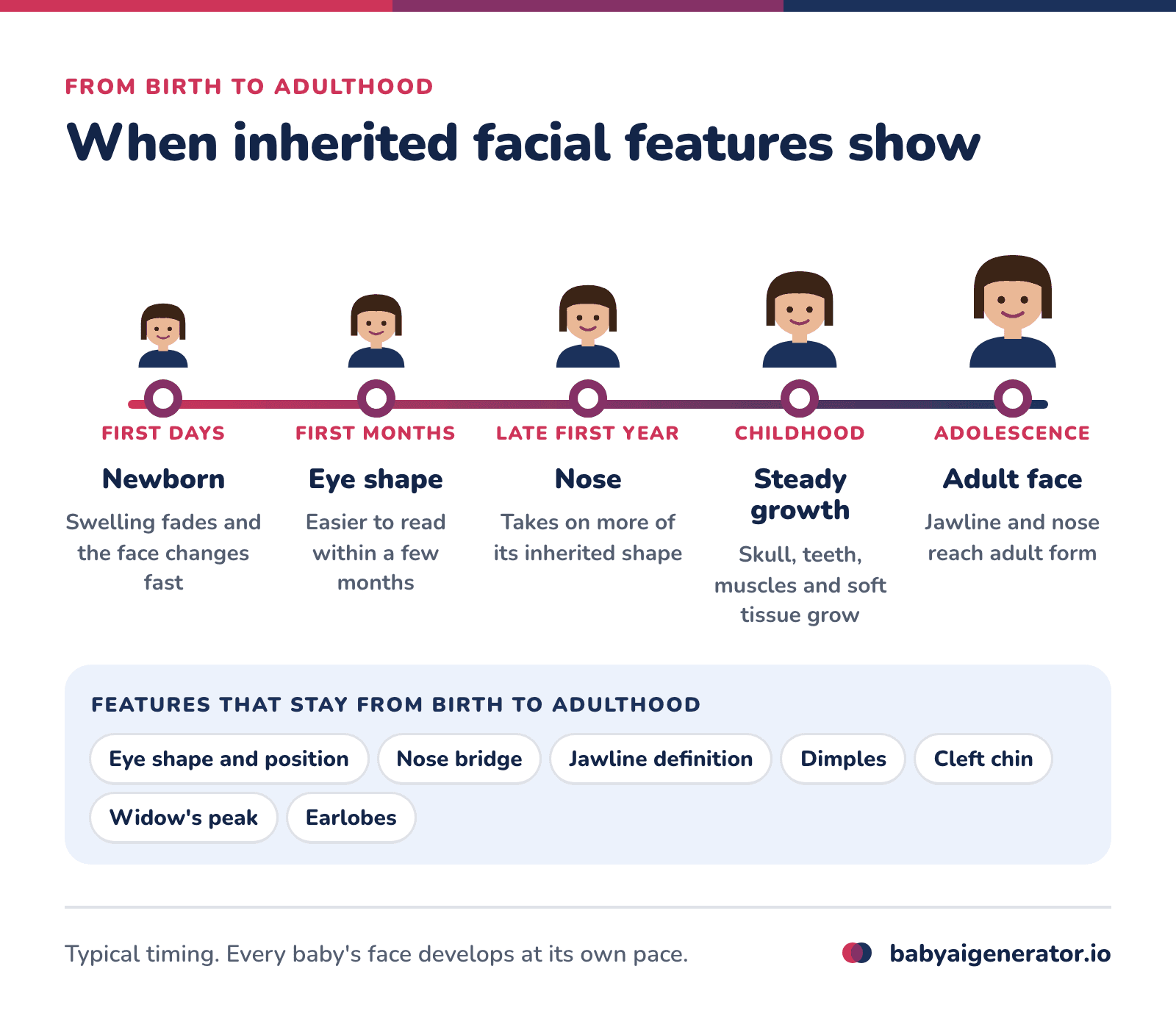
A baby's inherited facial features become noticeably clearer over the first year of life, as newborn swelling fades in the first days and the face grows quickly through the following months. Cook Children's Health Care System explains in "Your Newborn Head to Toe" that a newborn's face can look quite puffy from fluid and the trip through the birth canal, and that facial appearance changes significantly during the first few days. The forehead, cheeks, chin, nose and upper lip change rapidly during infancy, and the shape of the face, jawline, nose and lips starts to show inherited characteristics more visibly.
Facial features keep developing through childhood as the skull, teeth, muscles and soft tissues grow. Eye shape becomes easier to read within the first few months, while the nose takes on more of its inherited shape later in the first year, and the adult form of the face is not set until adolescence.
Which Inherited Facial Features Stay From Birth to Adulthood?
The inherited facial features that stay from birth to adulthood are the shape and relative position of the eyes, the structure of the nose bridge and the definition of the jawline. Traits such as dimples, a cleft chin, a widow's peak and attached earlobes persist throughout life too. Facial proportions change as a person grows, but the stable features a baby inherits from both parents keep a family resemblance that spans generations.
Written by The Baby AI Generator team. We build the generator on this site and write about what it can and can't tell you.