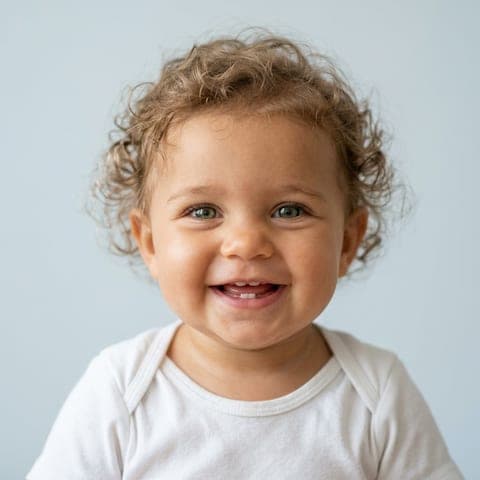
Gene 1: brown or not brown
One gene decides whether eyes are brown. Brown wins over not brown, so one brown copy is usually enough for brown eyes. In real DNA this is mostly the HERC2 switch that turns the OCA2 pigment gene up or down.
Calculate your baby's eye color odds from both parents' eye colors using Baby AI Generator's free eye color calculator.
Your baby's chances
Pick both parents' eye colors, then press Calculate.
Free and private: the math runs in your browser.
The same odds as the calculator, for all six pairs of parents.
| Parents | Brown | Green | Blue |
|---|---|---|---|
| Brown and Brown | 75% | 18.75% | 6.25% |
| Brown and Green | 50% | 37.5% | 12.5% |
| Brown and Blue | 50% | 25% | 25% |
| Green and Green | 0% | 75% | 25% |
| Green and Blue | 0% | 50% | 50% |
| Blue and Blue | 0% | 0% | 100% |
Brown includes dark brown and amber, green includes hazel, blue includes gray. The most likely color for each pair is highlighted. Assumes brown-eyed parents carry hidden green and blue copies; see the working in the calculator.
Baby eye color is inherited through several genes, with OCA2 and HERC2 doing most of the work. The calculator simplifies them into two genes: each parent passes on one copy of each, and it adds up every combination. For a mixed-race couple, the Mixed Race Baby Generator shows eyes on whole faces, with each child's skin tone checked against both of yours.
One gene decides whether eyes are brown. Brown wins over not brown, so one brown copy is usually enough for brown eyes. In real DNA this is mostly the HERC2 switch that turns the OCA2 pigment gene up or down.
If the first gene says not brown, a second gene decides between green and blue. Green wins over blue.
OCA2 and HERC2 have the largest influence on iris melanin, but other genes add variation, so eye color is polygenic. That's why siblings can have different eye colors and why no dominant-recessive model is ever certain. A 2026 Ask a Geneticist answer from The Tech Interactive, "How do different genes contribute to our traits like eye and skin color?" by Austin Huang, names OCA2 and HERC2 as the two genes with the largest roles.
Brown is the most likely baby eye color whenever at least one parent has brown eyes: two brown-eyed parents have a 75% chance of a brown-eyed baby, and a brown-eyed and a blue-eyed parent a 50% chance. It is also the most common eye color worldwide, with more than half of all people having brown eyes, as the American Academy of Ophthalmology reports in "Eye Color: Unique as a Fingerprint" (September 2026).
Blue eyes are close to certain when both parents have blue eyes, and less likely with every brown-eyed parent. MedlinePlus Genetics explains in "Is eye color determined by genetics?" (National Library of Medicine, July 2022) that blue eyes have much less iris pigment, because a HERC2 variant reduces the activity of the OCA2 gene.
Green eyes are a rarer result, linked to moderate melanin levels and found in about 2% of people worldwide, one of the least common eye colors. The calculator gives a green eye probability from the family eye colors entered.
Hazel eyes blend brown and green pigmentation into a multicolored iris, in many cases with flecks of gold. In the calculator, hazel counts with green, so the green result includes the chance of a hazel-eyed baby.
Gray eyes are the rarest outcome in most families, coming from very low melanin in the iris combined with a collagen structure that scatters light. They are least likely when parents and grandparents mostly have brown, green, or hazel eyes, and in the calculator they count with blue.
The color your baby is born with often isn't the one they keep.
Many babies, especially with lighter-skinned parents, are born with blue or gray eyes. Babies with darker skin are often born with brown eyes.
Pigment builds up in the iris. This is when most changes happen: blue can turn green, hazel or brown.
For most children the color is close to final by their first birthday.
Small shifts can continue for a while. Hazel and green eyes are the most likely to keep changing.
The two-gene model is a teaching tool. These studies show what's really going on, and why families sometimes surprise it.
Study · 2008
Blue versus brown really does behave mostly like one switch, which is why the brown percentage above works well. Green and hazel depend on more genes, so those numbers are rougher.
Researchers at the University of Queensland compared DNA and eye color in thousands of people of European descent. A single variant (rs12913832) in the HERC2 gene, which acts as a switch for the OCA2 pigment gene, predicted blue versus brown far better than anything found before.
Sturm et al., American Journal of Human Genetics, 2008Study · 2008
Blue eyes need two copies of the switched-off version, one from each parent. That's why blue only appears in the calculator when both parents pass on hidden copies.
A University of Copenhagen team mapped blue eyes in a large Danish family to the same HERC2 region. They found the blue-eye version was perfectly associated with blue eyes, and press coverage reported it likely arose in one person around 6,000 to 10,000 years ago.
Eiberg et al., Human Genetics, 2008 (via ScienceDaily)Case study · twins
Wait before you call it: the color at birth, or even at age 1, isn't always final.
The Louisville Twin Study followed white twins from childhood into adulthood. Most children's eye color was stable by about age 6, but 3.8% to 8.6% changed by two or more shades later on. Identical twins matched closely (r = 0.98), fraternal twins much less (r = 0.49).
Bito et al., Archives of Ophthalmology, 1997Case study · families
When the calculator says 0%, read it as very unlikely, not impossible.
Geneticist John McDonald (University of Delaware) documents that blue-eyed parents can, rarely, have brown-eyed children, and that eye color is not the simple one-gene trait many textbooks show. Other genes can restore pigment even when the main switch is off.
J. H. McDonald, Myths of Human Genetics: Eye colorUpload a photo of each parent and see four children with your eyes, hair and smile. Our AI baby creator adds a note on which traits came from whom, and your first result is free.
OCA2 and HERC2 determine eye color by regulating melanin production in the iris. The OCA2 gene produces iris melanin, which sets eye pigmentation. A regulatory region in the neighboring HERC2 gene acts as a switch that turns OCA2 activity up or down. The OCA2 and HERC2 interaction decides whether the iris develops higher or lower melanin levels, which makes eyes brown, blue, green, or another color. MedlinePlus Genetics describes the mechanism at the gene level: the OCA2 gene produces the P protein involved in melanosome maturation, and a DNA segment in intron 86 of HERC2 controls OCA2 expression.
Yes, two brown-eyed parents can have a blue-eyed baby. Both parents may carry recessive genes for blue eyes and pass them to their child. Brown eyes behave as dominant, but if both parents carry hidden blue-eye alleles, the two-gene model gives a 6.25% chance of a blue-eyed child (1 in 16) and 18.75% for green.
It's rare but possible. The simple model says almost never, but eye color depends on many genes, so real families sometimes surprise the table.
It depends on the other parent. With a brown-eyed partner who carries hidden copies: 50% brown, 25% green, 25% blue. With a green-eyed partner: 50% green, 50% blue. With a blue-eyed partner the model says 100% blue, though real families occasionally differ.
Each parent can carry eye color versions they don't show. Green appears when a child inherits the right mix of hidden copies from both sides.
Baby eye color becomes permanent around the first birthday for most babies. Many infants start with blue or gray eyes because of low melanin in the iris. Light exposure stimulates melanin production as babies grow, and eye color stabilizes between six and twelve months, though subtle changes can continue up to age three. Nemours KidsHealth notes in "Getting to Know Your Newborn" (January 2023) that a baby's eye color usually reaches its permanent shade between 3 and 12 months of age.
Babies are born with blue or gray eyes because their irises have low melanin levels at birth. Melanin is the pigment behind eye color, and its production increases after birth as babies are exposed to light. Rising melanin changes the initial blue or gray eyes to their permanent color over the following months. Eye color stabilizes around the end of the first year, although slight variations can continue for a few years.
A baby eye color calculator is accurate as a probability estimate, not a guarantee, because it relies on a simplified genetic model. The model uses known inheritance patterns from major eye color genes, such as OCA2 and HERC2, to generate odds. Actual outcomes can differ because multiple genetic variants and interactions fall outside basic models. Real results depend on the exact gene variants each parent carries, including recessive alleles that do not show in their own eye color. The percentages show statistical likelihood across many families rather than a guaranteed outcome for any one baby. This calculator uses the two-gene model taught in genetics classes, with stated assumptions about each parent's hidden copies; amber and dark brown count as brown, hazel as green, and grey as blue.
The criteria for choosing a baby eye color calculator are listed below:
Not directly: the calculator gives odds, and the face comes from Baby AI Generator's baby generator, which reads each parent's eye color from their photo. Upload a photo of each parent to see whole children, each with an eye color drawn from both of you. The calculator's percentages and the generated faces are separate: the faces don't follow the odds you picked.
Now meet the baby behind the eyes. Your first result is free
Try the baby generator