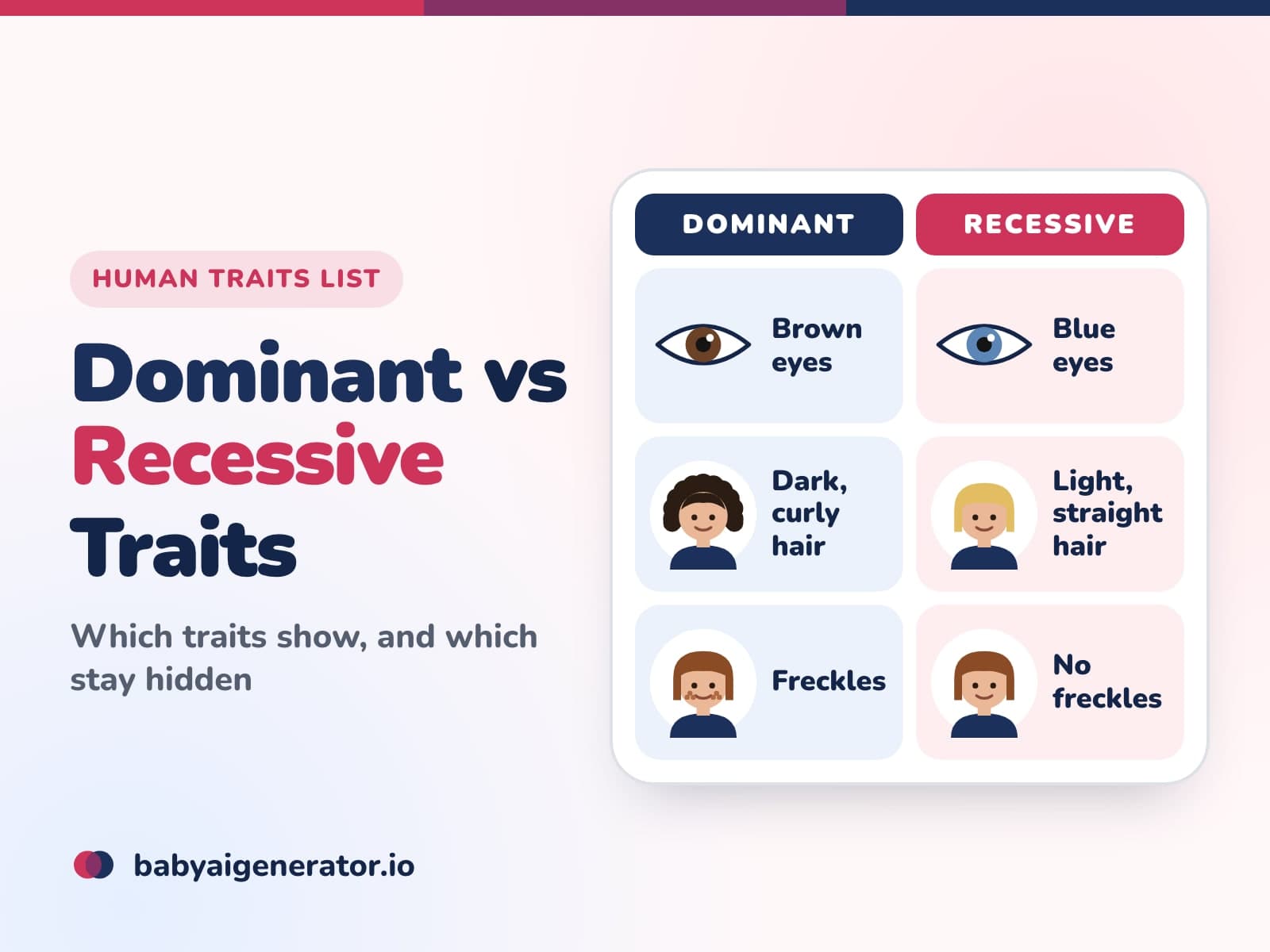
Dominant and recessive traits in humans describe how inherited alleles decide which version of a characteristic appears. A dominant trait appears when a person carries at least one dominant allele, while a recessive trait appears only when a person inherits two recessive alleles. Commonly listed dominant human traits include dark hair, brown eyes and dimples, and commonly listed recessive traits include blonde hair, blue eyes and the inability to roll the tongue.
Human traits fall into facial, hair, eye and hand groups. In the classic classification, freckles and a cleft chin count as dominant facial traits while a smooth chin counts as recessive, dark hair is dominant over light hair, and brown eyes are dominant over blue eyes.
Each parent passes one allele per gene to a child, so a dominant trait needs one dominant allele and a recessive trait needs two recessive alleles. Eye color and other polygenic traits do not follow simple dominant and recessive patterns, which limits how precisely a baby's traits can be predicted. AI baby generators visualize likely traits from the parents' visible features, yet parent photos show expressed traits, not hidden recessive alleles. Two parents with dominant traits can still have a child with a recessive trait when both carry a recessive allele, and a dominant trait is not necessarily more common than a recessive one.
Which Human Traits Are Dominant?
Dominant human traits are characteristics that appear when a person inherits at least one dominant allele. The dominant human traits most commonly taught in genetics classes are listed below:
- Dimples: Small indentations in the cheeks that show when smiling. Dimples are classed as dominant, though The Tech Interactive's "Is a dominant version of a trait always more common than the recessive one?" by Dr. D. Barry Starr (2006, editor's note 2021) now describes dimples as a complex, multifactorial trait.
- Widow's Peak: A V-shaped point in the hairline at the center of the forehead, usually listed as dominant in trait charts.
- Free Earlobes: Earlobes that hang below their point of attachment to the head, described as dominant over attached earlobes, although a 2017 study by Shaffer et al. in the American Journal of Human Genetics, "Multiethnic GWAS Reveals Polygenic Architecture of Earlobe Attachment," found 49 genetic loci linked to earlobe attachment across 74,660 people.
- Cleft Chin: A visible indentation in the middle of the chin, classified as a dominant trait.
- Tongue Rolling: The ability to curl the sides of the tongue upward into a tube. Tongue rolling is taught as dominant, but later studies point to a more complex basis.
- Mid-Digital Finger Hair: Hair on the middle segments of the fingers, listed as a dominant trait.
- PTC Tasting: The ability to taste the bitter compound phenylthiocarbamide (PTC), a classic dominant trait carried by the taster allele (T).
The dominant traits in classroom lists are simplified examples, and dominance describes the relationship between alleles rather than how common or important a trait is.
Which Human Traits Are Recessive?
Recessive human traits appear when a person inherits two copies of a recessive allele, one from each parent. A recessive allele stays hidden when paired with a dominant allele but can appear in a child when both parents carry it. The common recessive human traits are listed below:
- Blue or Green Eyes: Lighter eye colors such as blue and green appear when a child inherits low-melanin variants from both parents, and MedlinePlus Genetics notes in "Is eye color determined by genetics?" (July 2022) that the OCA2 and HERC2 genes on chromosome 15 play a major role in that variation.
- Blonde or Red Hair: Lighter hair colors count as recessive. MedlinePlus Genetics explains in "Is hair color determined by genetics?" (July 2022) that loss-of-function changes in both copies of the MC1R gene almost always produce very red hair, although hair color inheritance involves several genes.
- Straight Hair: Straight hair is the recessive form and curly hair is the dominant form, so a person needs two straight hair alleles for straight hair.
- Type O Blood: Type O is recessive to both A and B in the ABO blood group, so a person must inherit an O allele from each parent to have type O blood.
- Inability to Roll the Tongue: The inability to roll the tongue into a U shape is classed as recessive, though tongue rolling may have a more complex basis.
- Attached Earlobes: Earlobes that join the side of the head with no hanging lobe are classed as recessive, while free-hanging earlobes are dominant.
- Inability to Taste PTC: The inability to taste phenylthiocarbamide (PTC) is recessive, and PTC tasting is one of the clearer single-gene examples, with the nontaster allele recessive.
Many recessive traits in the classic lists are influenced by several genes, which makes their inheritance more involved than classical Mendelian genetics suggests.
What Are Dominant and Recessive Traits?
Dominant and recessive traits are the two ways alleles, the versions of a gene, decide a characteristic in humans. A dominant trait shows when at least one dominant allele is present, even alongside a recessive allele. A recessive trait shows only when a person inherits two recessive alleles, one from each parent, with no dominant allele to mask it.
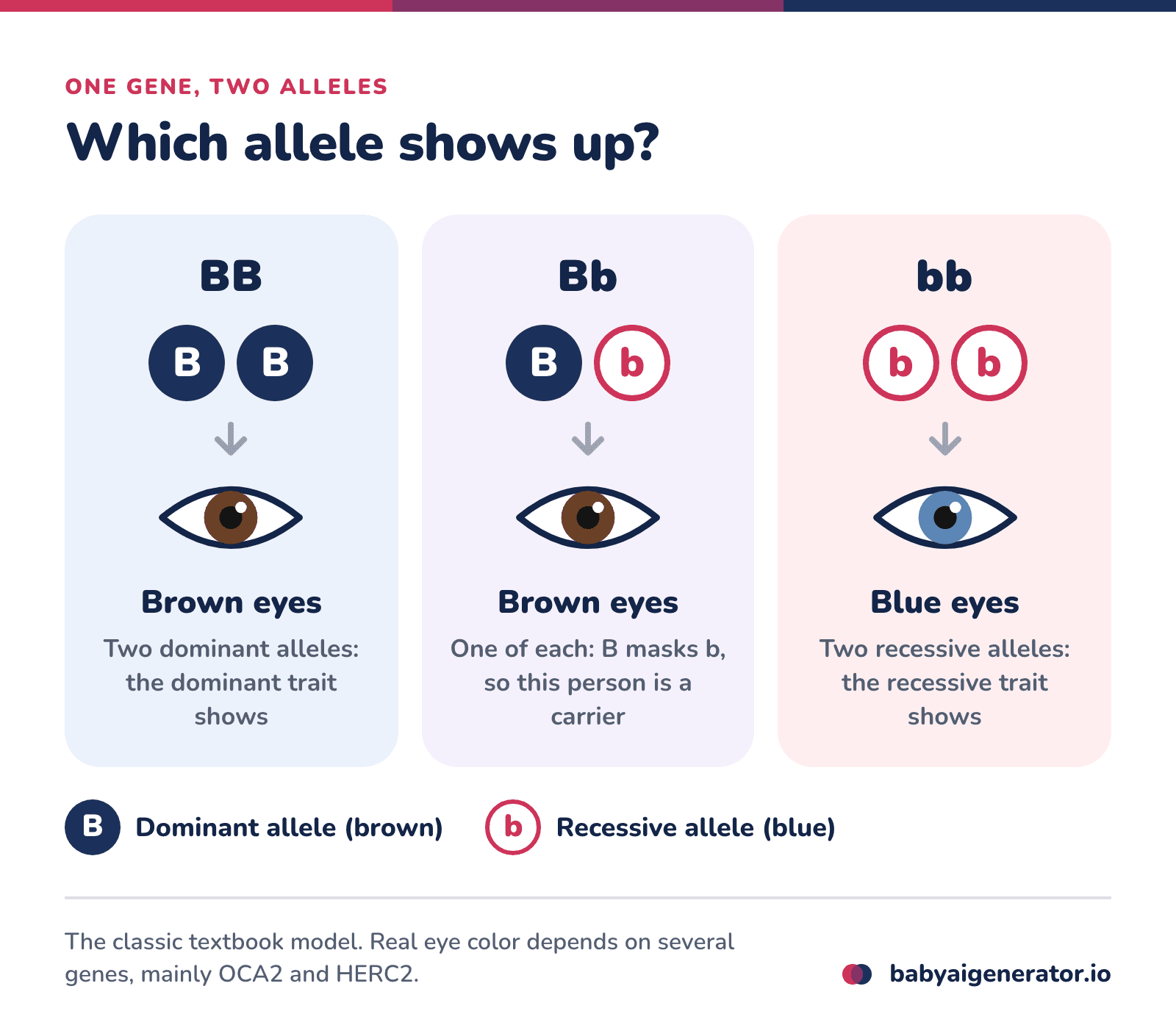
Classic examples of dominant traits include tongue rolling, a widow's peak and unattached earlobes. Classic recessive traits include the inability to roll the tongue, a straight hairline and attached earlobes. Geneticists identify dominant and recessive patterns by tracing how traits pass across generations. Hair color, eye color and many other human traits do not follow simple Mendelian inheritance because several genes and environmental factors shape them.
Dominant and Recessive Traits Chart
The dominant and recessive traits chart groups the classic textbook classifications of human traits by body area, showing the dominant and recessive form of each trait:
| Trait | Dominant Form | Recessive Form | Body Area |
|---|---|---|---|
| Facial Traits | |||
| Earlobes | Free or unattached earlobes | Attached earlobes | Face and Ears |
| Dimples | Presence of dimples | Absence of dimples | Cheeks |
| Freckles | Presence of freckles | Absence of freckles | Skin and Face |
| Chin | Cleft chin | Smooth chin | Face |
| Eye Shape | Almond-shaped eyes | Rounder eye shape | Eyes |
| Tongue Rolling | Can roll the tongue | Cannot roll the tongue | Mouth |
| Tongue Folding | Cannot fold the tongue into a clover shape | Can fold the tongue into a clover shape | Mouth |
| Hair Traits | |||
| Hairline | Widow's peak | Straight hairline | Hair and Forehead |
| Eyebrows | Broad eyebrows | Slender eyebrows | Face and Hair |
| Eyebrow Arrangement | Separated eyebrows | Joined or continuous eyebrows | Face and Hair |
| Eyelashes | Long eyelashes | Short eyelashes | Eyes and Hair |
| Finger Mid-Digital Hair | Hair on the middle sections of the fingers | No hair on the middle sections of the fingers | Hands and Hair |
| Eye Traits | |||
| Iris Pigmentation | Brown or other pigmented eyes | Blue or lightly pigmented eyes | Eyes |
| Hand Traits | |||
| Thumb Shape | Straight thumb | Hitchhiker's thumb, which bends backward | Hands |
| Little Finger | Bent little finger | Straight little finger | Hands |
| Finger Interlacing | Left thumb rests over the right when fingers are interlaced | Right thumb rests over the left | Hands |
| Hair on the Back of the Hand | Hair present | Little or no hair | Hands and Hair |
The chart reflects classic textbook classifications, and several traits in the chart are shaped by more than one gene.
Dominant and Recessive Facial Traits
Dominant and recessive facial traits depend on the alleles a person inherits from each parent. The dominant facial traits are listed below:
- Cleft Chin: A noticeable indentation in the center of the chin that appears when a person inherits at least one dominant allele.
- Dimples: Small indentations in the cheeks that can appear when only one parent has dimples.
- Unattached Earlobes: Earlobes that hang free from the side of the head, expressed when the dominant allele is inherited.
Recessive facial traits need two recessive alleles to show, so recessive facial traits appear when both parents pass on a recessive allele. The recessive facial traits are listed below:
- Smooth Chin: A chin with no cleft, which appears when a person inherits two recessive alleles.
- Absence of Dimples: Smooth cheeks, which occur when both inherited alleles are recessive.
- Attached Earlobes: Earlobes joined directly to the side of the head, visible when two recessive alleles are present.
Knowing the facial traits of both parents helps estimate the chance of each facial feature appearing in a child.
Dominant and Recessive Hair Traits
Dominant and recessive hair traits follow genetic inheritance patterns for color and texture. Dark hair colors such as brown and black are dominant and need only one dominant allele to appear. Lighter hair colors such as blonde and red are recessive and need two copies of the recessive allele. Curly and wavy hair textures count as dominant and can appear when only one parent passes them on, while straight hair is recessive and needs alleles from both parents.
Several genes interact to shape hair traits. The MC1R gene is the main gene behind red hair, a recessive trait, so two dark-haired parents can have a red-haired child when both carry the recessive allele. Hair texture depends on several genes too, so variation appears even within the dominant and recessive categories.
Dominant and Recessive Eye Traits
Dominant and recessive eye traits center on eye color, where brown eyes count as dominant over lighter shades such as blue and green. Brown eyes contain more melanin, and the amount of melanin in the iris is controlled by several genes, with OCA2 and HERC2 playing the largest part. Blue eyes have less melanin and are regarded as recessive. Eye color is polygenic, so two brown-eyed parents can have a blue-eyed child when both carry alleles for lower melanin production. Eye color inheritance therefore involves interacting genes rather than a simple dominant and recessive relationship.
Dominant and Recessive Hand Traits
Dominant and recessive hand traits include thumb shape, finger interlocking patterns and hand preference, and none of the three follows simple Mendelian genetics. The hand traits are listed below:
- Thumb Shape: A straight thumb is classed as dominant over the hitchhiker's thumb, which bends backward at a sharp angle, though the genetic basis of thumb shape is not fully known.
- Finger Interlocking Patterns: In hand clasping, the left thumb over the right is listed as dominant and the opposite pattern as recessive, but studies suggest habit shapes clasping more than inheritance does.
- Hand Preference: Right-handedness is more common than left-handedness but is not a simple dominant trait, because several genes along with prenatal and environmental factors shape hand preference.
How Are Dominant and Recessive Traits Passed From Parents to Children?
Dominant and recessive traits pass from parents to children through alleles, the different versions of a gene. Each parent contributes one allele for each gene. A child who inherits at least one dominant allele expresses the dominant trait, while a recessive trait appears only when the child inherits two recessive alleles, one from each parent.
Parents who each carry one dominant and one recessive allele are carriers. A child of two carriers has a 25% chance of inheriting two recessive alleles and showing the recessive trait, a 50% chance of being a carrier, and a 25% chance of inheriting two dominant alleles. Carrier inheritance explains why two parents with dominant traits can have a child with a recessive trait.
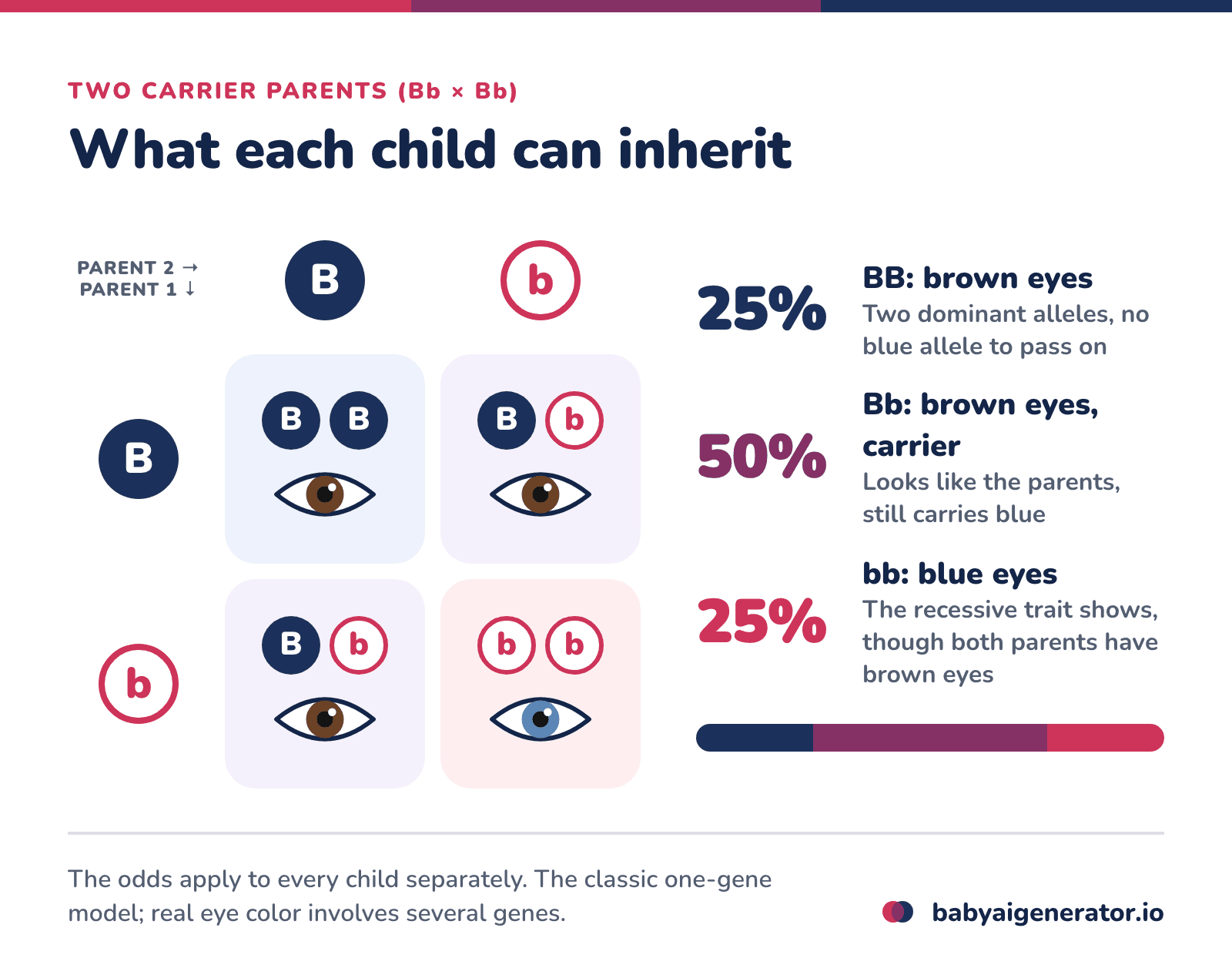
Hair color, eye color and many other human traits depend on several genes, so their inheritance produces a range of outcomes that simple dominant and recessive models cannot predict.
Which Traits Are Not Simply Dominant or Recessive?
The traits that are not simply dominant or recessive include hair color, eye color and skin tone, which are polygenic traits shaped by several genes working together. Blue eyes are classed as recessive, yet blue-eyed parents can sometimes have brown-eyed children, which shows how genes interact in eye color inheritance.
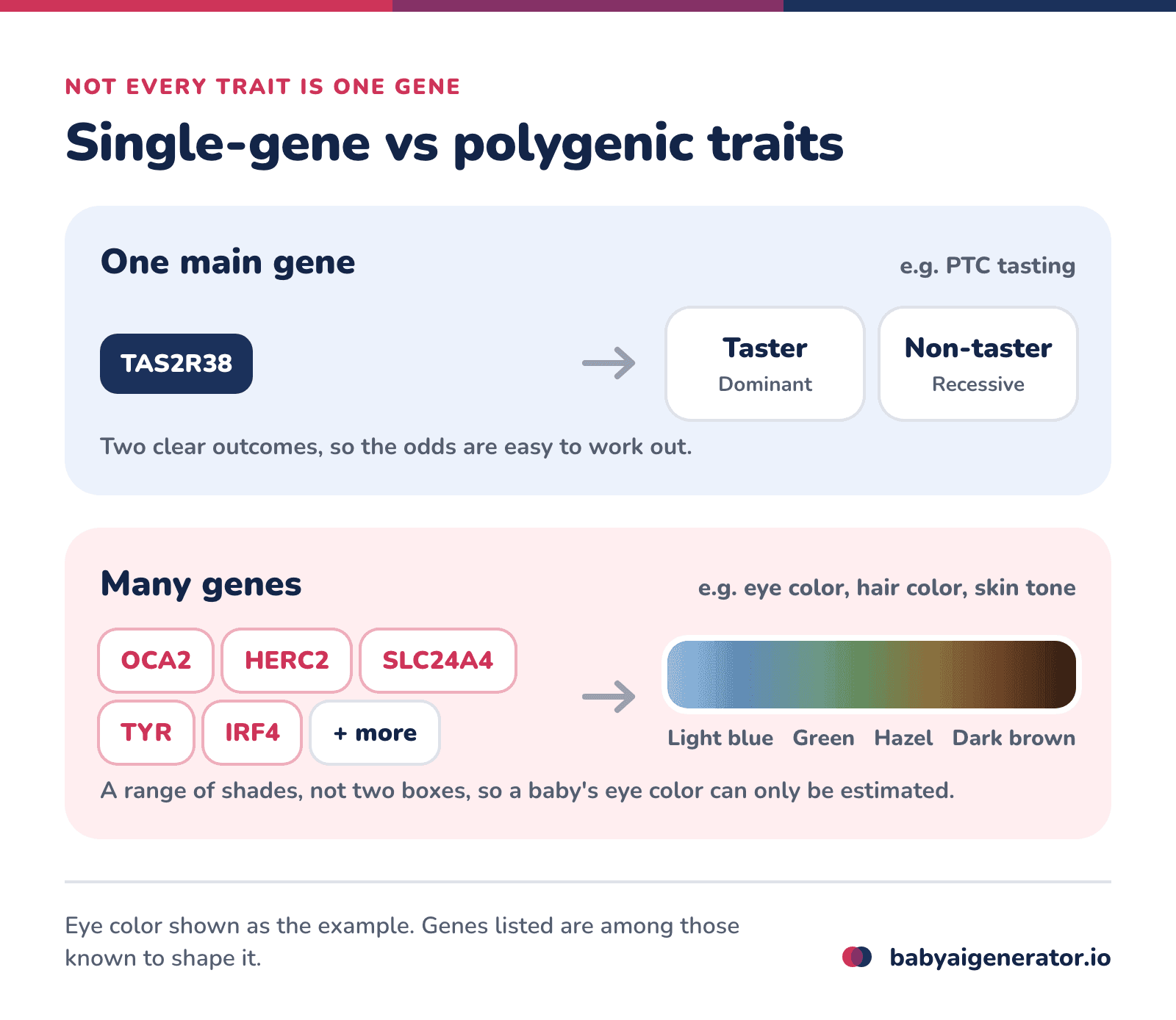
Hair color and eye color do not follow simple Mendelian genetics because several genes contribute to each trait, and children can show blended outcomes such as hair shades that mix the parents' colors. John H. McDonald of the University of Delaware shows in "Myths of Human Genetics" (2011) that most visible traits used in classrooms, including hair color, eye color, cheek dimples and attached earlobes, do not follow a simple one-gene dominant and recessive pattern.
Multigene traits make baby predictions less certain than single-gene traits, which sets the limit on which characteristics can be predicted in a baby.
Which Dominant and Recessive Traits Can Be Predicted in a Baby?
The dominant and recessive traits that can be predicted in a baby with reasonable accuracy are single-gene traits with clear Mendelian inheritance. PTC tasting is among the most predictable traits because one main gene determines it, while earlobe attachment and a widow's peak are less predictable than trait charts suggest.
Most visible human characteristics, including eye color, hair color and skin tone, involve several genes, which makes precise prediction from parental traits difficult. Probabilities can be estimated when the parents' genotypes are known, but those estimates remain educated guesses rather than certainties. A small group of single-gene traits can be predicted with confidence, while the multigene traits that define most of a baby's appearance stay uncertain until birth.
How Do Baby Trait Predictors Use Dominant and Recessive Traits?
Baby trait predictors use the dominant and recessive traits of both parents to estimate the characteristics a child might inherit. Baby trait predictors apply Mendelian genetics to traits such as eye color, hair texture and facial features. When both parents have a dominant trait such as brown eyes, a predictor such as a baby eye color calculator calculates the chance of a brown-eyed or blue-eyed child by checking whether one or both parents may carry a recessive allele for blue eyes.
Many predictors rely on simplified genetic models. Trait predictors estimate single-gene traits well but struggle with polygenic traits such as skin tone and hair texture, where many genes interact. Baby trait predictors therefore give general estimates rather than precise predictions.
Can the AI Baby Generator Show Which Dominant Traits Your Baby Inherits?
Yes, the AI Baby Generator can show which dominant traits a baby may inherit by analyzing the visible features in both parents' uploaded photos. The AI Baby Generator reads facial features, eye color, hair color, skin tone and other observable traits from the parent images and predicts how those dominant characteristics might appear in a child. Pattern recognition models blend the parents' features to simulate likely outcomes, showing how dominant traits such as dark hair, brown eyes, dimples or a parent's facial structure might carry into the baby's face. The AI Baby Generator predicts visible dominant traits from the photos, but the AI Baby Generator cannot account for hidden recessive alleles that both parents carry without displaying them.
Why Can't Parent Photos Show Recessive Traits?
Parent photos cannot show recessive traits because a photograph captures only a person's phenotype, the physical appearance, not the genotype, the full genetic makeup. Dominant alleles mask recessive alleles in the phenotype, so a person who carries one dominant and one recessive allele shows only the dominant version. The recessive allele stays in the DNA and never appears in the photo.
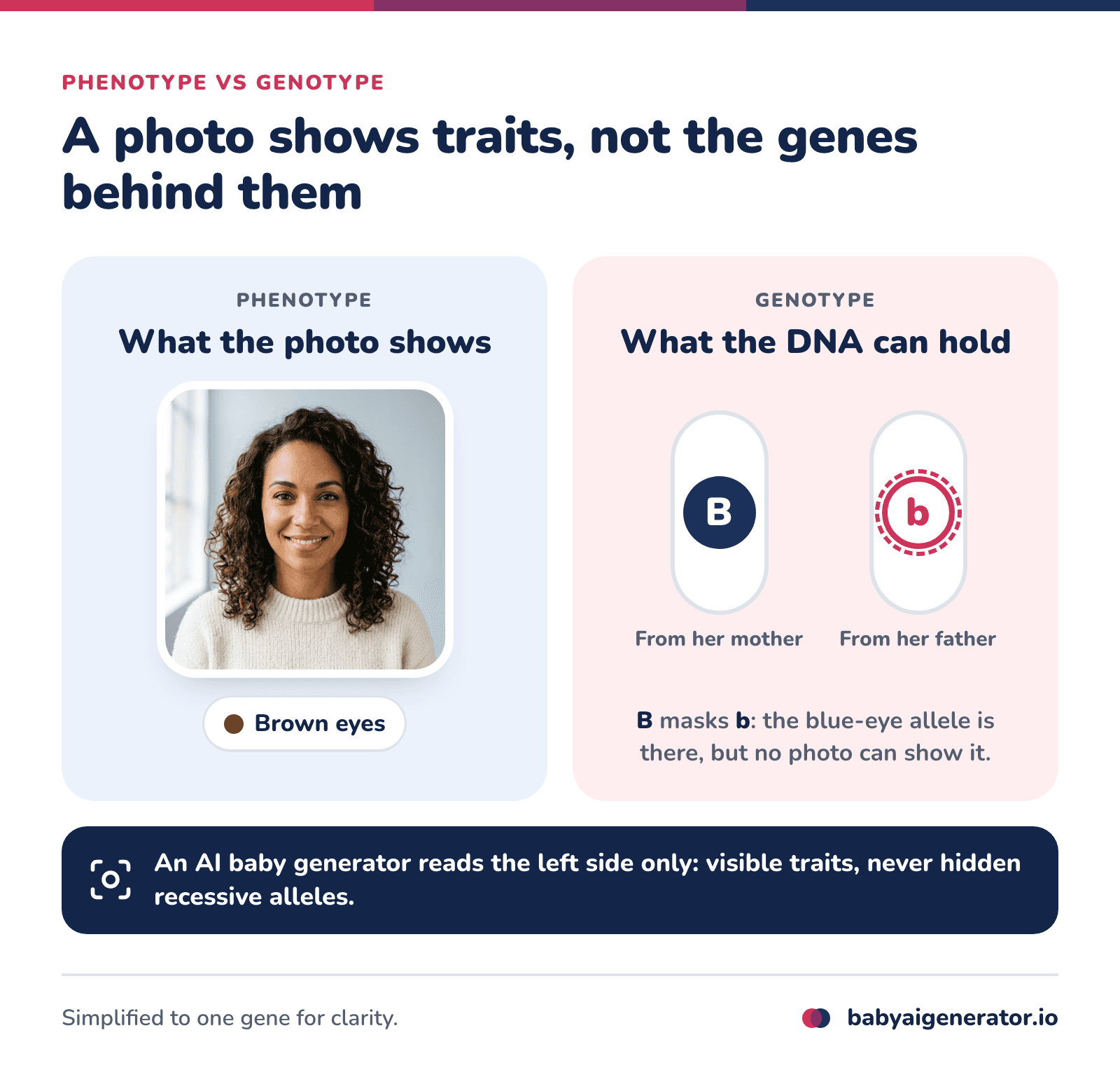
Parents who show dominant traits in photos may still carry recessive alleles and pass them to their children, where the recessive trait appears if the child inherits a recessive allele from each parent. Two brown-eyed parents, for example, might both carry a blue-eye allele that their photos do not show and still have a blue-eyed child.
Can Two Parents With Dominant Traits Have a Child With a Recessive Trait?
Yes, two parents with dominant traits can have a child with a recessive trait when both parents are heterozygous carriers with one dominant and one recessive allele each. A child who receives the recessive allele from both parents inherits two copies and expresses the recessive trait. Carrier inheritance explains why recessive traits can appear unexpectedly in families, including in eye color and hair color.
Can Two Brown-Eyed Parents Have a Blue-Eyed Baby?
Yes, two brown-eyed parents can have a blue-eyed baby when both parents carry an allele for blue eyes alongside their brown-eye alleles. A child who receives the blue-eye allele from each parent has blue eyes even though both parents have brown eyes. Several genes shape eye color, with OCA2 and HERC2 playing major parts, so the old model of brown as dominant and blue as recessive is an oversimplification, as MedlinePlus Genetics confirms in "Is eye color determined by genetics?" (July 2022).
Can Two Dark-Haired Parents Have a Red-Haired Baby?
Yes, two dark-haired parents can have a red-haired baby. Red hair is a recessive trait driven by variations in the MC1R gene. Both parents must carry a red hair allele that their dark hair genes mask, and a child who inherits the allele from both parents can have red hair. Ruth Tennen of The Tech Interactive explains in "WHY is it that some alleles are dominant, and some are recessive?" (July 2007) that a small amount of working MC1R protein is enough to prevent red hair, which keeps the red hair allele hidden in carriers.
Can Recessive Traits Skip a Generation?
Yes, recessive traits can skip a generation when carriers hold a recessive allele without showing the trait because a dominant allele masks it. Carriers pass the recessive allele to their children, and a child who inherits the allele from both parents shows the trait, so the trait seems to skip a generation. Autosomal recessive inheritance follows the same pattern, with carrier parents having a 25% chance per pregnancy of an affected child.
Are Dominant Traits More Common Than Recessive Traits?
No, dominant traits are not necessarily more common than recessive traits. Allele frequency, natural selection, genetic drift and population history decide how common a trait is, not whether the trait is dominant or recessive. Polydactyly is a dominant trait yet rare, while five fingers, the recessive form, is almost universal. Dr. D. Barry Starr of The Tech Interactive makes the same point in "Is a dominant version of a trait always more common than the recessive one?" (September 2006), noting that type O blood predominates in most of the world even though type O is recessive. The prevalence of each trait depends on the distribution of alleles in the gene pool and the evolutionary pressures acting on them, which separates dominance from frequency across the list of dominant and recessive traits in humans.
Written by The Baby AI Generator team. We build the generator on this site and write about what it can and can't tell you.