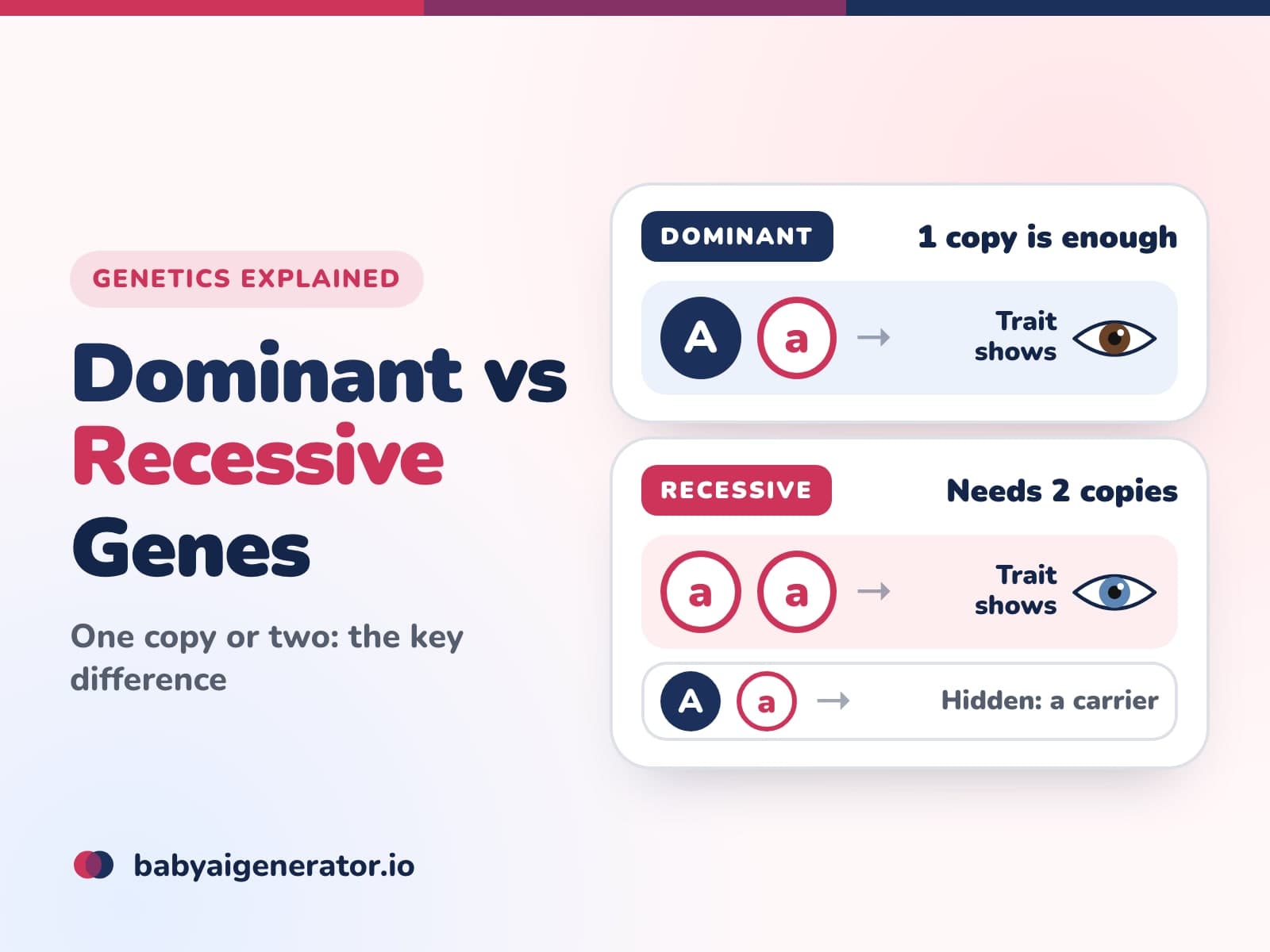
The core difference between dominant and recessive genes is that a dominant gene needs only one copy for its trait to appear, whereas a recessive gene needs two copies. Dominant and recessive genes are different alleles of the same gene, with one allele inherited from each parent. A dominant allele expresses its trait even in a heterozygous genotype, while a recessive allele usually produces a nonworking protein and shows its trait only when both alleles are recessive.
The key differences between dominant and recessive genes cover expression, genotype notation, protein function and inheritance pattern. Dominant alleles are written with uppercase letters such as A, and recessive alleles with lowercase letters such as a. Dominant alleles usually make enough working protein to express a trait, whereas recessive alleles usually make a broken or absent protein. Dominant traits appear in every generation of a family tree, while recessive traits can skip generations. Both gene versions sit at the same position on paired chromosomes, and examples include Huntington's disease for dominant genes and cystic fibrosis and albinism for recessive genes.
The protein an allele produces decides whether the allele behaves as dominant or recessive, and pedigree analysis, test crosses and molecular analysis identify the pattern of a trait. Dominant and recessive genes shape a baby's traits by combining alleles from both parents, and Punnett squares give probabilities, though many traits involve several genes and environmental factors. An AI Baby Generator reads visible traits from parent photos but cannot detect hidden alleles. Recessive genes stay hidden in parents because a single dominant allele masks the recessive trait, dominance is not always complete, and a dominant gene is neither stronger nor more common than a recessive gene, since dominance only reflects how many copies a trait needs.
What Is the Difference Between Dominant and Recessive Genes?
The difference between dominant and recessive genes is the number of copies each needs to express a trait: a dominant gene needs one allele, while a recessive gene needs two. Dominant and recessive genes are alleles of the same gene and influence characteristics such as eye color and inherited disorders.
| Attribute | Dominant Gene | Recessive Gene |
|---|---|---|
| Copies needed for expression | One copy is enough to express the trait | Two copies are required to express the trait |
| Genotype notation | Uppercase letters (A in AA or Aa) | Lowercase letters (aa) |
| Carrier status | No carriers, since the trait shows whenever the allele is present | Carriers possible, since heterozygotes (Aa) carry the allele without the trait |
| Protein effect | Usually produces a working protein, and one working copy is enough | Usually linked to a nonworking or broken protein, so two copies are needed to show the trait |
| Inheritance pattern | Trait appears in every generation, and affected individuals have at least one affected parent | Trait can skip generations and can appear in children of two unaffected carrier parents |
| Human example | Huntington's disease, Marfan syndrome | Cystic fibrosis, sickle cell disease, albinism |
Dominant genes produce enough working protein, or change the trait, with a single allele. Recessive genes show their trait only when both alleles are nonworking, which explains why some traits run visibly through families while others appear unexpectedly.
What Is a Dominant Gene?
A dominant gene is an allele that expresses its trait even when only one copy is present. A person who inherits a dominant allele from one parent shows the associated trait in their phenotype, whatever the other allele is. Dominant alleles usually produce a working protein that is enough to produce the trait on its own.
Dominant alleles are written with uppercase letters such as A. A heterozygous person with one dominant allele (Aa) expresses the dominant trait because the single working protein from the dominant allele meets the biological requirement for the trait.
Examples of dominant traits in humans include Huntington's disease and Marfan syndrome, and classroom lists add brown eyes and a widow's peak as simplified examples. Each dominant trait can appear with just one copy of the dominant allele.
What Is a Recessive Gene?
A recessive gene is an allele that needs two identical copies to express its trait in the phenotype. A person who inherits a recessive allele from each parent shows the associated trait, while a dominant allele, when present, keeps the recessive trait hidden.
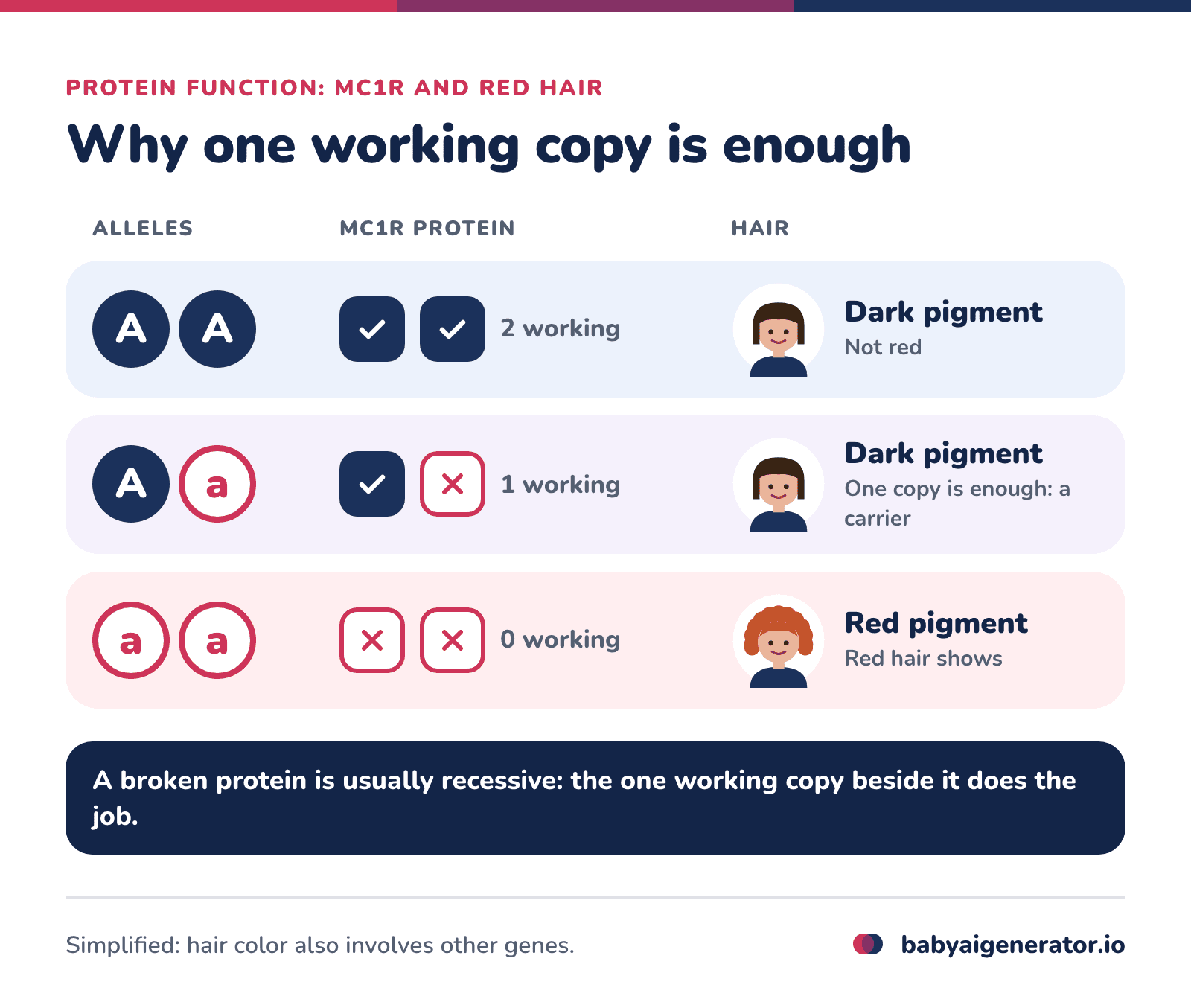
Recessive alleles usually produce nonworking proteins, so the recessive trait appears only when no dominant allele is present to mask it. Red hair, for example, is recessive because a broken MC1R protein cannot switch pigment production from red to dark pigment. People with two copies of the recessive MC1R allele have red hair, while people with at least one working allele do not.
Recessive alleles are written with lowercase letters, such as a in the genotype aa. People with one recessive and one dominant allele (Aa) are carriers, who do not show the recessive trait but can pass the recessive allele to their children.
What Are the Key Differences Between Dominant and Recessive Genes?
The key differences between dominant and recessive genes are expression requirements, genotype notation, protein function and inheritance pattern, and each difference is broken down below.
Expression Differences Between Dominant and Recessive Genes
The expression difference between dominant and recessive genes is the number of allele copies a trait needs. A dominant gene shows its trait with one allele copy, so the trait appears whether a person is heterozygous or homozygous for the dominant allele. A recessive gene needs two copies, one from each parent, so the recessive trait appears only in a homozygous recessive genotype.
The expression pattern follows the protein each allele produces. Dominant alleles generate enough working protein to show the trait from a single copy, while recessive alleles produce nonworking or absent proteins and need two copies to show the trait. In a heterozygous person, the working protein from the dominant allele masks the nonworking protein from the recessive allele, so the dominant trait appears.
Genotype Differences Between Dominant and Recessive Genes
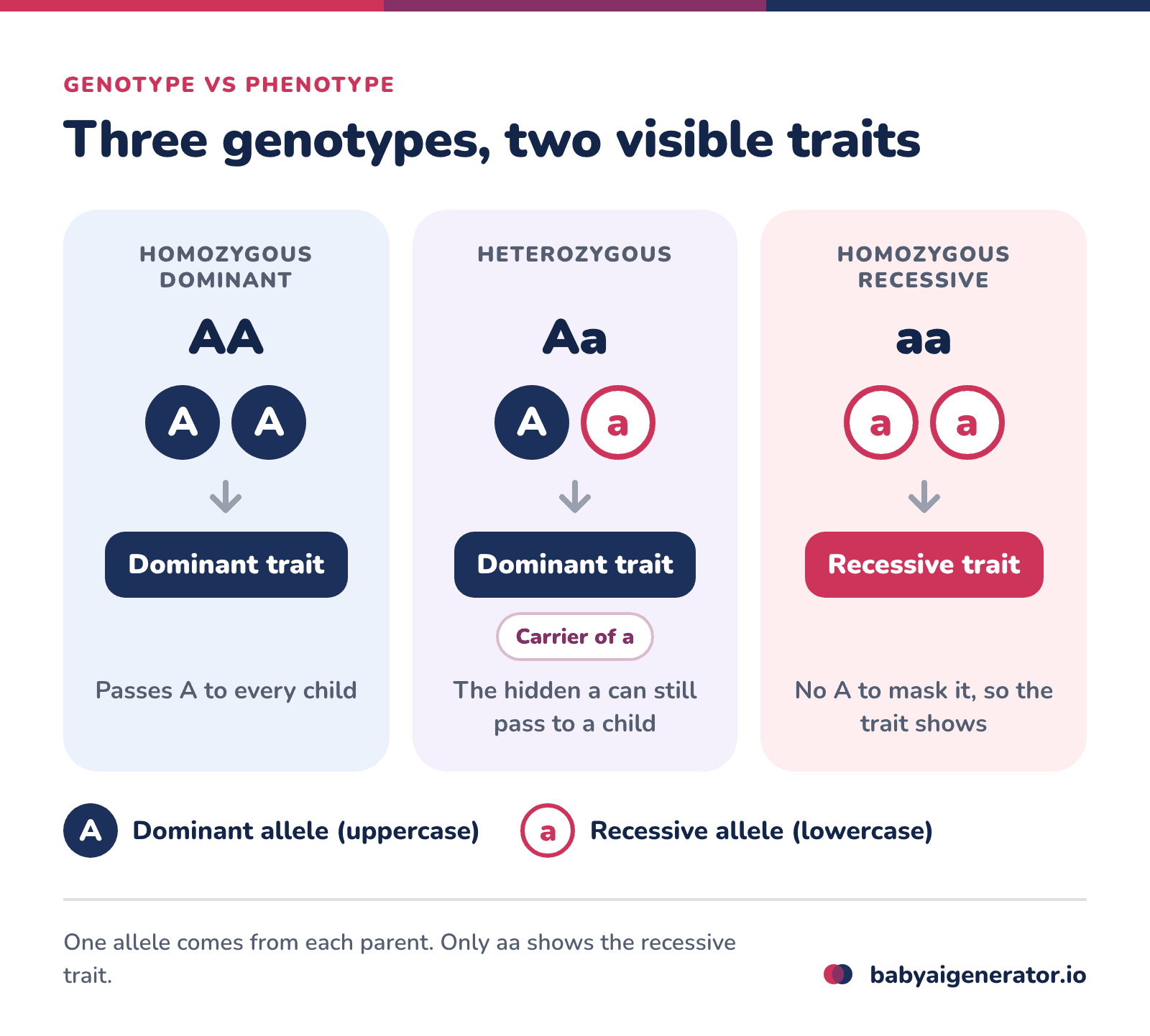
The genotype difference between dominant and recessive genes lies in how allele pairs express a trait. Dominant alleles show their trait in one or two copies, while recessive alleles need two copies. Genotype notation uses uppercase letters for dominant alleles and lowercase letters for recessive alleles, which forms three combinations: homozygous dominant (AA), heterozygous (Aa) and homozygous recessive (aa). Each combination produces its own phenotype outcome, as the genotypes below show.
Homozygous Dominant Genotype
A homozygous dominant genotype consists of two identical dominant alleles, one inherited from each parent. The homozygous dominant genotype is written with two uppercase letters, such as AA or BB. People with a homozygous dominant genotype express the dominant trait because no recessive allele is present to produce an alternative phenotype. Every child of a homozygous dominant parent receives the dominant allele, which carries the dominant trait into the next generation.
Heterozygous Genotype
A heterozygous genotype occurs when a person carries two different alleles for a gene, one inherited from each parent. The heterozygous genotype is written with one uppercase letter for the dominant allele and one lowercase letter for the recessive allele, such as Aa. In a heterozygous genotype, the dominant allele decides the observable trait, while the recessive allele stays unexpressed but can still pass to children. A heterozygous person is therefore a carrier who can transmit the recessive allele to the next generation without showing its trait.
Homozygous Recessive Genotype
A homozygous recessive genotype contains two identical recessive alleles for a gene. The homozygous recessive genotype is written with two lowercase letters, such as aa or bb, showing that both alleles are the recessive form. People with a homozygous recessive genotype display the recessive trait, because only the absence of a dominant allele allows the recessive trait to show. A person with blue eyes, for example, has in the simplified model inherited a blue-eye allele from each parent.
Protein Function Differences Between Dominant and Recessive Genes
The protein function difference between dominant and recessive genes centers on whether the protein produced works. Dominant alleles usually encode a working protein, which lets one allele copy express the trait. Recessive alleles usually produce a nonworking protein, so the trait appears only when both alleles are recessive. Red hair arises from two copies of a broken MC1R protein that cannot switch pigment production away from red pigment, and MedlinePlus Genetics notes in "Is hair color determined by genetics?" (July 2022) that people with loss-of-function changes in both copies of the MC1R gene almost always have very red hair.
Dominant traits can arise through mechanisms beyond simple protein loss. Haploinsufficiency describes cases where a single working allele is not enough for normal function, which makes the trait dominant even though the protein is only half missing. Dominant negative effects occur when a malfunctioning protein disrupts a normal protein, as with certain mutated p53 proteins that interfere with cell regulation. Gain-of-function mutations make an allele dominant by causing the protein to act excessively or in a new way, as the FGFR3 gene does in achondroplasia, where the altered protein restricts bone growth.
Inheritance Pattern Differences Between Dominant and Recessive Genes
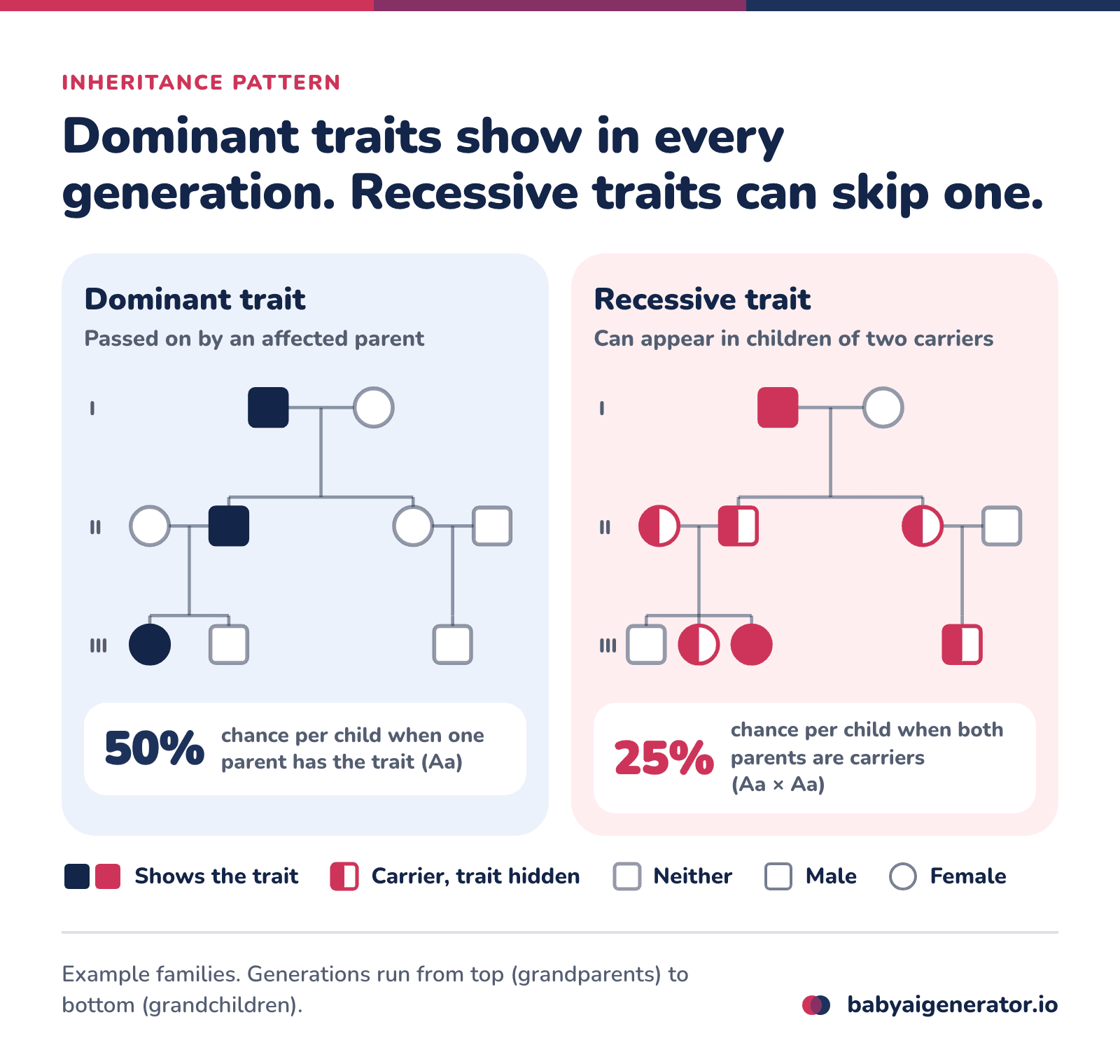
The inheritance pattern difference between dominant and recessive genes shapes how traits pass across generations. A dominant gene needs only one allele from either parent for the trait to appear, so a dominant trait can show in every generation. A recessive gene needs two copies of the allele, one from each parent, so a recessive trait can skip generations when both parents are carriers who do not show the trait.
In autosomal dominant inheritance, a parent who carries the dominant allele gives each child a 50% chance of inheriting and expressing the trait. In autosomal recessive inheritance, two carrier parents have a 25% chance of a child who expresses the trait, a 50% chance of a carrier child and a 25% chance of a child with two dominant alleles. Recessive traits can therefore appear unexpectedly in families with no recent history of the trait, while dominant traits show a visible pattern of transmission across generations.
What Do Dominant and Recessive Genes Have in Common?
Dominant and recessive genes have in common that both are alleles, alternative versions of the same gene located at the same position on paired chromosomes. Each allele carries genetic instructions for a protein that influences a trait, and both dominant and recessive alleles pass from parents to children following Mendelian principles.
Dominant and recessive alleles exist in pairs in diploid organisms such as humans, with one copy inherited from each parent, and both pass down through generations. Neither allele type is better or worse, since dominant and recessive alleles are simply different versions of genetic information that can produce different protein functions.
Dominant and recessive genes are subject to the same mechanisms of inheritance, mutation and natural selection. Dominant and recessive alleles occupy the same gene locus, code for variations of the same protein and together set the range of possible phenotypes for a trait. The labels dominant and recessive therefore describe only how two alleles interact when paired, not their nature as units of heredity.
What Are Examples of Dominant and Recessive Genes?
Examples of dominant and recessive genes cover both visible human traits and inherited conditions, and MedlinePlus Genetics lists Huntington's disease and Marfan syndrome as autosomal dominant conditions and cystic fibrosis and sickle cell disease as autosomal recessive conditions in "What are the different ways a genetic condition can be inherited?" (April 2021). The dominant gene examples are listed below:
- Brown Eyes: Classed as dominant over blue or green eyes because brown eyes contain more melanin.
- Dark Hair: Classed as dominant over lighter hair colors, influenced by eumelanin levels.
- Huntington's Disease: A neurodegenerative disorder caused by a single altered copy of the HTT gene.
- Marfan Syndrome: A connective tissue disorder caused by variants in the FBN1 gene.
Recessive genes need two copies of the allele to show their trait. The recessive gene examples are listed below:
- Blue Eyes: Result from low iris pigment and need two recessive alleles in the simplified model.
- Cystic Fibrosis: A genetic disorder of the respiratory and digestive systems caused by variants in the CFTR gene.
- Sickle Cell Disease: A disorder of abnormal hemoglobin that needs two copies of the altered allele.
- Albinism: A condition of reduced pigmentation that needs two nonworking alleles of the relevant gene.
Why Are Some Genes Dominant and Others Recessive?
Some genes are dominant and others recessive because of the protein each allele produces and how that protein works in the body. Dominant alleles usually produce a working protein, while recessive alleles usually produce a nonworking protein, so a dominant gene shows its trait with one copy and a recessive gene needs two.
Several mechanisms explain why an allele becomes dominant or recessive. In haploinsufficiency, a single working copy of a gene is not enough to maintain normal function, which makes the trait dominant, as in certain kidney diseases tied to the CD2AP gene. In the dominant negative effect, a malfunctioning protein interferes with the normal protein, as with p53, which regulates cell growth. Gain-of-function mutations create dominant alleles when the altered protein gains new and harmful activity, as in achondroplasia, a form of dwarfism caused by a hyperactive FGFR3 gene.
Dominance and recessiveness depend on the gene involved and the change in protein function, not on any built-in strength of the gene. Ruth Tennen of The Tech Interactive sets out the same three mechanisms in "WHY is it that some alleles are dominant, and some are recessive?" (July 2007), explaining that a broken protein is usually recessive because one working copy is enough.
How Do You Know if a Trait Is Dominant or Recessive?
To know if a trait is dominant or recessive, geneticists trace how the trait passes through families and test the alleles involved. The methods for identifying dominant and recessive traits are listed below:
- Family Pedigree Analysis: Geneticists track a trait across several generations of a family. A dominant trait appears in every generation and passes from an affected parent to children, while a recessive trait may skip generations and appear in children whose parents do not show the trait.
- Genetic Testing: DNA testing identifies the alleles a person carries and reveals whether a person has dominant or recessive versions of a gene.
- Breeding Experiments: Controlled crosses between organisms with known traits reveal dominance patterns through the ratio of offspring showing each trait.
- Population Studies: Records of how a trait appears in families and populations help establish whether one or two allele copies are needed for expression.
Identifying a trait as dominant or recessive is the first step toward predicting how dominant and recessive genes shape a baby's traits.
How Do Dominant and Recessive Genes Shape a Baby's Traits?
Dominant and recessive genes shape a baby's traits by deciding which of the two inherited alleles shows in the baby's appearance, including the facial features babies inherit. A baby inherits one allele from each parent, and the dominant allele usually decides the observable trait. A child who receives a dominant allele for brown eyes from one parent and a recessive allele for blue eyes from the other will most likely have brown eyes, because the dominant allele masks the recessive one.
Recessive traits such as blue eyes or red hair appear only when both parents pass on the recessive allele, which produces a homozygous recessive genotype. The homozygous recessive combination explains why children sometimes show traits that neither parent shows, since both parents can carry the recessive allele hidden in a heterozygous genotype.
Can a Baby's Traits Be Predicted From Dominant and Recessive Genes?
Yes, a baby's traits can be predicted from dominant and recessive genes, but only as probabilities. When the parents' genotypes for a trait are known, geneticists use Punnett squares, the method behind a baby eye color calculator, to estimate the likelihood of each outcome. Two heterozygous carrier parents have a 25% chance of a child who expresses the recessive trait, a 50% chance of a carrier child and a 25% chance of a child with two dominant alleles. Those predictions are not certainties because each child receives a random combination of alleles.
Polygenic traits limit prediction accuracy further. Single-gene traits such as certain genetic disorders can be predicted with reasonable confidence, but most physical characteristics, such as height and eye color, are shaped by several interacting genes. Environmental factors affect gene expression as well, so predicting a baby's exact traits remains an imprecise science that combines genetic probability with biology.
How Does the AI Baby Generator Handle Dominant and Recessive Genes?
The Baby AI Generator handles dominant and recessive genes by using the visible traits in parent photos to predict a baby's likely characteristics. The AI Baby Generator works with phenotypes, the observable traits produced by dominant genes or by paired recessive genes, such as eye color, hair color, skin tone and facial structure. Pattern recognition models then estimate how the parents' visible traits might combine in a child.
The AI Baby Generator cannot detect recessive alleles that stay hidden in heterozygous parents, because a dominant allele masks those carried variants. The AI Baby Generator predicts traits from visible parental features, but hidden recessive genes can still produce traits in a child that neither parent shows.
Why Do Recessive Genes Stay Hidden in Parents?
Recessive genes stay hidden in parents because a dominant allele masks their expression. A heterozygous parent who carries one dominant and one recessive allele shows the dominant trait in the phenotype, while the recessive allele stays unexpressed. The parent is therefore a carrier of the recessive gene without showing the associated trait.
When both parents carry the same recessive allele, their child has a 25% chance of inheriting two recessive alleles, one from each parent, and expressing the recessive trait. Carrier inheritance explains why traits such as blue eyes or inherited conditions can appear in children when neither parent shows the trait. The recessive genes remain in the parents' genetic makeup but stay hidden unless a child inherits two copies.
How Do Dominant and Recessive Genes Differ in Genotype and Phenotype?
Dominant and recessive genes differ in genotype and phenotype in how many allele copies a visible trait needs. In genotype terms, a dominant allele is expressed in both the homozygous (AA) and heterozygous (Aa) forms, while a recessive allele is expressed only in the homozygous recessive form (aa). In phenotype terms, one dominant allele produces a visible trait, whereas a recessive trait needs two copies of the recessive allele.
Is Albinism Caused by a Recessive Gene?
Yes, albinism is caused by a recessive gene in its most common forms. Albinism occurs when a person inherits two copies of a nonworking gene for melanin production, one from each parent. People with one working copy have normal pigmentation but can carry the albinism allele and pass it to their children. MedlinePlus Genetics confirms in "Oculocutaneous albinism" (November 2024) that oculocutaneous albinism follows an autosomal recessive pattern, with both copies of the gene carrying a variant and carrier parents showing no signs.
Are Dominant Genes Always Fully Dominant Over Recessive Genes?
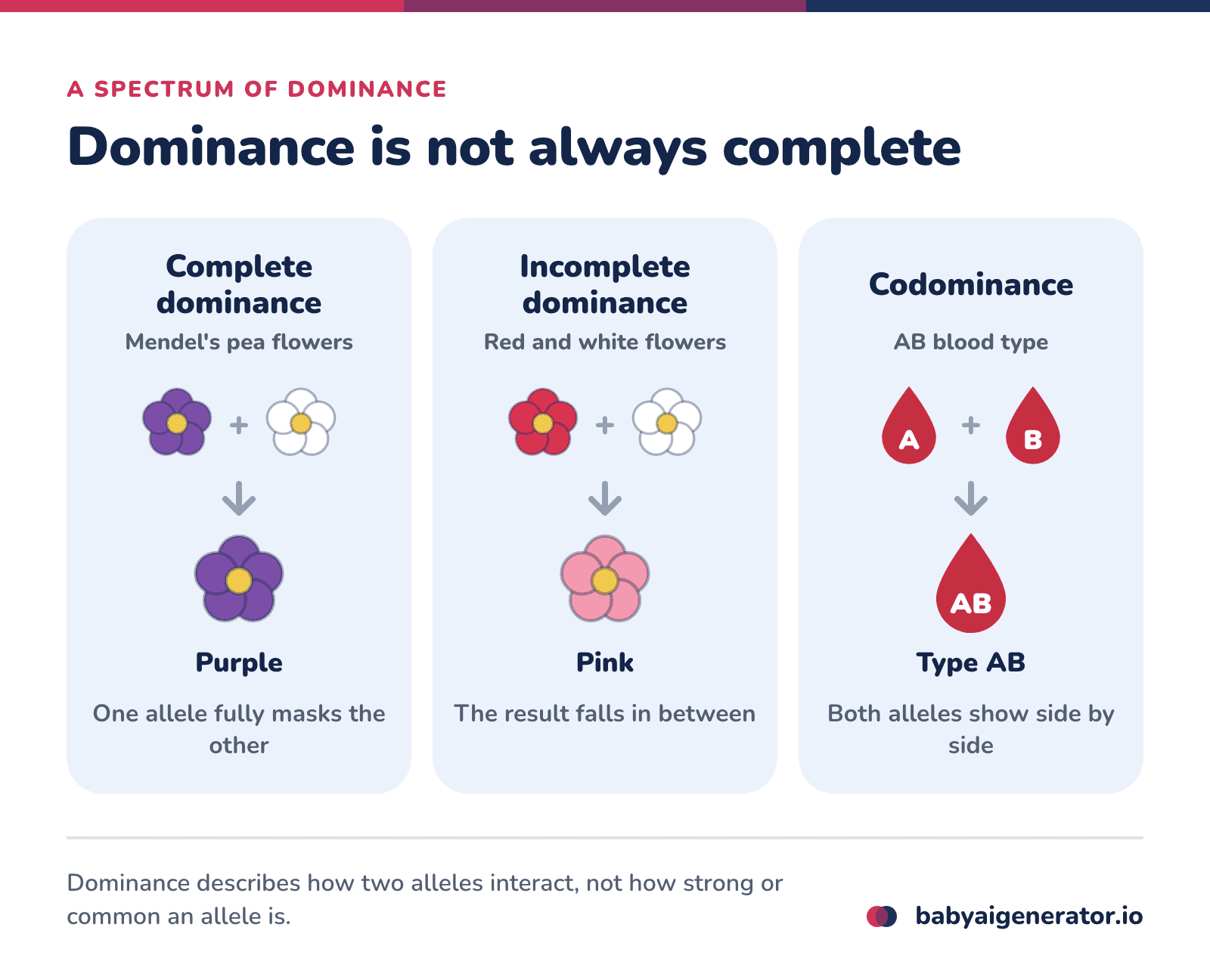
No, dominant genes are not always fully dominant over recessive genes. Classical genetics described dominant alleles as completely masking recessive ones, but modern research shows a spectrum of dominance. Incomplete dominance occurs when a heterozygote shows a phenotype between the two homozygous forms, such as pink flowers from red and white alleles. Codominance occurs when both alleles are expressed side by side, as in the AB blood type, where both A and B antigens are present. Haploinsufficiency, dominant negative effects and gain-of-function mutations shape genetic dominance as well, so dominance is a graded relationship rather than an absolute rule.
How Did Mendel Define Dominant and Recessive Genes?
Gregor Mendel defined dominant and recessive traits through experiments with pea plants in the 1860s. Mendel observed that dominant traits appeared in offspring when at least one parent contributed the dominant form, while recessive traits appeared only when both parents contributed the recessive form. Characteristics such as tall plant height and purple flowers masked their alternative forms, short height and white flowers, in hybrid crosses. Mendel's observations established that dominant factors determine the phenotype even when paired with recessive factors, while recessive factors need two copies to show.
Is a Dominant Gene Stronger or More Common Than a Recessive Gene?
No, a dominant gene is neither stronger nor more common than a recessive gene. Dominance describes the ability of an allele to show its trait when paired with a different allele, so in a heterozygous genotype the dominant allele's trait appears. Whether an allele is dominant or recessive does not decide how frequent the allele is in a population. The allele for polydactyly, which produces extra fingers or toes, is dominant but rare, while the recessive allele for five digits is far more common. A 2006 article by Dr. D. Barry Starr of The Tech Interactive, "Is a dominant version of a trait always more common than the recessive one?", makes the same point with blood types, since type O predominates in most of the world even though type O is recessive. The core difference between dominant and recessive genes therefore lies in the number of copies needed for expression, not in strength or frequency.
Written by The Baby AI Generator team. We build the generator on this site and write about what it can and can't tell you.