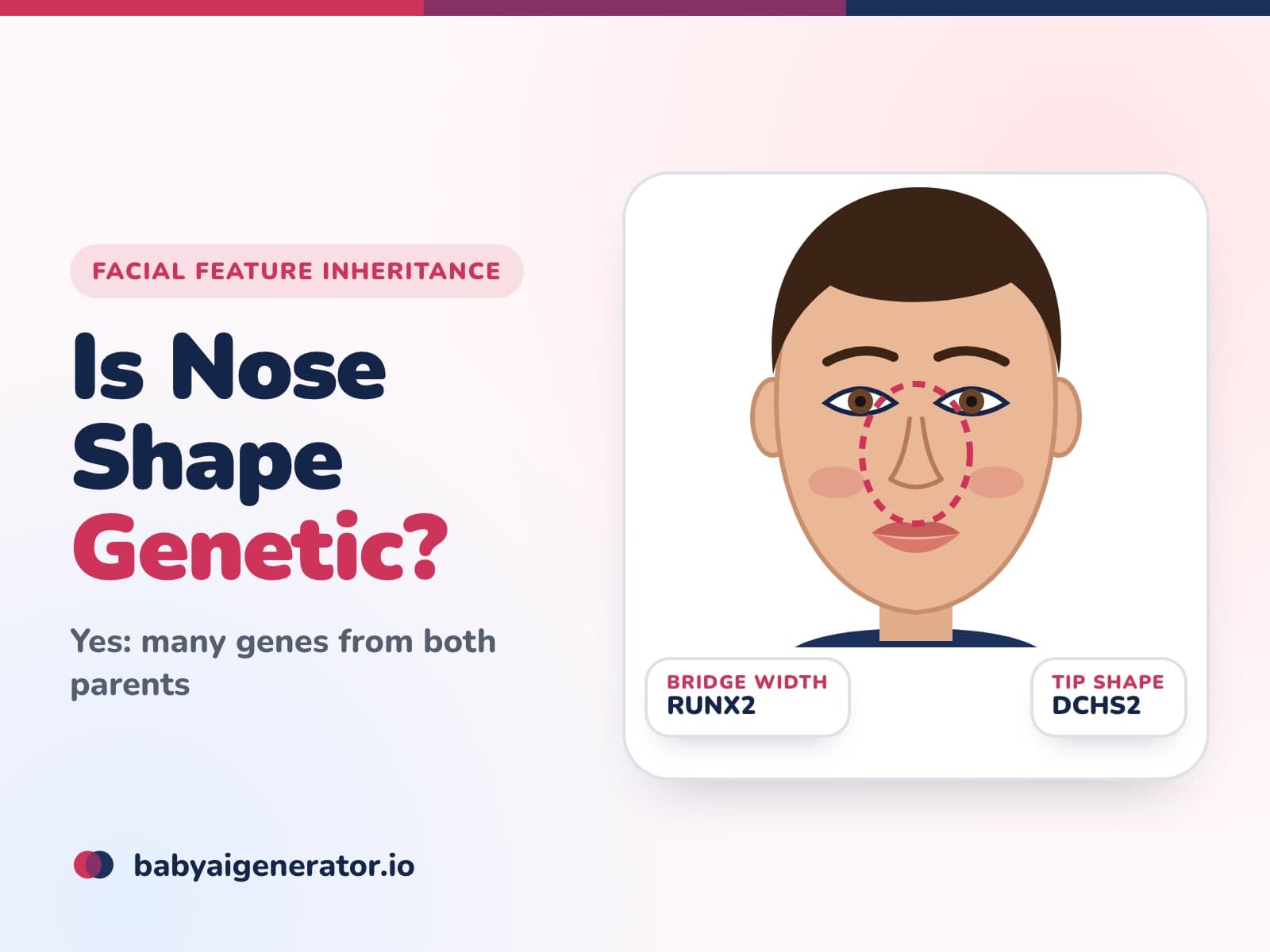
Yes, nose shape is genetic and shaped by several genes inherited from both parents. Nose shape inheritance passes traits such as nasal width, bridge structure and tip shape from parents to children, and several genes contribute, with DCHS2 influencing the nose tip and RUNX2 affecting bridge width. The genetic basis of nose shape explains the wide range of nose shapes across human populations, from the aquiline nose with its high, curved bridge to the broad nose with its wide base and flatter bridge.
Ancestry shapes nose shape, because nasal variants spread in populations whose climates favored them, and nose shapes help regulate the temperature and humidity of the air a person breathes. A child can have a nose shape different from both parents because the parents' variants recombine, so predicting a baby's nose from the parents is difficult, and the AI Baby Generator gives a visual estimate from nose landmarks in parent photos. A baby's nose changes shape after birth as cartilage and bone develop, nose shape is inherited alongside lip shape and face shape, and genetic factors account for most of the variation in nasal features.
Is Nose Shape Inherited From Parents?
Yes, nose shape is inherited from parents, through a combination of genes from both the mother and the father. Genetic inheritance shapes the width, bridge and tip of the nose, and the process involves many genes rather than a single dominant or recessive gene.
Genetic research has linked particular genomic regions to nasal features, including a region inherited from Neanderthals. Researchers measured facial features in thousands of Latin American volunteers and matched the measurements with their DNA, which established genetic links to nose shape. A 2023 study led by Qing Li at UCL, published in Communications Biology, analyzed more than 6,000 volunteers from five Latin American countries and found that a Neanderthal-derived variant near the ATF3 gene increases nose height. Children often share nasal features with their parents, but the combination of genes can produce a nose that differs from either parent.
Is a Big Nose Dominant or Recessive?
A big nose is not decided by a single dominant or recessive gene. Nose size is a polygenic trait that results from the interaction of many genes affecting nasal width, bridge height and tip shape. Larger noses can appear more often when one parent carries variants for larger features, but the inheritance pattern is not simple, and a child's nose size can differ from both parents', so dominant and recessive rules cannot predict nose size.
Which Genes Shape the Human Nose?
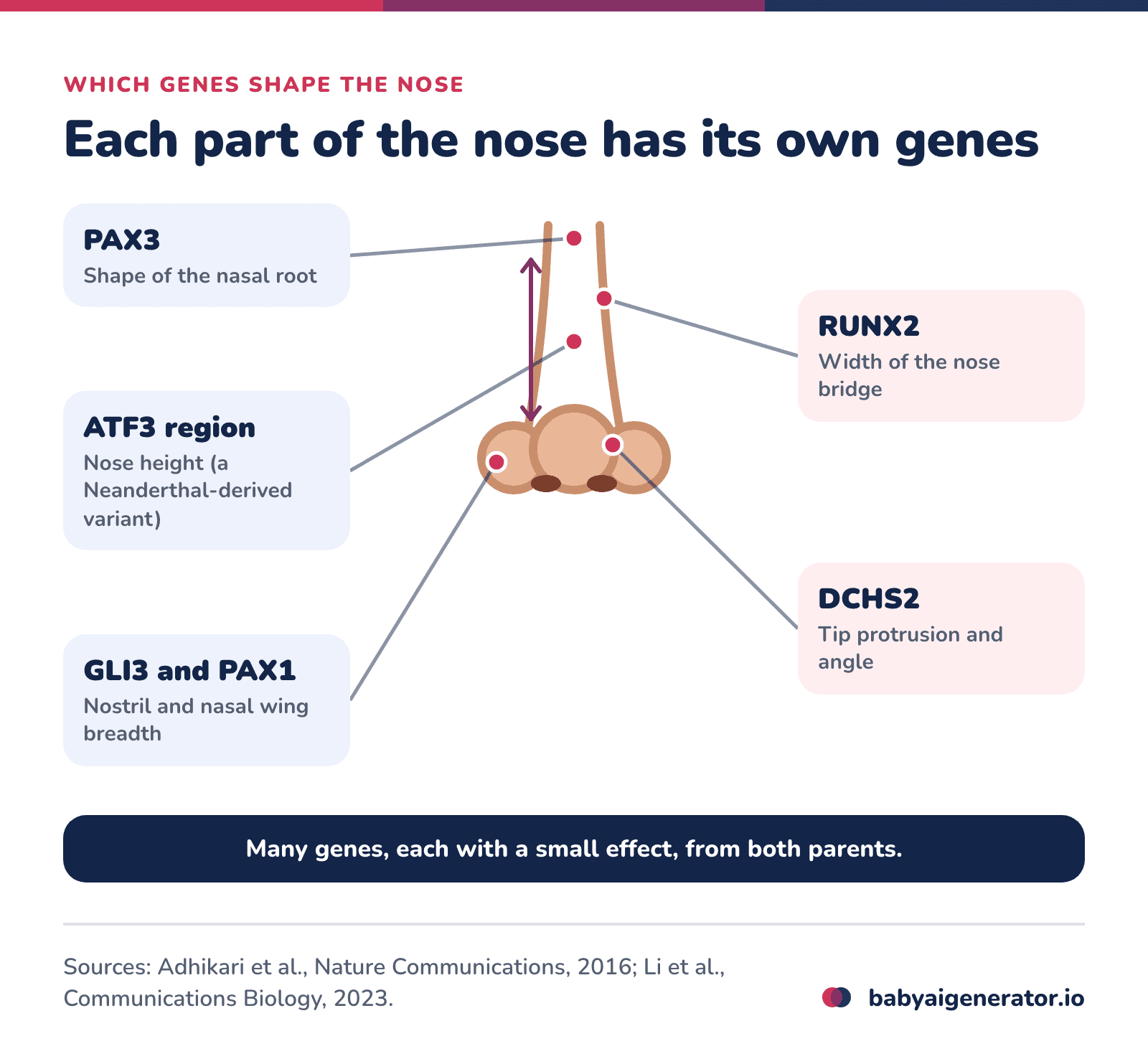
The genes that shape the human nose include DCHS2, which affects nose tip protrusion, and RUNX2, which affects the width of the nose bridge. GLI3 and PAX1 are linked to nostril and nasal wing breadth, and PAX3 influences the shape of the nasal root. Adhikari et al. identified the DCHS2, RUNX2, GLI3 and PAX1 links in "A genome-wide association scan implicates DCHS2, RUNX2, GLI3, PAX1 and EDAR in human facial variation" (Nature Communications, May 2016), a study of about 6,000 Latin Americans. Nose genes interact with each other and with environmental factors to create the range of nose shapes seen across human populations, and the two best-known nose genes are explained below.
DCHS2 and Nose Tip Shape
The DCHS2 gene influences the shape and projection of the nose tip. DCHS2 encodes a calcium-dependent cell-adhesion protein involved in cartilage development in the face. DCHS2 variants are linked to differences in nose tip prominence, including nose protrusion, nose-tip angle and the inclination of the columella. DCHS2 is a key factor, but nose tip shape depends on several genetic variants, developmental processes and environmental factors.
RUNX2 and Nose Bridge Width
The RUNX2 gene influences nose bridge width, the horizontal size of the nasal bridge. RUNX2 regulates bone and cartilage development in the face, which sets how wide or narrow the upper part of the nose looks, and RUNX2 variants lead to broader or narrower nasal bridges. A genome-wide study of about 6,000 Latin American participants found a strong statistical link between the RUNX2 region and nose bridge breadth, which makes RUNX2 a key genetic factor in nasal bridge width.
What Are the Main Nose Shapes?
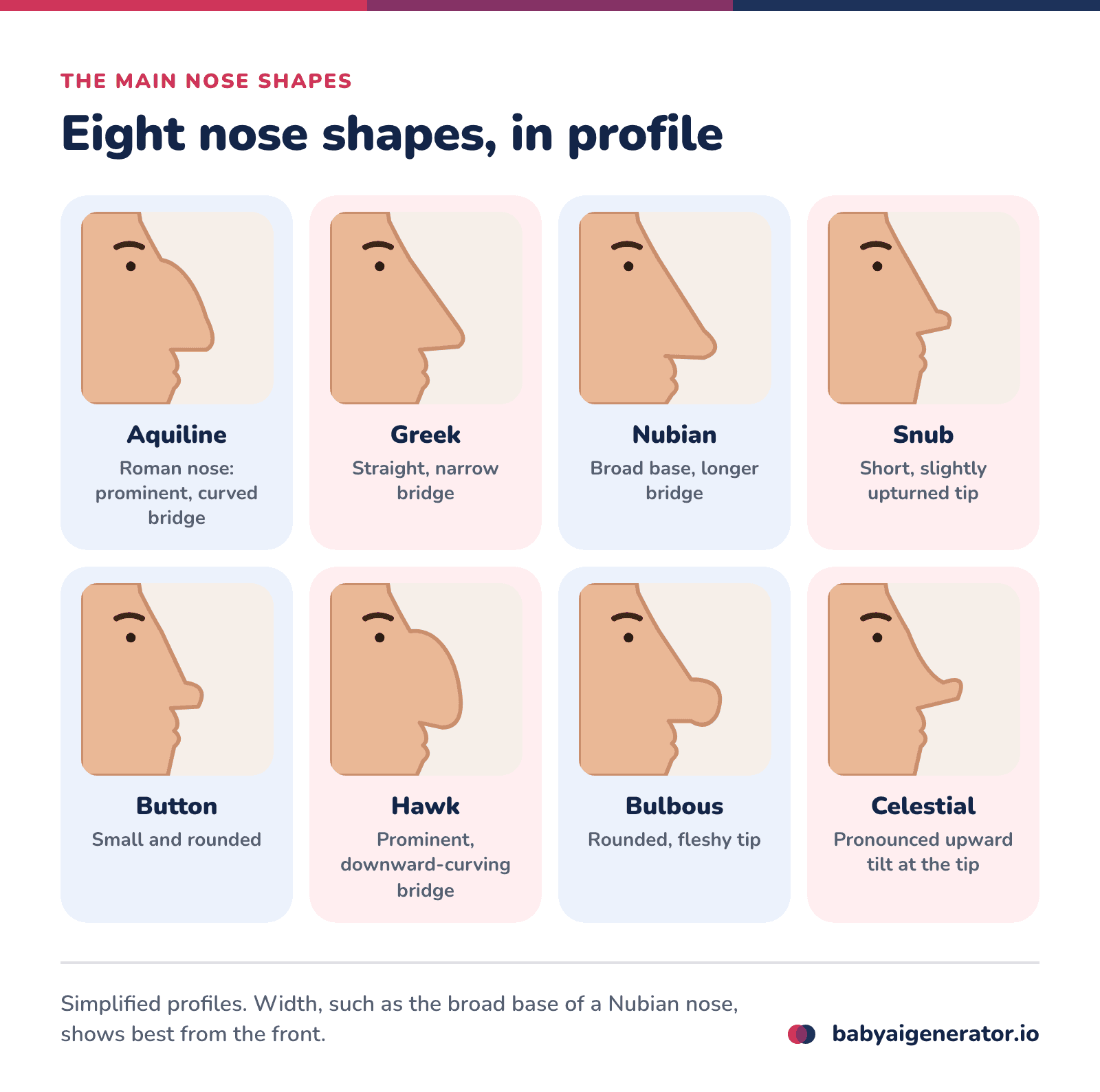
The main nose shapes are listed below:
- Aquiline Nose: Known as the Roman nose, with a prominent bridge and a downward curve.
- Greek Nose: A straight, narrow bridge.
- Nubian Nose: A broad base and a longer bridge, common in African populations.
- Snub Nose: A small, short nose with a slightly upturned tip.
- Button Nose: A small, rounded nose.
- Hawk Nose: A prominent, downward-curving bridge.
- Bulbous Nose: A rounded, fleshy tip.
- Celestial Nose: A pronounced upward tilt at the tip.
Aquiline Nose
An aquiline nose is a nose with a curved shape that resembles the beak of an eagle, with a prominent, convex bridge that curves downward in profile. The term aquiline comes from the Latin word aquilinus, meaning eagle-like. The aquiline nose goes by the names Roman nose and hawk nose, and its high bridge and downward-pointing tip make it one of the most recognizable nose shapes, long associated with strength and nobility.
Broad Nose
A broad nose is a nose with extra width across the nasal base, the nostrils or both, often with a flatter or lower nasal bridge. Broad noses are common in African, African-American and Afro-Caribbean populations, and the broad nose is sometimes called a flat or wide nose in nose shape classifications. The broad nose shows how geographic ancestry and adaptation to the environment have shaped facial features across populations.
How Does Ancestry Shape Nose Shape?
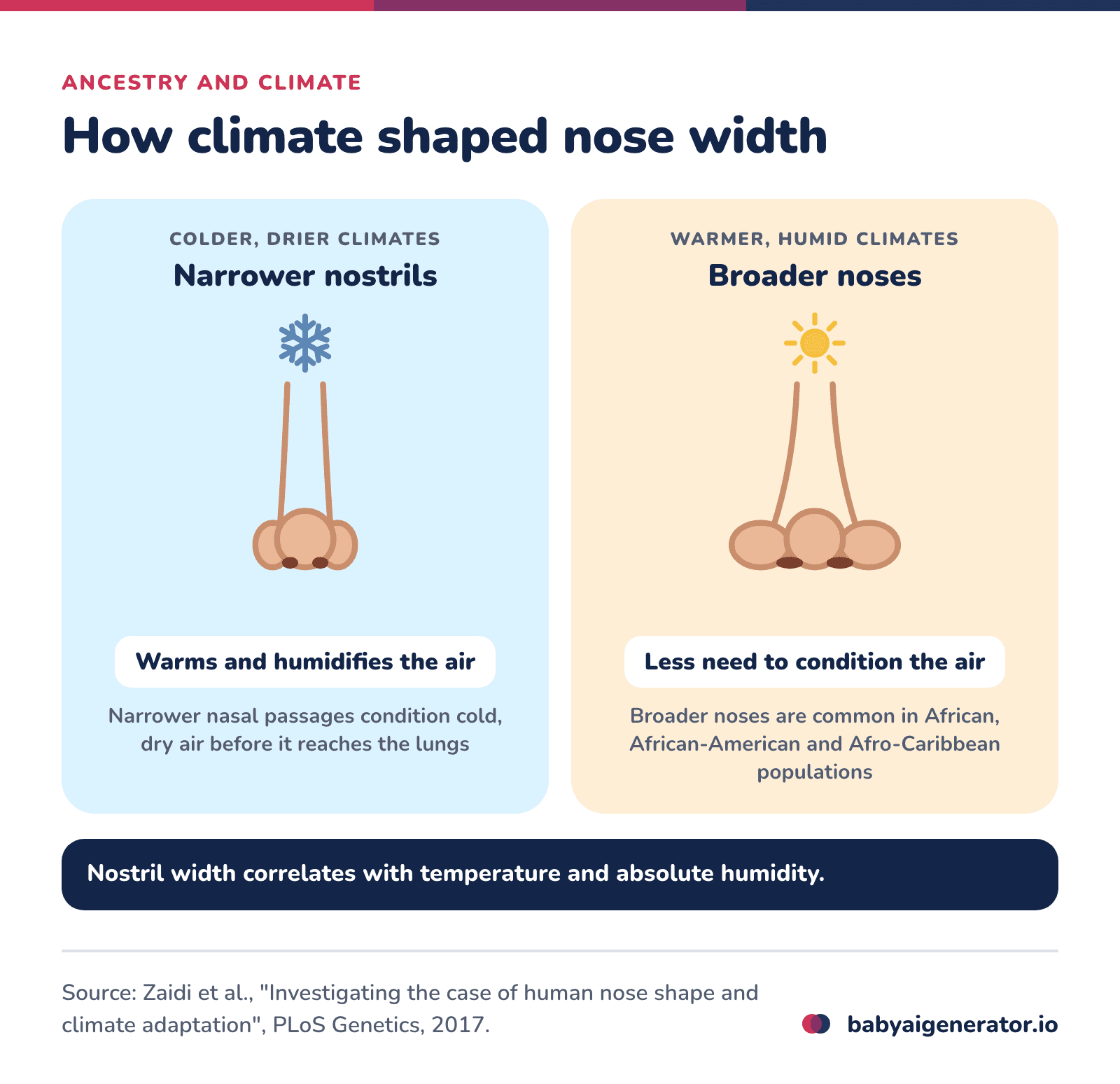
Ancestry shapes nose shape through evolutionary adaptation to different climates. Variants linked to nose shape spread in ancestral populations according to their geographic and climatic conditions, so people from colder, drier climates tend to have narrower nasal passages that warm and humidify cold air before it reaches the lungs, while people from warmer, humid climates tend to have broader noses.
A region of the genome that increases nose height was likely inherited from Neanderthals, which shows how interbreeding with ancient human groups influenced modern facial shape. The Latin American volunteers who revealed the Neanderthal nose variant carry a blend of European, Native American and African ancestry.
Nose shape differences relate to regulating the temperature and humidity of inhaled air, and a 2017 study by Zaidi et al. in PLoS Genetics, "Investigating the case of human nose shape and climate adaptation," found that nostril width correlates with temperature and absolute humidity. Broader noses are common in African, African-American and Afro-Caribbean populations, while narrower, more prominent bridges are typical of populations with European or East Asian ancestry, reflecting thousands of years of adaptation to local environments.
What Is the Rarest Nose Shape?
The rarest nose shape cannot be named with certainty, because nose types vary widely by geographic region and ancestry. The concavo-convex shape, sometimes called the Nixon nose, with a dip at the bridge and a curve at the tip, is often cited as one of the rarest. Highly pronounced aquiline noses and some bulbous noses with unusual tip features are uncommon too, but a nose shape that is rare in one population can be common in a different one.
Can a Child Have a Different Nose Shape From Both Parents?
Yes, a child can have a different nose shape from both parents. Nose shape is a polygenic trait shaped by many genes from both parents, and the alleles, or gene versions, that control bridge width, nostril size and tip shape combine in new ways at conception, producing a nose unlike either parent's.
A child might inherit a variant for a wider bridge from one parent and a variant for a more pointed tip from the other, which creates a new combination. Some variants act more strongly than others, and their interaction can produce unexpected results, so nose shapes vary even among siblings with the same parents.
Environmental factors during development play a minor role in final nose shape, while genetics remains the main factor. The reshuffling of many nose genes explains why a child's nose can differ from both parents, which raises the question of whether a baby's nose shape can be predicted at all.
Can You Predict a Baby's Nose Shape From the Parents?
No, you cannot reliably predict a baby's exact nose shape from the parents. Nose shape is polygenic, with many genes each contributing a small effect, and the combination a child inherits is reshuffled at random. Genes such as DCHS2 and RUNX2 are linked to nose tip and bridge breadth, but those links do not give a precise forecast for one child.
The parents' nose shapes suggest a family resemblance or a likely range of traits, but they cannot set the nose shape a child will have. Development shapes how facial features emerge too, so any prediction is an estimate of resemblance rather than a biological certainty.
How Does the AI Baby Generator Predict Your Baby's Nose Shape?
The AI Baby Photo Generator cannot predict a baby's exact nose shape, but it gives a visual estimate by analyzing nose landmarks in both parents' front-facing photos. The AI Baby Generator identifies nose width, bridge height, tip projection and nostril shape in each parent's image, then blends those features to show how they might combine in a child. A baby's nose is mostly soft cartilage that keeps changing after birth, so the nose in the generated face shows one possible resemblance, not the shape the child's nose will finally take.
The estimate depends on how plainly the parent photos show the nose landmarks. The AI Baby Generator maps reference points from the root of the nose at the bridge down to the tip and nostril base, which lets it model how the parents' nasal features might combine in the generated baby face.
Using Front-Facing Parent Photos for Nose Shape Predictions
Front-facing parent photos give the AI Baby Generator the clearest view of nose width and tip. Straight-on photos without side angles or shadows keep the nasal landmarks visible for the most precise estimate.
Why Does a Baby's Nose Change Shape After Birth?
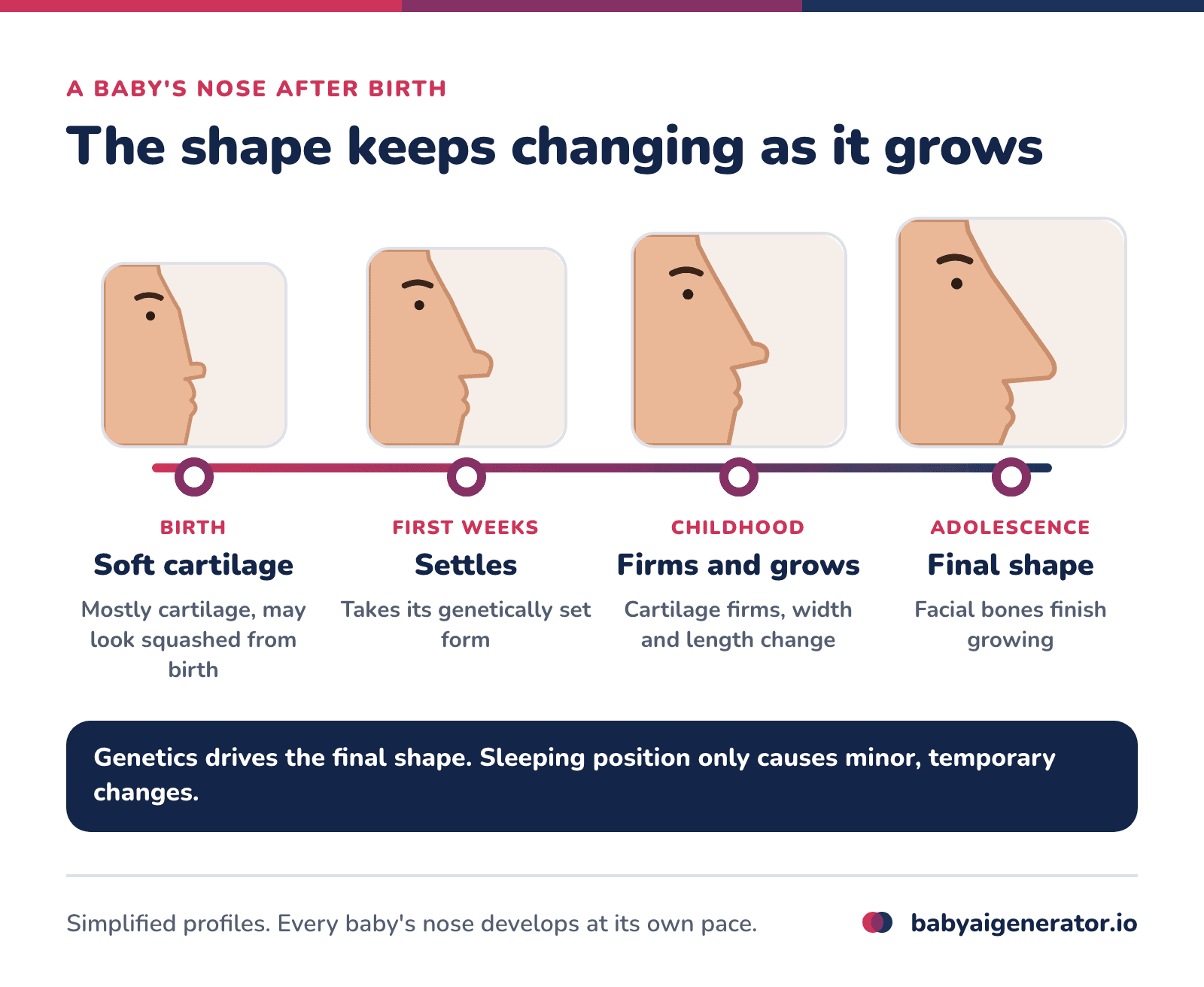
A baby's nose changes shape after birth because its cartilage and bone keep developing. A newborn's nose is made mostly of soft, flexible cartilage rather than bone, and the cartilage gradually firms and grows, which changes the nose's width, length and shape through infancy and childhood. Passing through the birth canal can temporarily compress a newborn's nose, which settles into its genetically determined form in the days and weeks after delivery. Sleeping position can cause minor temporary changes, but genetics drives the nose's final shape as cartilage matures and facial bones grow through childhood and adolescence.
Which Facial Features Are Inherited Like Nose Shape?
The facial features inherited like nose shape, each shaped by many genes working together, part of the wider facial feature inheritance picture, are listed below:
- Lip Shape: The fullness and curve of the lips.
- Face Shape: The outline and proportions of the face.
- Eye Shape: The size and orientation of the eyes.
- Eyebrow Thickness: The density and arch of the eyebrows.
- Ear Shape: The size and form of the ears.
- Chin Structure: The prominence and shape of the chin.
Is Lip Shape Inherited Like Nose Shape?
Yes, lip shape is inherited like nose shape. Genetic variation shapes lip thickness, the upper-lip profile and mouth width, and many genes and variants from both parents work together, so children can have lips like one parent, both parents or neither. Twin research shows substantial genetic effects on lip shape, though environmental factors contribute to some lip features.
Is Face Shape Inherited Like Nose Shape?
Yes, face shape is inherited like nose shape. Face shape results from the combined effects of many genes from both parents that shape the jawline, cheekbones and facial proportions. Face shape follows a polygenic pattern rather than a single dominant or recessive gene, so children can resemble one or both parents in face shape without matching either exactly.
Which Other Genes Shape the Face Around the Nose?
The other genes that shape the face around the nose include PAX3, which affects the position of the nasal root and the area between the eyes, and TP63, which is linked to facial width and the arrangement of midface structures. Many more regions of the genome contribute to the shape of the face around the nose, and together they create the facial structure that frames the nose.
How Much of Your Nose Shape Comes From Genes?
Most of your nose shape comes from genes. Twin studies show that identical twins, who share all their DNA, have much more similar nose shapes than fraternal twins, who share about half, which places the nose among the most heritable parts of the face, including bridge width, nostril shape and tip projection. A 2017 King's College London study of about 1,000 twins, "Heritability maps of human face morphology through large-scale automated three-dimensional phenotyping" (Scientific Reports), ranked the tip of the nose among the most heritable facial areas.
Aging and development change the nose's appearance to a lesser extent. Genetics remains the main factor, so nose shape is a genetic trait passed down through generations, in line with how other heritable physical features are inherited from parents.
Written by The Baby AI Generator team. We build the generator on this site and write about what it can and can't tell you.