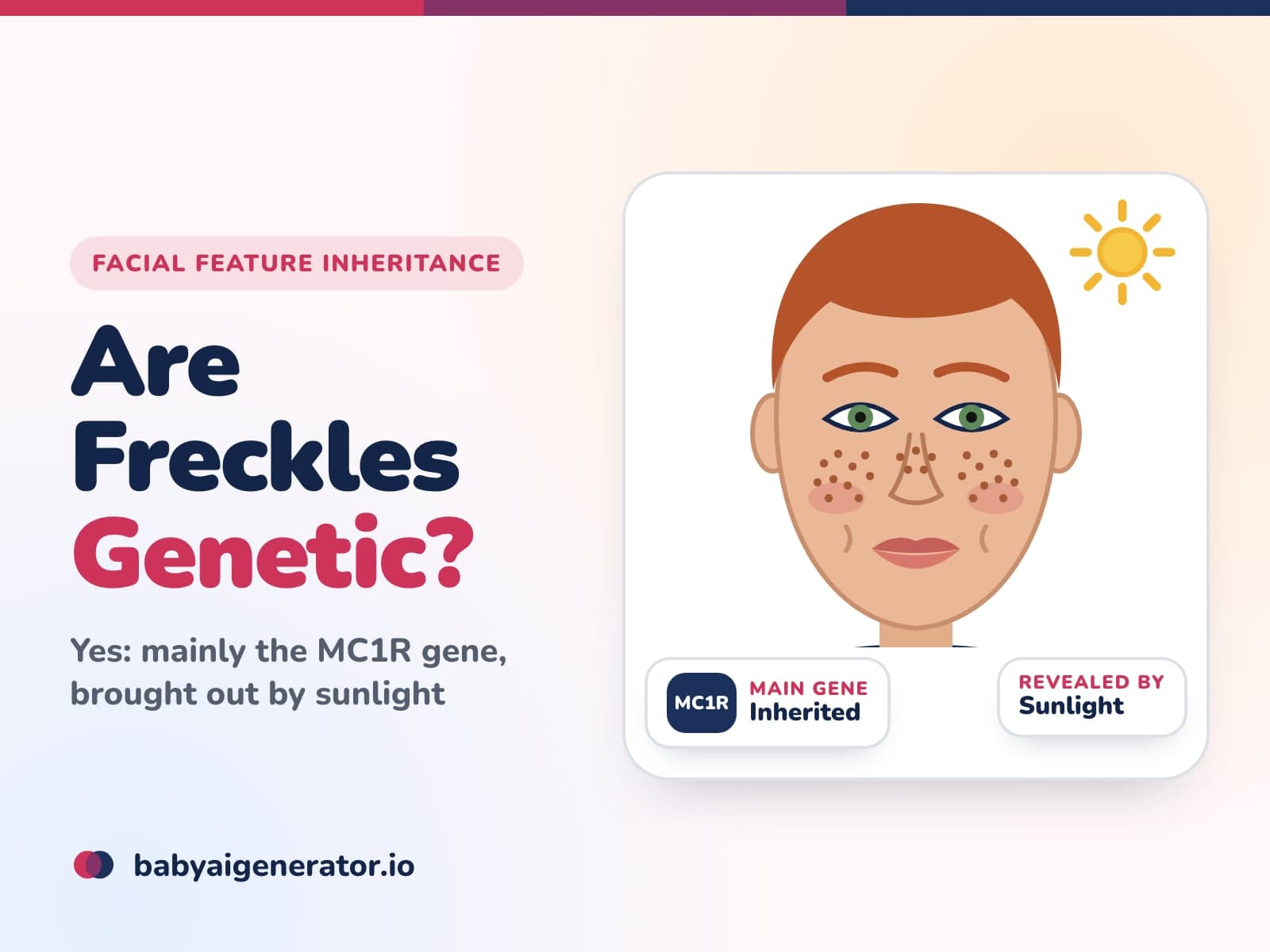
Yes, freckles are genetic and linked mainly to the MC1R gene. Freckles, known medically as ephelides, are small clusters of melanin in the skin that form when existing melanocytes produce more pigment, not when the skin grows more pigment cells. Freckle inheritance is polygenic, so several genes shape it rather than one dominant or recessive gene, and variations in MC1R and IRF4 contribute the most. MC1R variants raise the skin's sensitivity to sunlight, and sunlight is what makes inherited freckles appear.
Freckles become more visible with sun exposure and are not present at birth, appearing in early childhood on sun-exposed areas such as the face and shoulders. Redheads have more freckles because MC1R variants affect both hair color and skin pigmentation, and Black people can have freckles too, though less often. A child can develop freckles when neither parent shows them, since parents can carry hidden freckle variants, so trait predictors and the AI Baby Generator can only estimate a baby's freckles. Freckles do not always show in parent photos because of lighting, makeup or seasonal fading, and freckles are linked to red hair genes, skin tone and other inherited traits such as dimples, with freckles first appearing in early childhood.
Are Freckles Hereditary?
Yes, freckles are hereditary. The genetic basis of freckles centers on variations in the melanocortin-1 receptor (MC1R) gene, which change how skin cells respond to sun exposure and lead to freckles. Several genetic markers contribute to freckles rather than a single gene, so MC1R plays the largest part while other genes add to the hereditary tendency. A 2018 study by Hernando et al. in Forensic Science International: Genetics compared 192 freckled and 266 non-freckled people in Spain and found four loci associated with freckling: MC1R, IRF4, ASIP and BNC2.
The inherited tendency toward freckles shows in families where freckles are common among relatives, and people whose parents or close relatives have freckles are more likely to develop them. Sun exposure decides when the inherited tendency becomes visible, which sets up two questions: whether freckles are dominant and which parent passes them on.
Are Freckles Dominant or Recessive?
Freckles do not follow a simple dominant or recessive pattern. Freckles follow a polygenic inheritance model, shaped mainly by MC1R variants among other genes that do not follow strict Mendelian rules, unlike textbook dominant and recessive genes. Some genetic references describe freckling as having an autosomal dominant tendency, but freckles result from several genetic factors working together, with variants that may show incomplete dominance or additive effects. Inheriting freckle-associated variants therefore does not guarantee freckles, because sun exposure decides whether freckles become visible.
Are Freckles Inherited From the Mother or the Father?
Freckles can be inherited from either the mother or the father. MC1R, the main freckle gene, sits on a non-sex chromosome, so both parents can pass it to their children. Each parent contributes one copy of every gene, including the genes that influence freckling, so the variants that predispose a child to freckles can come from either parent. IRF4 and other genes add to freckle inheritance, and a parent with no visible freckles can still carry and pass on freckle variants.
What Are Freckles?
Freckles are small, flat, round spots on the skin made of concentrated clusters of melanin, the pigment that colors skin and hair. Freckles, known scientifically as ephelides, appear most often on sun-exposed areas such as the face, shoulders and arms. Unlike moles, freckles do not come from extra melanocyte cells but from existing melanocytes producing more melanin and spreading it unevenly to the surrounding skin cells.
Freckle color ranges from light tan to dark brown, and freckles become more pronounced with exposure to ultraviolet (UV) radiation. The extra melanin acts as a partial natural defense against UV radiation. Freckles are harmless, but watching for changes in pigmented spots helps detect skin conditions such as melanoma.
Which Genes Cause Freckles?
The genes that cause freckles are mainly MC1R and IRF4, which influence how melanin is produced and spread in the skin. MC1R is linked to higher sensitivity to sunlight and is the main factor in freckle formation, while IRF4 shapes how often and how strongly freckles appear. ASIP, TYR and BNC2 contribute to pigmentation and are linked to freckling as well, and the two main freckle genes are explained below.
MC1R Gene
The MC1R gene is the main gene behind freckles. MC1R encodes the melanocortin 1 receptor, which regulates melanin production in melanocytes. MC1R variants shift production toward pheomelanin, a lighter red-yellow pigment, and away from eumelanin, the darker pigment, which results in fairer skin and a higher chance of freckles.
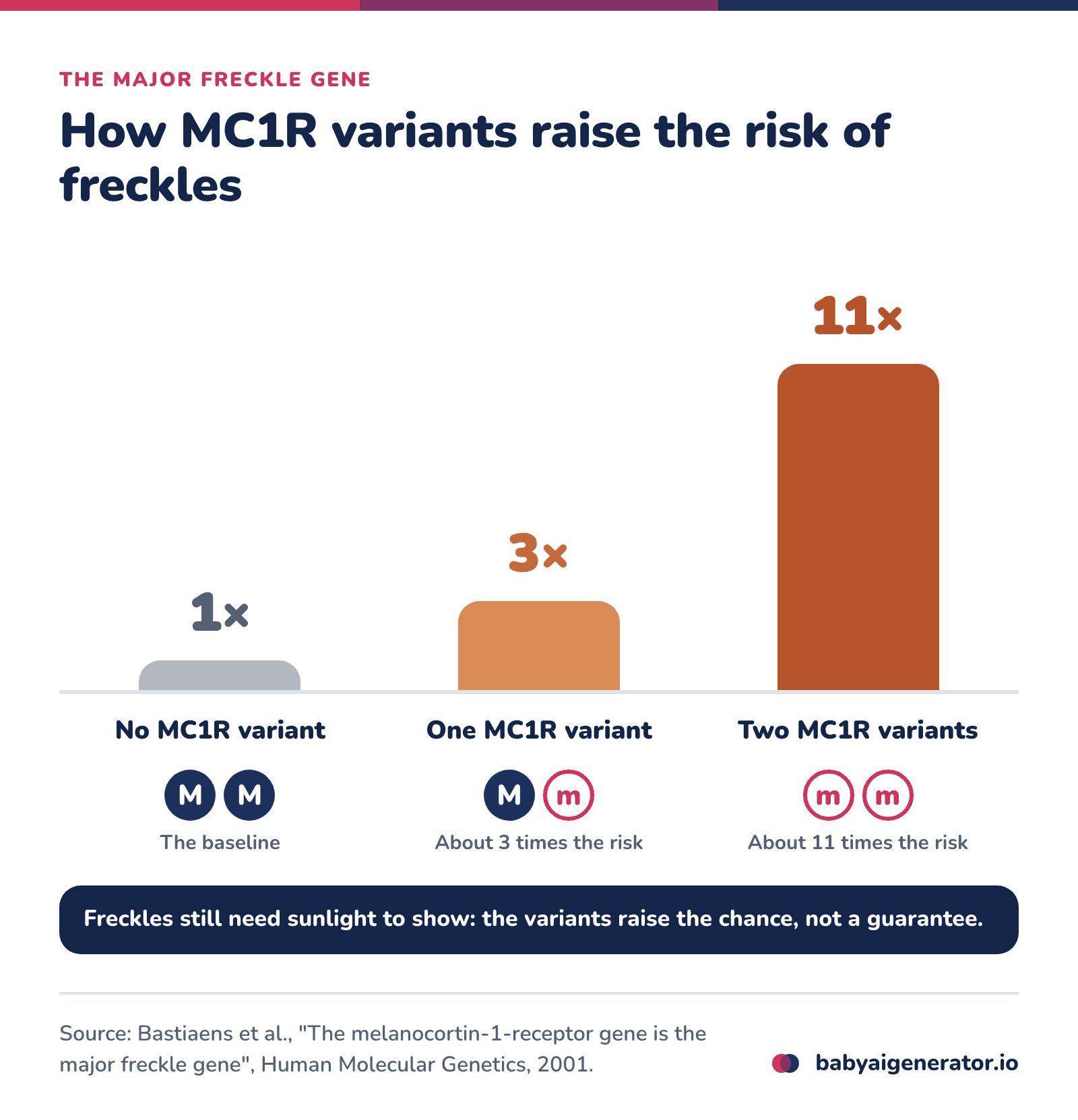
MC1R variants are strongly linked to red hair and fair skin, both of which raise freckle prevalence. MC1R variants make skin more sensitive to ultraviolet (UV) radiation, which prompts freckles to form as a protective response. Bastiaens et al. reported in "The melanocortin-1-receptor gene is the major freckle gene" (Human Molecular Genetics, 2001) that carriers of one or two MC1R variants had a 3-fold and 11-fold higher risk of developing freckles.
IRF4 Gene
The IRF4 gene shapes freckle development alongside MC1R by regulating the activity of genes involved in melanin production. A particular IRF4 variant, rs12203592, affects a regulatory region linked to freckling, lighter eye color and higher sensitivity to sunlight.
MC1R is the gene most often tied to freckles, but IRF4 adds to the set of genetic markers behind freckle development. Variations in IRF4 change how melanocytes produce melanin and how the skin responds to ultraviolet exposure, so freckles result from several genetic variants combined with environmental factors.
What Causes Freckles to Appear?
Freckles appear because melanocytes, the pigment-producing cells in the skin, increase melanin production and distribute the melanin unevenly into small, flat spots. Freckles come from heightened melanocyte activity rather than a larger number of melanocytes. Ultraviolet (UV) radiation from the sun is the main trigger, since sunlight activates melanocytes to produce more melanin as protection, and in people with freckle variants, especially MC1R variants, the extra melanin gathers in clusters instead of spreading evenly.
Freckles appear most on sun-exposed areas such as the face, shoulders, arms and upper back. Researchers do not fully understand why melanin spreads unevenly in some people, but the combination of genetic predisposition and melanin production lets sunlight bring out inherited freckles.
How Does Sun Exposure Trigger Inherited Freckles?
Sun exposure triggers inherited freckles by activating melanocytes to produce more melanin in response to ultraviolet (UV) radiation. UV rays reaching the skin stimulate melanin production as a natural defense against further damage, and in people with freckle variants, especially MC1R variants, the melanin collects in small clusters instead of spreading evenly. Freckles therefore appear or darken on sun-exposed areas such as the face, shoulders and upper back, darkening in summer and fading in winter when sun exposure drops.
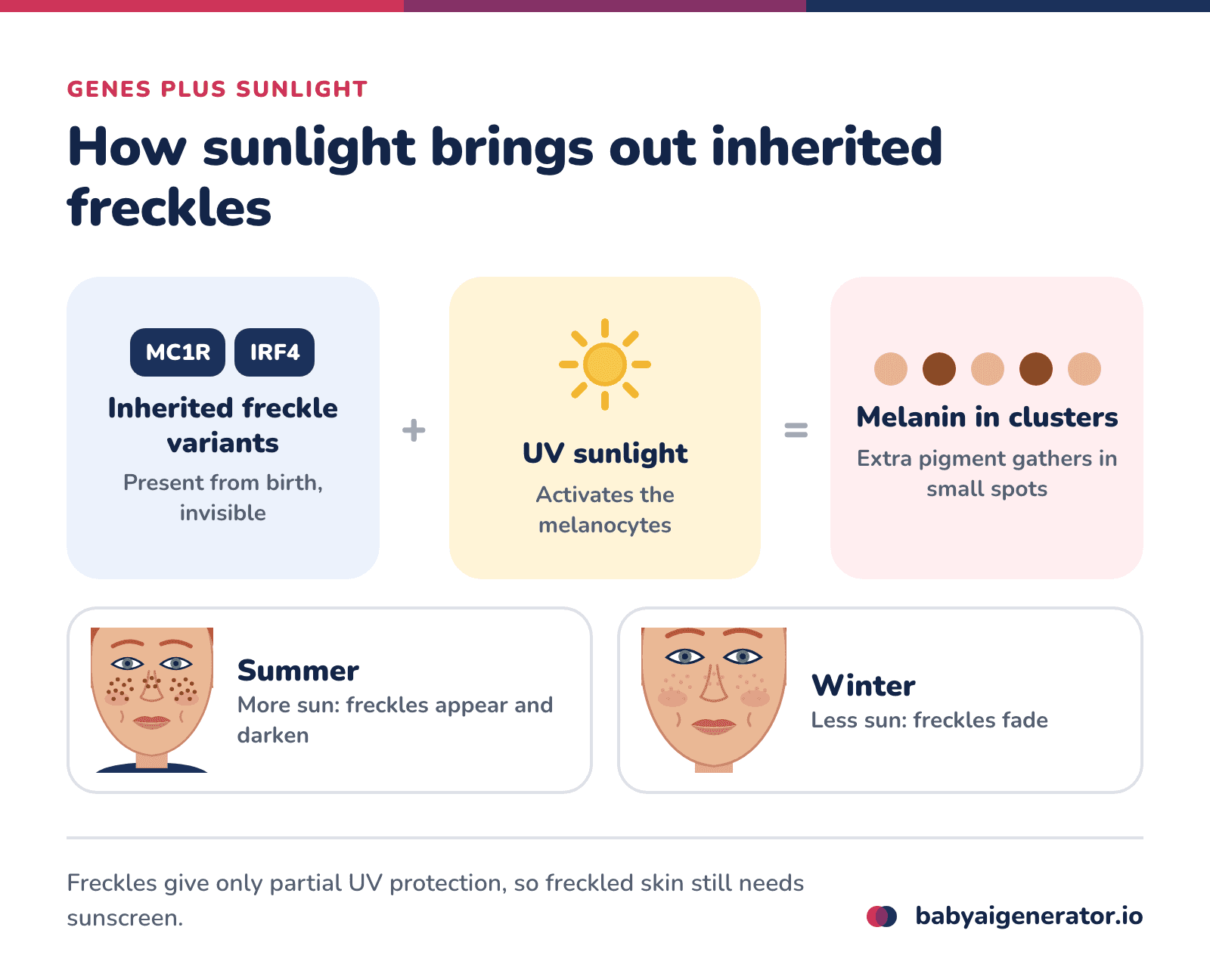
Freckles are the skin's attempt to shield vulnerable areas from UV radiation, but freckles give only partial protection. The variants that predispose someone to freckling come with lighter skin that has less baseline pigment, so people with freckles, especially those with lighter skin and red hair, need sunscreen and shade at peak sun hours to limit skin damage.
Are People Born With Freckles?
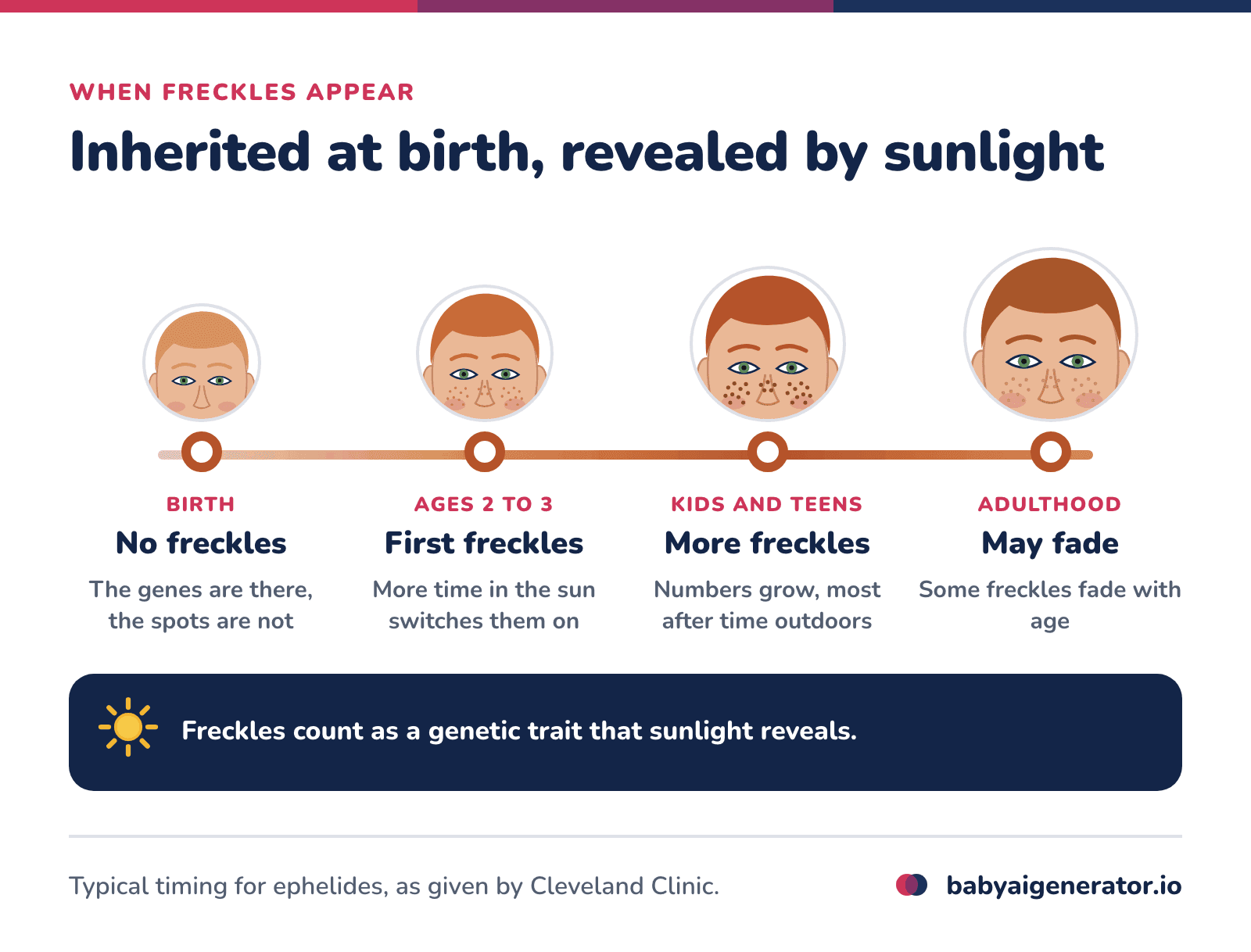
No, people are not born with freckles. Freckles develop after exposure to sunlight, even though the genetic tendency toward freckles, shaped by genes such as MC1R and IRF4, is present from birth. Freckles first emerge in early childhood, when children spend more time in sunlight that activates melanocytes, so the visible spots need sunlight to appear.
Why Do Redheads Have More Freckles?
Redheads have more freckles because of variations in the MC1R gene. MC1R variants shift melanin production toward pheomelanin, the pigment behind red hair and fair skin, and reduce eumelanin, the darker pigment that gives more protection against UV radiation. Red-haired people therefore have less natural sun protection, and their skin produces freckles in response to UV exposure.
MC1R links hair color and skin pigmentation, so redheads' lighter skin and higher sun sensitivity make freckles common, especially on sun-exposed areas such as the face and arms. MedlinePlus Genetics explains in "Is hair color determined by genetics?" (July 2022) that people with loss-of-function changes in both copies of MC1R almost always have very red hair.
Can Black People Have Freckles?
Yes, Black people can have freckles. Freckles are small, concentrated areas of extra melanin that can appear on any skin tone, and on darker skin freckles show as darker brown spots that are less noticeable against the higher baseline melanin. The genetic factors behind freckles, such as MC1R and IRF4 variants, occur across ethnicities, including people of African descent.
Freckles on darker skin follow the same genetic mechanisms as freckles on lighter skin, and sun exposure darkens freckles on any skin tone. Freckles are less common in Black people than in people with fair skin, and freckles should not be confused with other sun-related marks such as solar lentigines.
Skin checks are useful for people of all skin tones, since melanoma and other skin conditions can affect everyone, and sun protection remains important despite the protective effect of higher melanin levels.
How Common Are Freckles?
Freckles are common, especially among people with fair skin, and how often freckles appear varies widely between populations because of ethnicity, geography and genetic background. Cleveland Clinic notes in "Freckles (Ephelides and Solar Lentigines)" (May 2022) that people with lighter skin and blond or red hair are more likely to have freckles. People of European descent, above all those with Celtic ancestry, show higher rates of freckling than people of Asian or South Asian descent.
Several genetic markers are linked to freckles, and MC1R variants are more common in people with lighter skin. The genetic predisposition combined with sun exposure explains why freckles are frequent in some populations, and freckles count as a common inherited trait rather than a rare condition.
Can a Child Have Freckles if Neither Parent Does?
Yes, a child can have freckles when neither parent shows them. Freckles are a polygenic trait shaped by several genes, such as MC1R and IRF4, and both parents can carry freckle variants without expressing freckles themselves. When both parents carry the variants, they can pass them to a child who then develops freckles.
Parents may not show freckles because of low sun exposure or darker skin pigmentation that masks freckling, while a child with a lighter complexion or more sun exposure can develop freckles more visibly. Ultraviolet (UV) exposure triggers the melanin production that makes inherited freckles visible, so freckles can appear unexpectedly and seem to skip generations.
Hidden freckle genes in both parents explain why predicting a baby's freckles with certainty is difficult, since genetic analysis can estimate the likelihood of freckles but cannot guarantee the result.
Can You Predict Whether a Baby Will Have Freckles?
No, you cannot predict with certainty whether a baby will have freckles. Freckle variants such as MC1R and IRF4 indicate a likelihood of freckles, because those genes influence melanin production, but freckle expression depends on sun exposure as well. A child who inherits the predisposition may not develop visible freckles without enough sunlight, so genetic testing can estimate the probability of freckling but cannot say if or when freckles will appear.
Can a Trait Predictor Show Your Baby's Chance of Freckles?
Yes, a baby trait predictor can estimate a baby's chance of freckles from the parents' traits, such as freckle presence and hair color. A trait predictor uses what is known about pigmentation genes such as MC1R to calculate a probability, and because freckles depend on several genes and on sun exposure, the result is an estimate rather than a guarantee.
Can the AI Baby Generator Show Your Baby With Freckles?
Yes, the Baby Face Generator can show a baby with freckles when freckles are visible in the parents' photos. The AI Baby Generator analyzes the facial traits in the uploaded images, including freckles, and combines them into a composite image of a likely baby, so prominent freckles in the parent photos carry into the generated face. The freckles in the image are a visual estimate rather than a genetic prediction of a future child's freckles.
Why Don't Freckles Always Show in Parent Photos?
Freckles do not always show in parent photos because freckle visibility changes with sun exposure and the seasons. Freckles become more pronounced after exposure to ultraviolet (UV) light and fade during darker months such as winter, so photos taken indoors or in less sunny periods may not show freckles plainly.
Lighting, makeup and photo editing can hide freckles in photographs, since professional lighting, filters and image processing soften freckles and foundation can cover them, especially in formal portraits. Parents who carry freckle variants may therefore show no freckles in a given photo and still pass the variants to their children.
How Are Freckles Linked to Red Hair Genes?
Freckles are linked to red hair genes through the melanocortin-1 receptor (MC1R) gene, which affects pigment production in both skin and hair. MC1R variants reduce eumelanin, the dark pigment, and increase pheomelanin, the red-yellow pigment, which produces red hair and a higher tendency toward freckles. People with red hair carry MC1R variants that make their skin more sensitive to UV radiation and more likely to freckle, while other genes influence freckles and red hair as well, the same mix a baby hair color calculator works from.
Do Freckles and Red Hair Share the Same Inheritance?
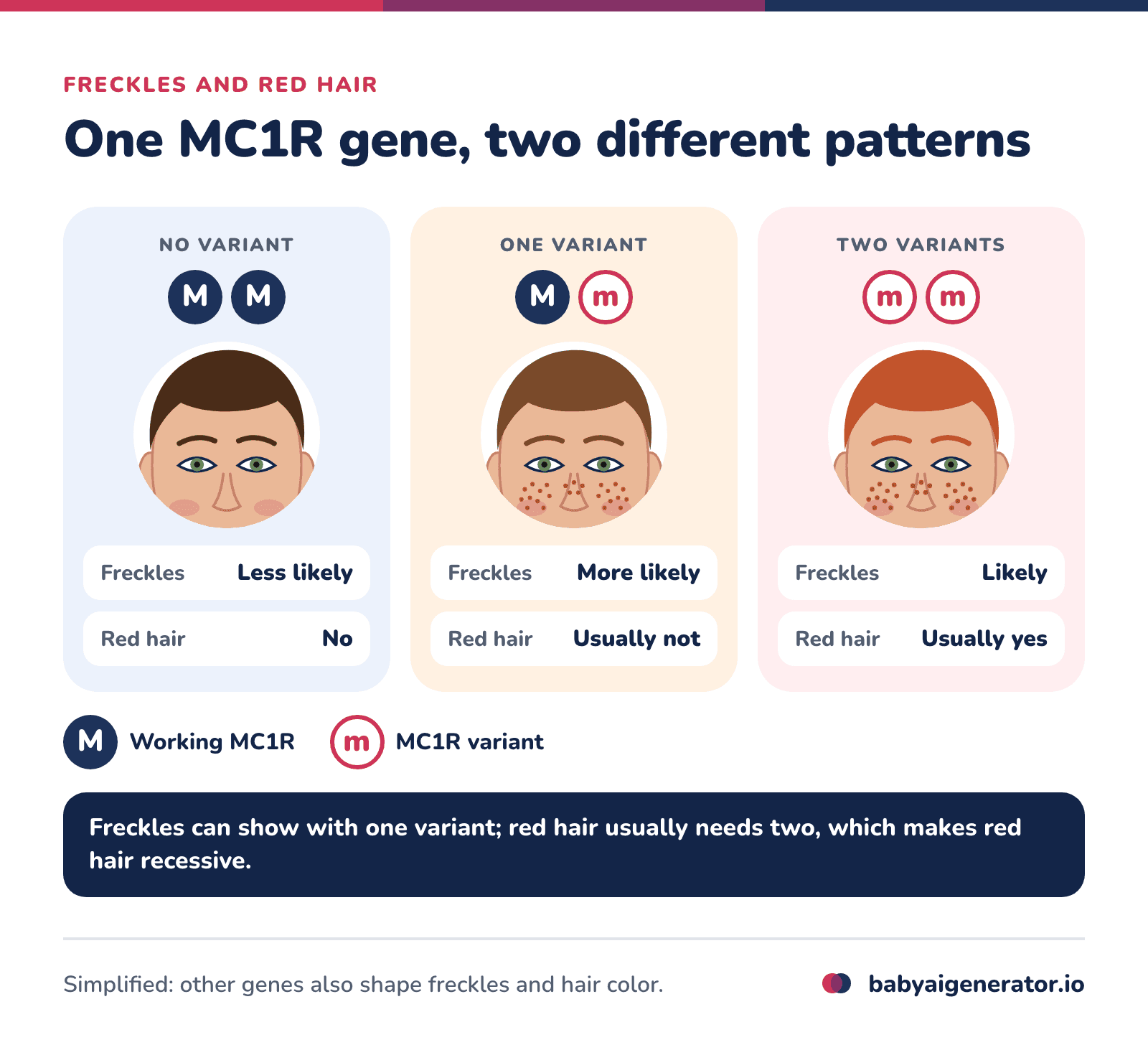
Yes, freckles and red hair share a genetic link through the MC1R gene, though the two traits do not follow exactly the same inheritance pattern. Freckles can appear with one or two copies of certain MC1R variants, while red hair usually needs two copies, which makes red hair a recessive trait, so one MC1R variant can produce freckles without red hair.
Do Freckles Follow Skin Tone Inheritance?
No, freckles do not follow the same inheritance pattern as skin tone. Freckles and skin tone both depend on melanin, but different genetic mechanisms control them: skin tone depends on many genes that set baseline melanin levels, the basis of a baby skin tone predictor, while freckles come from localized melanin clusters triggered by variants such as MC1R and IRF4 in response to sun exposure. A person can inherit freckle genes independently of the genes for complexion, so freckles can appear on every skin tone while showing most on lighter skin with less background pigment.
Which Facial Traits Are Inherited Like Freckles?
The facial traits inherited like freckles, part of the wider facial feature inheritance picture, are listed below:
- Dimples: Small indentations in the cheeks, classically inherited as a dominant trait.
- Cleft Chin: A chin with a visible indentation shaped by genetic factors.
- Widow's Peak: A V-shaped point in the hairline that runs in families.
- Eye Color: A trait set by several genes that produce a range of shades.
- Hair Texture: A trait shaped by genetic variants that affect curliness and thickness.
- Nose Shape: A trait shaped by genetic inheritance that varies widely between people.
- Ear Shape: A trait that includes earlobe attachment, influenced by several genes.
Like freckles, the inherited facial traits can skip generations or appear unexpectedly when both parents carry hidden variants.
Are Dimples Inherited Like Freckles?
No, dimples are not inherited in the same way as freckles. Dimples are traditionally viewed as a dominant trait, so a child needs one copy of the dimple variant from either parent to show dimples, although no single dimple gene has been identified. Freckles depend on several genes, such as MC1R and IRF4, and on sun exposure.
When Do Inherited Freckles First Appear on a Child?
Inherited freckles first appear on a child between the ages of 2 and 3 years, a range Cleveland Clinic gives for ephelides, which then increase during the teen years and may fade with age. The timing matches the rise in a young child's sun exposure, which activates melanin production in genetically predisposed skin, and freckles grow in number through childhood and the teen years, especially after time outdoors. The age at which freckles appear shows how inherited freckle genes and sunlight work together, which is why freckles count as a genetic trait that sunlight reveals.
Written by The Baby AI Generator team. We build the generator on this site and write about what it can and can't tell you.