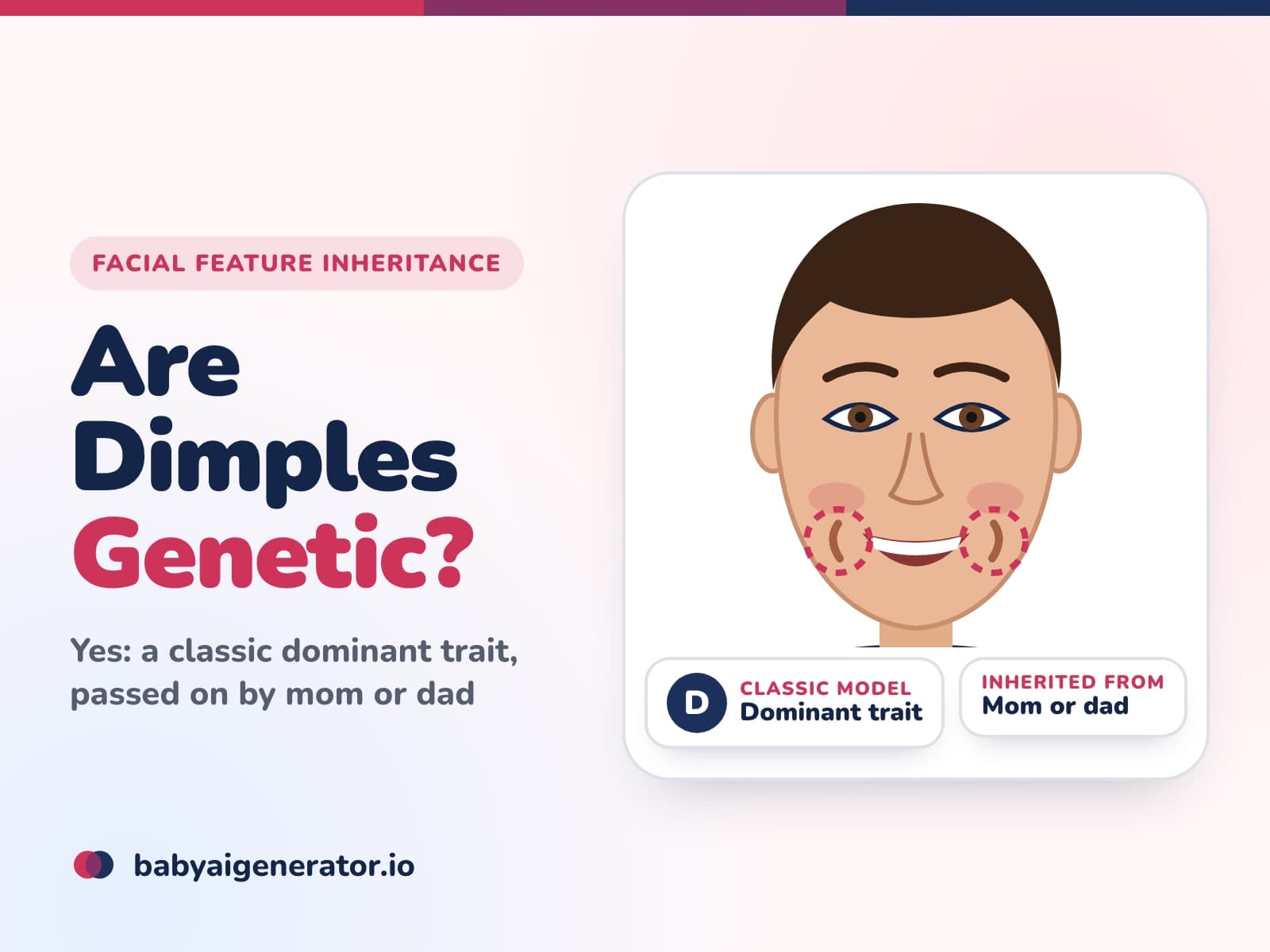
Yes, dimples are genetic and are classically treated as an inherited dominant trait. Dimples are small skin indentations linked to a variation in the zygomaticus major muscle, which pulls the skin inward when a person smiles. Dimples count as an autosomal dominant trait in the classic model, so a child can inherit them from either the mother or the father, yet dimples can appear even when neither parent has them, which points to a more involved genetic mechanism.
Cheek dimples come from a split zygomaticus major muscle that tethers the skin, while chin dimples come from incomplete fusion of the jawbone during development. Dimples are a harmless anatomical variation rather than a genetic defect, and two parents without dimples can still have a child with dimples.
Babies can show inherited dimples at birth, though dimples can become more or less visible as a baby grows. Trait predictors and the AI Baby Generator can estimate whether a child will have dimples from the parents' traits, and inherited dimples add to a child's resemblance to a parent, much like a cleft chin, freckles or a widow's peak. The genetics of dimples remains debated, because researchers still question whether dimples follow a simple dominant pattern or depend on several genetic factors.
Are Dimples Hereditary?
Yes, dimples are generally considered hereditary. Dimples are classed as an autosomal dominant trait, meaning a single copy of the dimple variant from one parent can produce dimples in a child. Dimple inheritance is not as straightforward as a simple dominant and recessive pattern, because several genes and facial muscle development play a part in how dimples show, and MedlinePlus Genetics notes in "Are facial dimples determined by genetics?" (July 2022) that dimples are assumed to be inherited while some researchers say there is no proof. The hereditary answer therefore rests on two questions: whether dimples are dominant and which parent passes them on.
Are Dimples Dominant or Recessive?
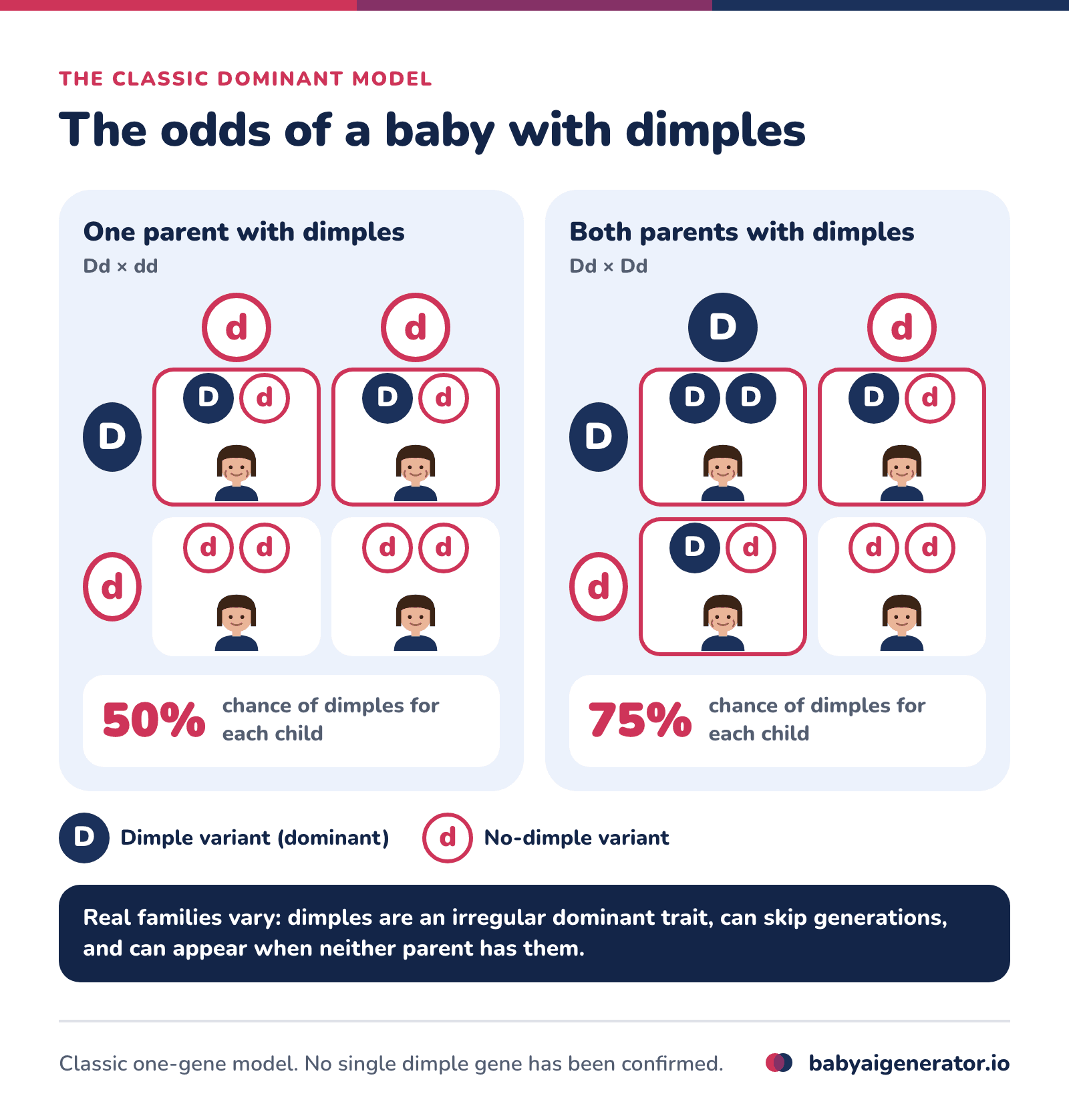
Dimples are generally considered a dominant genetic trait. Inheriting one copy of the dimple variant from either parent is usually enough for dimples to appear, since dominant traits need only one allele while recessive traits need two, the rule behind dominant vs recessive genes. Dimple inheritance is not always consistent, though, and some geneticists describe dimples as an irregular dominant trait because dimples appear unevenly among family members. Dr. D. Barry Starr of The Tech Interactive notes in "Is a dominant version of a trait always more common than the recessive one?" (2006, editor's note 2021) that dimples are now understood as a complex, multifactorial trait. No single gene responsible for dimples has been confirmed, which keeps the exact genetic mechanism open to debate.
Do Dimples Come From the Mother or the Father?
Dimples can come from either the mother or the father. Dimples are classed as an autosomal dominant trait, so a child can inherit dimples from just one parent who carries the dimple variant, and a child of a parent with dimples may develop them too. Modern research suggests dimple genetics may involve several genes or irregular dominance, which makes it hard to predict whether a child will inherit dimples from a particular parent, even when one or both parents have them.
What Are Dimples?
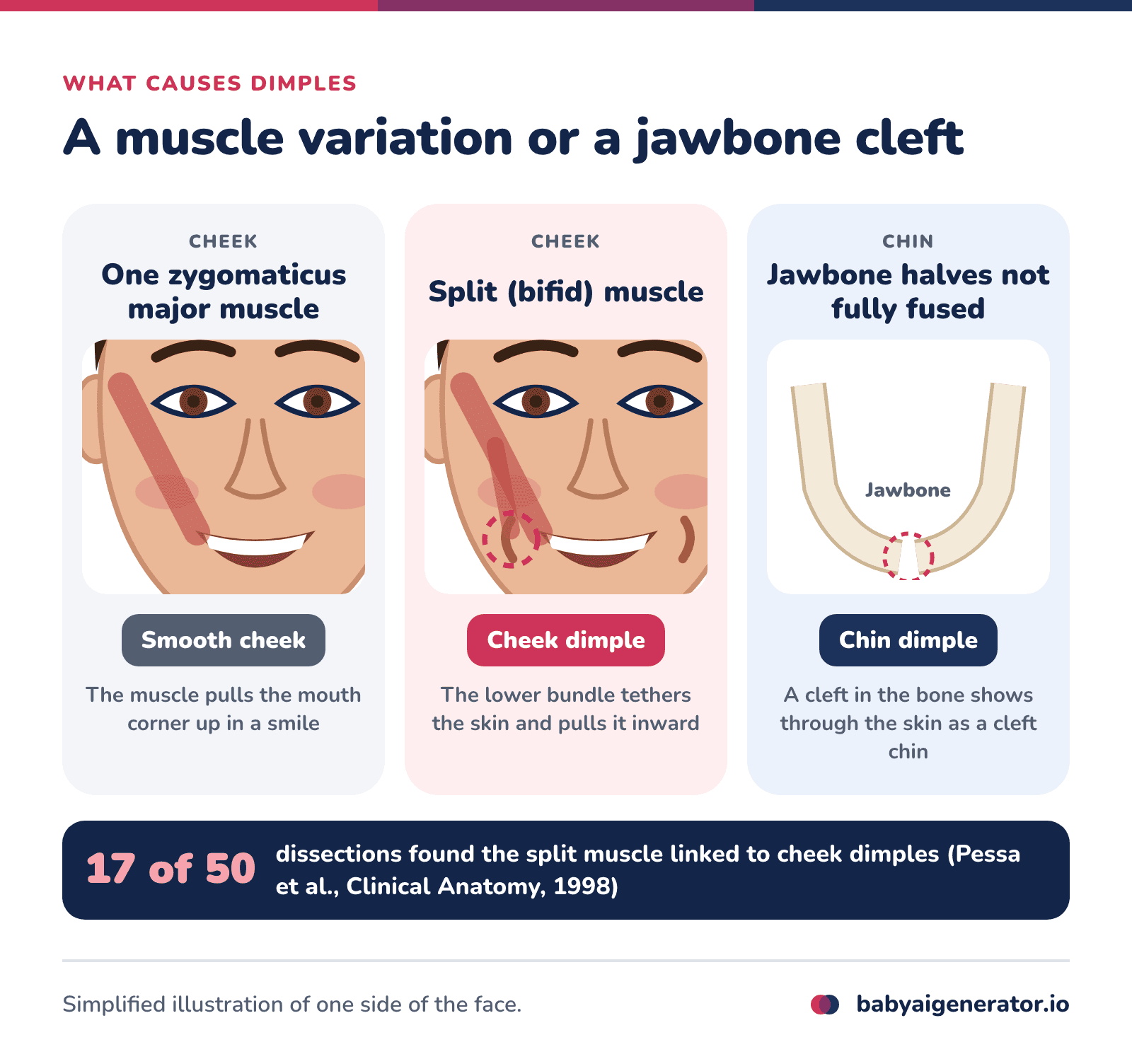
Dimples are small indentations in the skin, most commonly on the cheeks and sometimes on the chin, that show when a person smiles. Cheek dimples are linked to a variation in the zygomaticus major muscle, the muscle that pulls the corners of the mouth into a smile. In people with dimples, the zygomaticus major can split into two bundles, and the lower bundle pulls the skin inward to form a dimple when the muscle contracts.
Dimples on the chin, known as a cleft chin, come from a cleft in the jawbone left by incomplete fusion of the two halves of the jaw during development. Dimples are often linked with attractiveness and youthfulness, and dimples are regarded as a dominant genetic trait, although their exact inheritance pattern varies.
What Causes Dimples to Form?
Dimples form because of anatomical variations in the facial muscles and the jawbone. Cheek dimples are mainly caused by a bifid zygomaticus major muscle, which splits into two bundles, and the split creates a tethering effect on the skin that shows as a dimple during a smile. A 1998 study by Pessa et al. in Clinical Anatomy, "Double or bifid zygomaticus major muscle: anatomy, incidence, and clinical correlation," found the split muscle in 17 of 50 cadaver dissections and linked its lower bundle to dimple formation.
Chin dimples, known as cleft chins, have a different anatomical cause. Chin dimples result from a cleft in the jawbone that forms when the two halves of the jaw do not fully fuse during fetal development, leaving a visible depression on the surface of the chin.
Cheek and chin dimples are both considered genetic traits linked to dominant inheritance, but dimples can appear without a visible hereditary link. Variations in muscle and bone together give dimples their distinctive appearance.
What Are the Types of Dimples?
The types of dimples, grouped by their location on the face, are listed below:
- Cheek Dimples: Indentations on the cheeks that become more visible when a person smiles, linked to a variation in the zygomaticus major muscle.
- Chin Dimples: Indentations on the chin, commonly called cleft chins, that result from a cleft in the underlying jawbone.
Cheek Dimples
Cheek dimples are small indentations in the cheeks that show when a person smiles. Cheek dimples are caused by a bifid zygomaticus major muscle, meaning the muscle is split into two bundles, and the split pulls the skin inward to form a dimple when the muscle contracts.
Cheek dimples can appear on both sides of the face, called bilateral dimples, or on one side only, called unilateral dimples. Unilateral cheek dimples are more common than bilateral ones in population studies, and cheek dimples are linked with beauty and charm across many cultures.
Chin Dimples
Chin dimples, commonly called cleft chins, are a vertical indentation in the center of the chin. Unlike cheek dimples, which come from a facial muscle variation, chin dimples come from the underlying skeleton, where the two halves of the mandible do not fully fuse during fetal development. The resulting cleft in the bone shows through the overlying skin and soft tissue.
Chin dimples range from subtle grooves to pronounced clefts, depending on the depth of the bone cleft and the thickness of the skin and connective tissue. Chin dimples carry no health issues and count as a natural variation in human facial anatomy, and the trait can run in families.
How Rare Are Dimples?
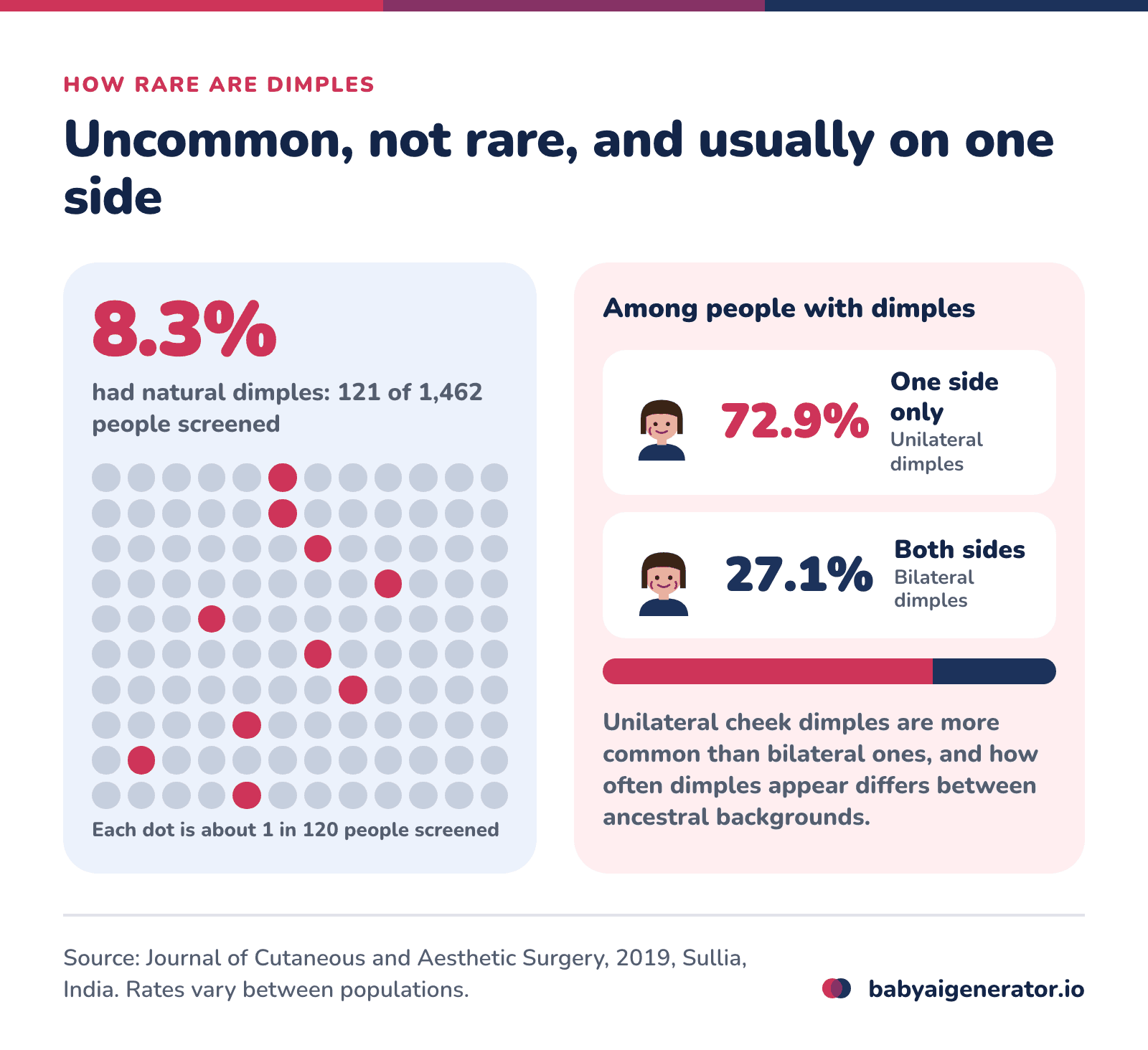
Dimples are uncommon but not rare, and how often dimples appear varies widely between populations. Population studies report very different rates depending on the group studied and on how researchers define a dimple. A 2019 study in the Journal of Cutaneous and Aesthetic Surgery screened 1,462 people in Sullia, India, and found natural dimples in 121 of them, about 8.3%, with 72.9% of those dimples on one side of the face only. Within people who have dimples, unilateral cheek dimples are more common than bilateral ones, and the exact frequency of dimples differs between ancestral backgrounds.
Are Dimples a Genetic Defect?
No, dimples are not a genetic defect. Cheek dimples are a harmless anatomical variation rather than a medical abnormality, produced by a split in the zygomaticus major muscle that indents the skin during a smile. The muscle variation is sometimes called an anomaly, but the term does not imply any health issue or loss of function.
Dimples are regarded as an attractive facial feature in many cultures, and some evolutionary theories suggest dimples may make facial expressions easier to read. Sacral dimples near the tailbone can occasionally point to spinal issues, but cheek and chin dimples are purely cosmetic and carry no health risk, so dimples count as normal human variation rather than a genetic abnormality.
Can You Get Dimples Without Inheriting Them?
Yes, a person can get dimples without inheriting them. A cosmetic procedure called dimpleplasty creates the appearance of dimples by attaching the inner cheek tissue to the overlying skin.
Dimples can form without genetic inheritance through variations in facial muscle development or skin elasticity during growth. Facial trauma or scarring can produce dimple-like indentations as well, although those differ from natural dimples.
Changes in weight or aging alter facial fat distribution, which can make dimples appear or disappear. Dimples are therefore not decided by parental genetics alone, and dimples can appear in people whose parents do not have them.
Can Two Parents Without Dimples Have a Child With Dimples?
Yes, two parents without dimples can have a child with dimples. A child with dimples born to two parents without them challenges the classic model of dimples as a simple dominant trait, which would need at least one parent with dimples. Modern genetics suggests dimple inheritance involves several genes, incomplete penetrance and possibly hidden variants carried by both parents, which can combine in a child.
The appearance of dimples in a child of two parents without them shows how variable dimple inheritance is. The zygomaticus major variation behind cheek dimples can develop without a strong family history, so dimple inheritance does not follow a straightforward dominant and recessive pattern.
The surprise of a dimpled child from two parents without dimples leads to the question of when dimples become visible in newborns, since some babies show dimples at birth while others develop them as facial muscles and soft tissue mature.
Do Babies Show Inherited Dimples at Birth?
Yes, babies can show inherited dimples at birth, though newborn dimples are not always visible right away. Dimples depend on the zygomaticus major muscle, which shows its variation during facial expressions such as smiling, and baby fat can hide dimples at first. Inherited dimples usually become more visible as the child grows and starts to smile and express emotion, the same step-by-step pattern seen across facial feature inheritance.
Can a Trait Predictor Show Whether Your Baby Will Have Dimples?
Yes, a baby trait predictor can estimate whether a baby will have dimples from the parents' dimple status. A trait predictor treats dimples as a dominant trait and uses whether one or both parents have dimples to calculate the probability that the baby inherits them. The result remains an estimate rather than a certainty, because dimple genetics is more involved than simple dominant and recessive inheritance.
Can the AI Baby Generator Show Your Baby With Dimples?
Yes, the AI Baby Face Generator can show a baby with dimples when the parents' photos display dimples. The AI Baby Generator analyzes the uploaded parent photos and blends the visible facial features into a predicted image of the child, so dimples that show plainly in the parent photos can carry into the baby's face. The AI Baby Generator works from visible features rather than DNA, so the dimples in the predicted image are a visual estimate rather than a genetic test.
Do Inherited Dimples Make a Baby Look Like a Parent?
Yes, inherited dimples can make a baby look like a parent. A child who inherits dimples from the mother or the father shares a distinctive feature with the dimpled parent, and dimples are one of several recognizable traits that build family likeness. Dimples show most during smiles and other expressions, so observers often notice them first when comparing a child with a parent.
Which Facial Traits Are Inherited Like Dimples?
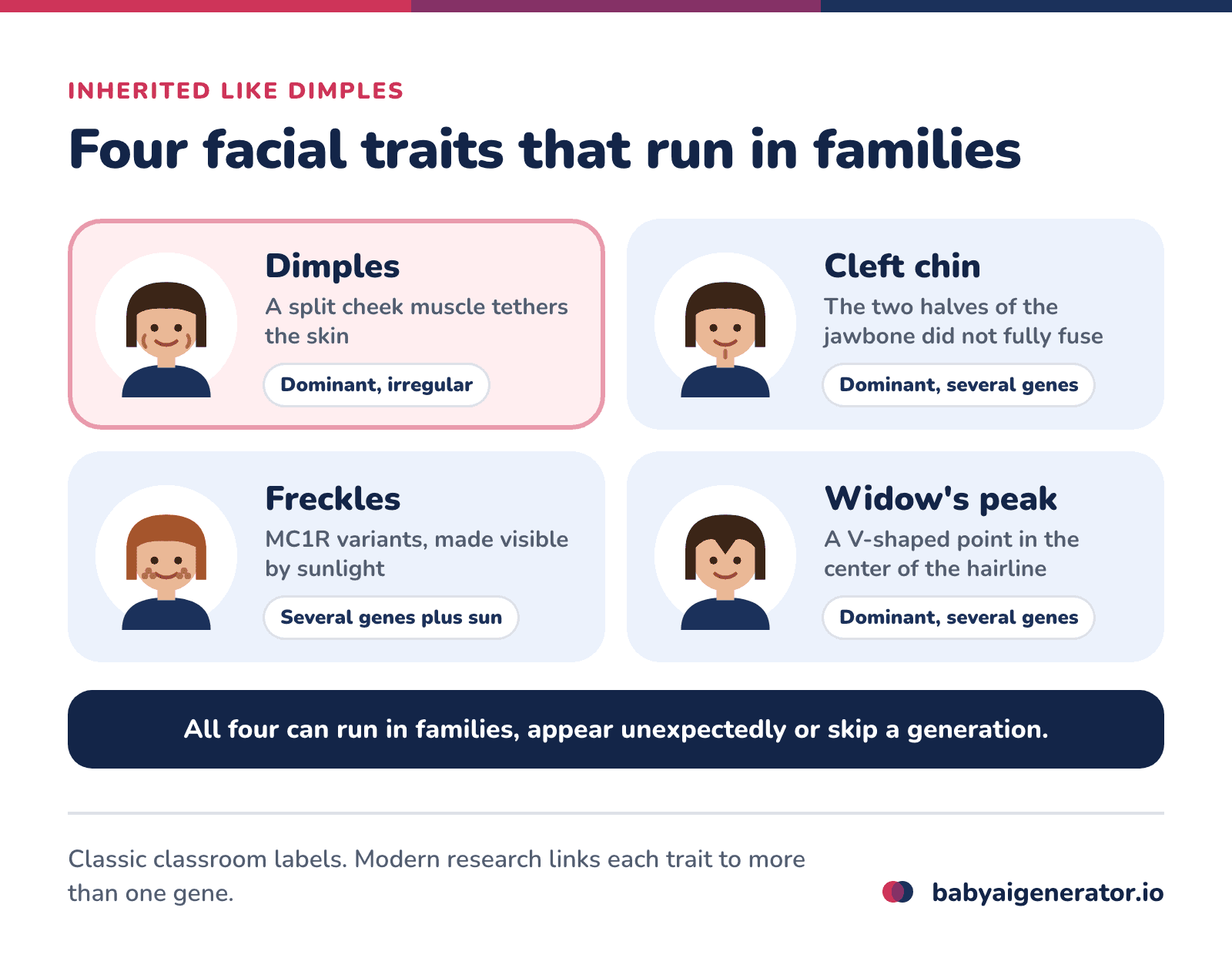
The facial traits inherited like dimples are the cleft chin, freckles and the widow's peak, all on the classic list of dominant and recessive traits. Each of the three traits passes from parents to children and adds to family resemblance across generations.
Is a Cleft Chin Inherited Like Dimples?
Yes, a cleft chin is inherited in a similar way to dimples, since both traits are classically considered dominant. A cleft chin comes from incomplete fusion of the two halves of the jawbone during development, and cleft chin inheritance involves several genes and variable expression, which makes it less predictable than simple dominant inheritance.
Are Freckles Inherited Like Dimples?
Yes, freckles are inherited, but freckles follow a more involved genetic pattern than dimples. Freckles result mainly from variations in the MC1R gene, which affects melanin production and is strongly linked to fair skin. Unlike dimples, which are structural features, freckles need sunlight to become visible, so freckle expression depends on both genetic predisposition and the environment.
Is a Widow's Peak Inherited Like Dimples?
Yes, a widow's peak is inherited in a similar way to dimples and is classically viewed as a dominant trait. Widow's peak genetics involves several genes rather than a single dominant gene, and both a widow's peak and dimples can run in families, appear unexpectedly or skip generations.
Why Is the Genetics of Dimples Still Debated?
The genetics of dimples is still debated because no single dimple gene has been confirmed and dimple inheritance does not follow consistent patterns. Dimples are classed as an autosomal dominant trait, yet dimples do not reliably follow simple Mendelian rules, and some geneticists propose that several genes or developmental factors in the face shape dimple formation. John H. McDonald of the University of Delaware lists cheek dimples among the classroom traits that do not follow a simple one-gene pattern in "Myths of Human Genetics" (2011). Researchers describe dimples as an irregular dominant trait whose inheritance cannot always be predicted, and dimples can appear in children whose parents do not have them, so the genetic basis of dimples still needs more research.
Written by The Baby AI Generator team. We build the generator on this site and write about what it can and can't tell you.