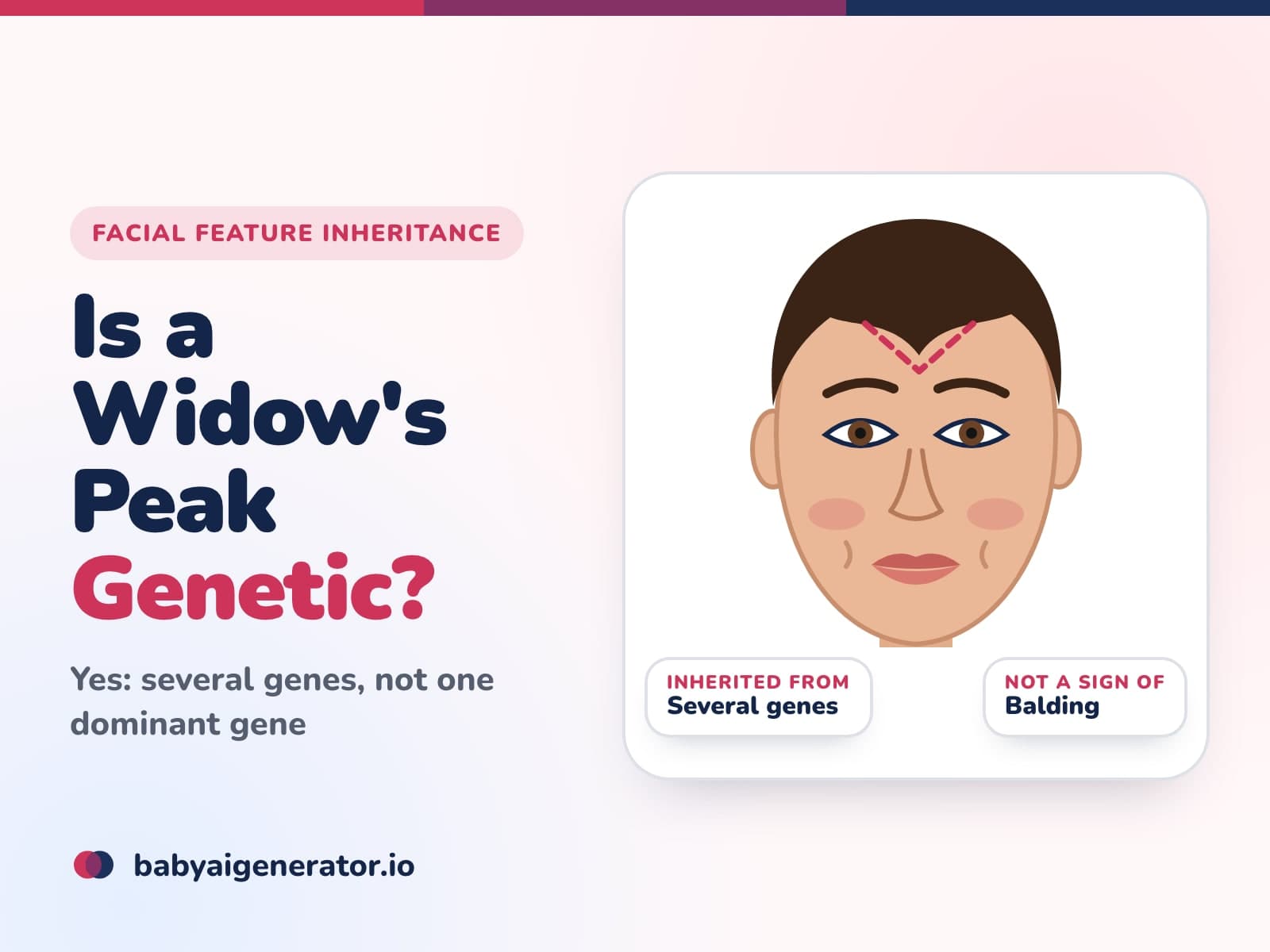
Yes, a widow's peak is genetic, shaped by the interaction of several genes rather than a single dominant gene. A widow's peak is a V-shaped point in the hairline at the center of the forehead. Widow's peak inheritance involves several genes working together, so either parent can contribute to the trait regardless of the parent's own hairline.
A widow's peak forms from hair growth patterns set during embryonic development, which create the V shape. Widow's peak hairlines range from subtle to pronounced, and the trait is common. A widow's peak differs from a receding hairline or balding because a widow's peak stays stable through life and does not signal hair loss, it can be less pronounced in women, and two parents without a visible widow's peak can have a child with one.
Predicting a baby's widow's peak is difficult, though the AI Baby Generator can give a visual estimate from hairline-visible parent photos. A widow's peak is hard to see on a newborn because infant hair is fine and sparse, and other traits such as curly hair, a cleft chin and attached earlobes can be inherited alongside it. A widow's peak is not the simple dominant trait it was long believed to be, which reflects the many genes behind the feature.
Is a Widow's Peak Hereditary?
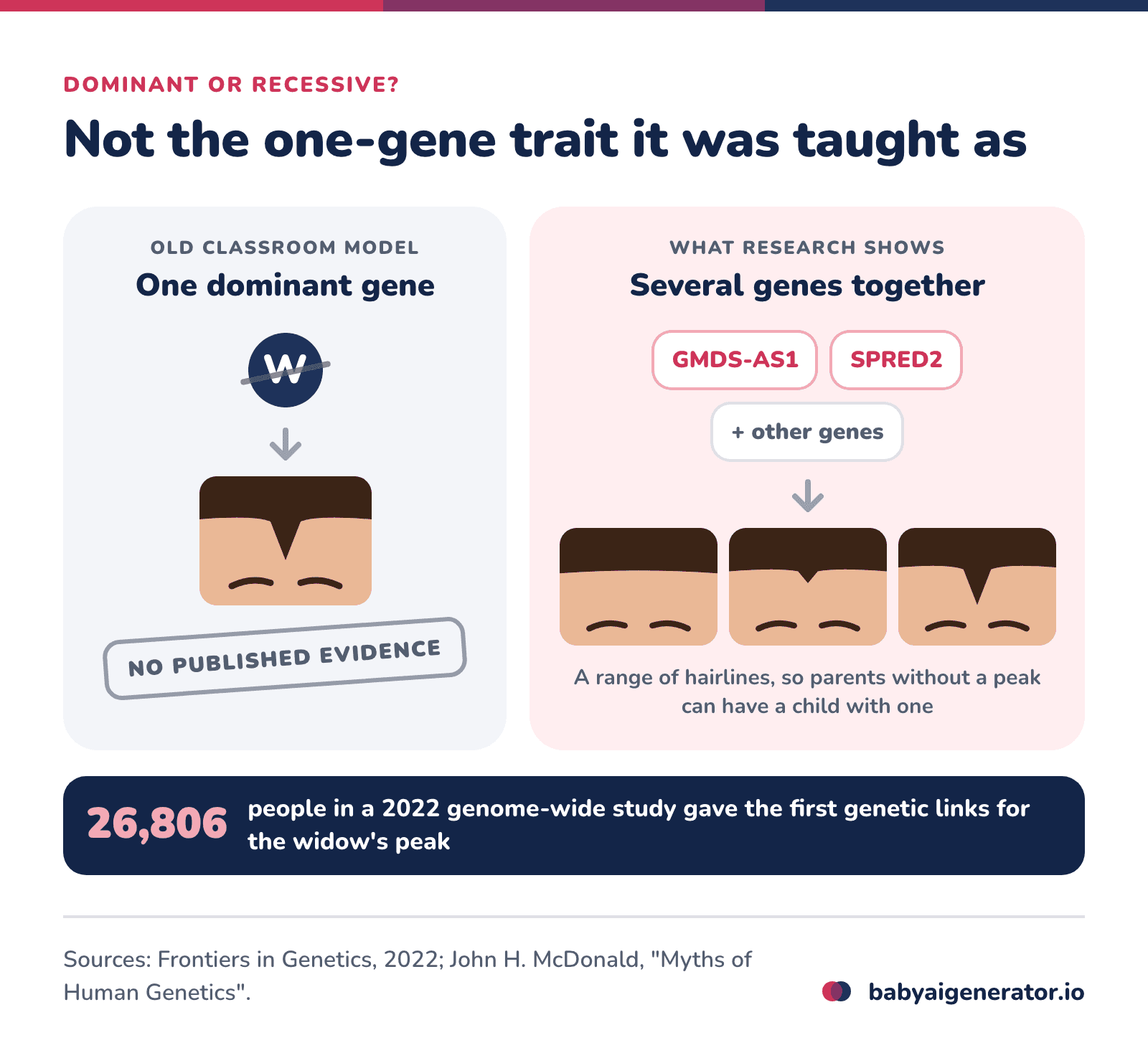
Yes, a widow's peak is hereditary. The V-shaped hairline passes down through families, though the mechanism is more involved than once believed. A widow's peak runs in families through the interaction of several genes rather than simple Mendelian inheritance, and a child is more likely to inherit a widow's peak when one or both parents have it. A 2022 genome-wide study of 26,806 people in China, "Novel genetic associations with five aesthetic facial traits: A genome-wide association study in the Chinese population" (Frontiers in Genetics), linked the widow's peak to variants near the GMDS-AS1 and SPRED2 genes, the first genetic associations reported for the trait.
Widow's peak inheritance is not guaranteed. Several genes shape the trait together, so its expression can vary even among siblings, and conditions during fetal development may affect how prominent the widow's peak becomes. The inherited hairline raises two questions: whether a widow's peak is dominant or recessive and which parent passes it on.
Is a Widow's Peak Dominant or Recessive?
A widow's peak is not simply dominant or recessive. Genetics teaching long described the widow's peak as a dominant trait, using the simple dominant vs recessive gene model, but research shows several genes influence its development, which produces varied expression within families. John H. McDonald of the University of Delaware reports in "Myths of Human Genetics: Widow's Peak" that no published evidence supports the single-gene dominant model and that no family or twin studies of widow's peak exist for the general population. The lack of evidence for single-gene control explains why a person with a widow's peak can have parents without one, and the reverse.
Who Do Children Inherit Their Hairline From?
Children inherit their hairline from both parents. Hairline shape, including a widow's peak, results from the combination of several genes contributed by the mother and the father, so hairline traits come from interactions between genetic variants rather than from one parent. A child's hairline therefore blends both sides of the family, which explains why siblings can have different hairlines and why a child's hairline can resemble one parent more closely or differ from both.
What Is a Widow's Peak?
A widow's peak is a V-shaped point in the hairline at the center of the forehead. The widow's peak forms a downward dip where the hair grows forward, and its prominence varies between people. A widow's peak shows most when the hair is styled away from the face or pulled back.
A widow's peak is a natural genetic trait that comes from the direction and pattern of hair follicle development during fetal growth. The widow's peak is a normal variation in hair growth, and unlike a receding hairline, a true widow's peak stays stable and is present from early development.
Widow's peaks differ in appearance, from a subtle dip in the hairline to a pronounced V-shaped point. Widow's peaks appear across all genders and ethnic backgrounds, and hair texture, density and styling affect how visible a widow's peak is.
Why Is It Called a Widow's Peak?
A widow's peak is called a widow's peak because the V-shaped hairline resembles the pointed hoods or veils that widows wore during mourning in Europe. Mourning hoods had a triangular point over the forehead, similar to the hairline shape. The name carried a superstition that a woman with a widow's peak would outlive her husband, a belief with no scientific basis. Today, widow's peak is a descriptive term for a normal variation in hairline shape.
What Causes a Widow's Peak to Form?
A widow's peak forms from the pattern of hair follicle development during fetal growth. The V-shaped hairline results from how hair follicles are distributed and oriented along the front of the scalp, where the hair growth fields meet at a point that extends downward. Several genes control follicle placement and growth direction, which makes the widow's peak a polygenic trait.
One developmental explanation holds that a widow's peak appears when the paired areas of hair-growth suppression above the eyes are smaller or set farther apart than usual, which lets the upper boundaries meet lower at the center of the forehead. A widow's peak is usually a normal genetic feature, but a widow's peak can occasionally accompany genetic syndromes such as Aarskog-Scott syndrome or Waardenburg syndrome, which come with other distinctive features beyond the hairline. MedlinePlus Genetics lists a widow's peak hairline among the facial features of Aarskog-Scott syndrome in "Aarskog-Scott syndrome" (May 2022).
In most cases, a widow's peak is a harmless hereditary trait with no medical significance. A stable widow's peak is a natural variation, separate from hair loss conditions, and a widow's peak does not raise the likelihood of androgenetic alopecia.
What Are the Types of Widow's Peak Hairlines?
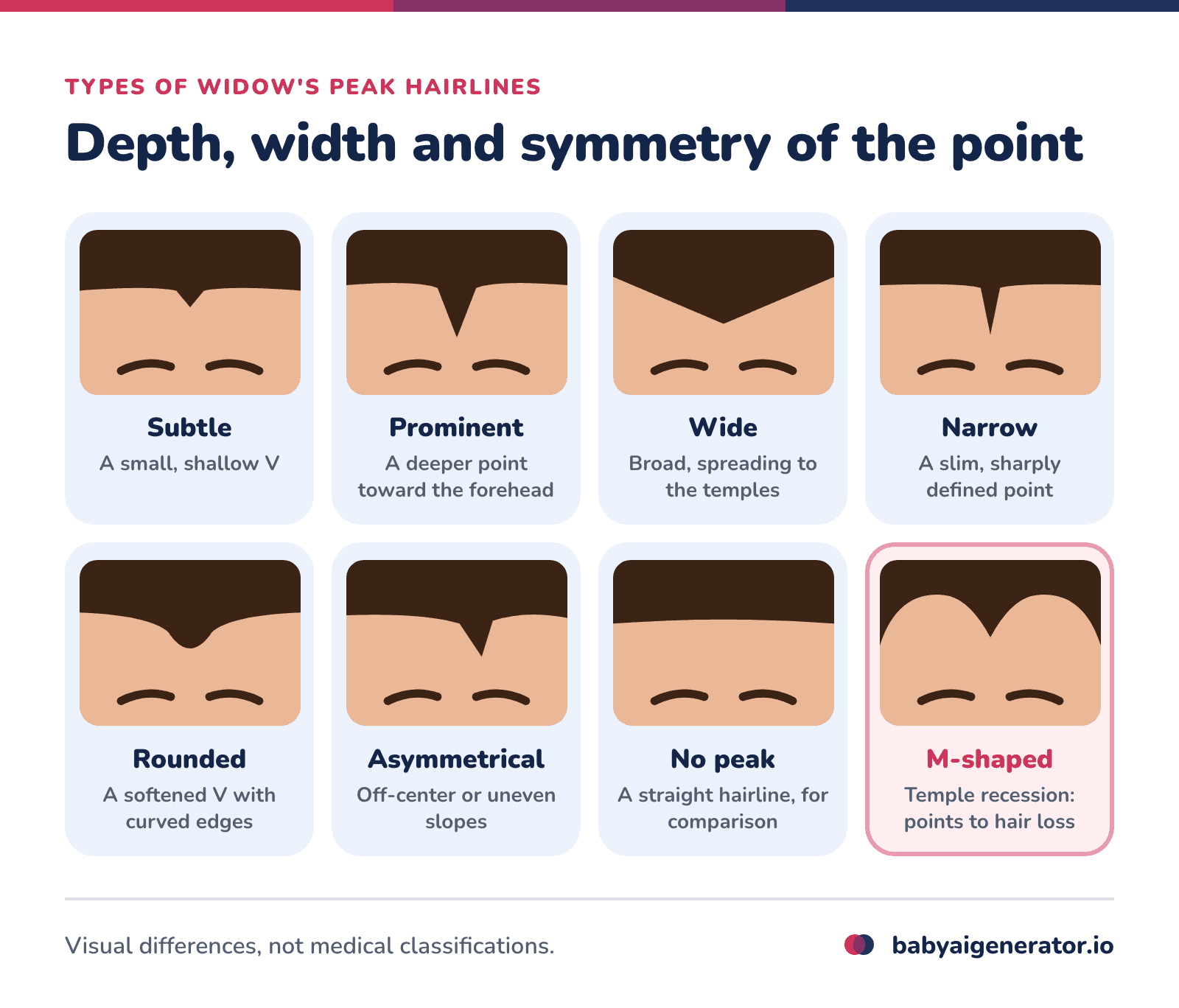
The types of widow's peak hairlines, which differ in the depth, width and symmetry of the central point, are listed below:
- Subtle Widow's Peak: A small, shallow V that blends into the surrounding hairline and is less noticeable.
- Prominent Widow's Peak: A deeper V-shaped point that extends farther toward the center of the forehead.
- Wide Widow's Peak: A broad central point with sides that spread gradually toward the temples.
- Narrow Widow's Peak: A sharply defined, slim point with steep angles on either side.
- Rounded Widow's Peak: A softened V with curved edges rather than sharp angles.
- Asymmetrical Widow's Peak: A peak that sits slightly to one side or has uneven slopes.
- M-Shaped Hairline With a Central Peak: A central point combined with recession at the temples, which points to hair loss rather than a stable widow's peak.
The widow's peak types describe visual differences rather than medical classifications.
How Common Is a Widow's Peak?
A widow's peak is a common hairline trait seen in men and women of all ages. How often a widow's peak appears varies between populations and ethnic groups, and studies on its exact distribution remain few. A widow's peak is a normal part of human hairline variation rather than an anomaly.
Is a Widow's Peak Different From a Receding Hairline?
Yes, a widow's peak is different from a receding hairline. A widow's peak is a genetic hairline pattern with a V-shaped point at the center of the forehead that stays stable over time and is not linked to hair loss. A receding hairline is the gradual backward movement of the hairline, usually starting at the temples, and it is often caused by androgenetic alopecia, which means actual hair loss rather than a natural hairline shape.
A widow's peak keeps its V shape from youth through adulthood without changing position. A receding hairline forms an M-shaped pattern as hair at the temples thins and pulls back, with the hairline moving higher on the forehead over months and years. Receding hairlines often come with other signs of hair loss, such as lower hair density, thinning at the crown and changes in hair texture.
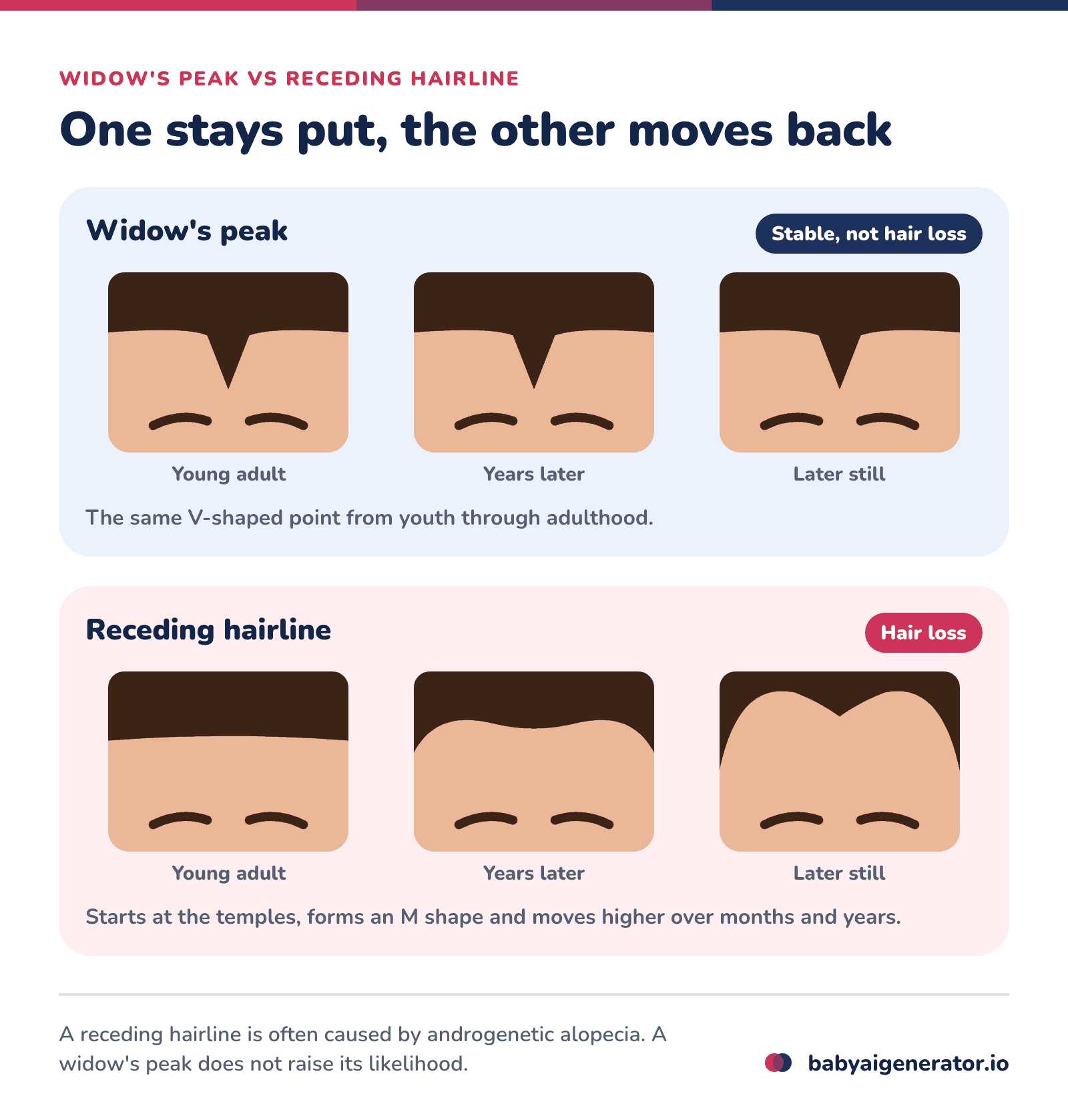
The difference between a stable hairline shape and progressive recession decides whether hair loss is occurring, which leads to the question of whether a widow's peak means balding.
Does a Widow's Peak Mean Balding?
No, a widow's peak does not mean balding. A widow's peak is a natural V-shaped hairline that is genetically determined and stable over time, unlike a receding hairline, which signals hair loss. A widow's peak does not raise the likelihood of androgenetic alopecia, the condition of progressive hair thinning and follicle shrinkage. A widow's peak can exist alongside balding, but it does not predict or cause balding, which shows instead as temple recession and general thinning.
Does a Widow's Peak Look Different in Women?
No, a widow's peak does not look fundamentally different in women. A widow's peak remains a V-shaped point at the center of the forehead in both sexes, though hairstyling changes how visible it is. Women with longer hair may style it to highlight or hide a widow's peak, since center parts and ponytails make the peak more visible while side parts or bangs can cover it.
The genetic basis and structure of a widow's peak are the same across sexes, and men and women inherit the trait through the same hereditary factors. Men often focus on telling a widow's peak apart from a receding hairline, while women tend to see it as a natural hairline variation, and in women a widow's peak does not signal hair loss unless thinning or a widening part appears too.
Beauty standards and hair length affect how prominent a widow's peak looks, but the trait itself does not change in shape between women and men.
Can Two Parents Without a Widow's Peak Have a Child With One?
Yes, two parents without a widow's peak can have a child with one. Several genes influence a widow's peak rather than a single dominant gene, so each parent can carry variants that do not show in their own hairline but combine in the child to produce the V-shaped hairline.
Widow's peak inheritance is more involved than simple dominant and recessive models suggest. Gene interactions and developmental factors produce variation in hairline shape, so children can show features that neither parent displays, and predicting a baby's hairline from the parents' visible traits alone is unreliable.
Can You Predict Whether a Baby Will Have a Widow's Peak?
No, you cannot predict with certainty whether a baby will have a widow's peak. Several genes influence a widow's peak, so its inheritance pattern is not straightforward, and two parents with a widow's peak do not guarantee a child with one, while two parents without one can have a child who develops it.
A newborn's hairline may not show a widow's peak at first, because newborn hair is sparse and changes as the child grows. Family hairline patterns can suggest a possibility, but they cannot settle whether a child will have a widow's peak.
Can the AI Baby Generator Show a Widow's Peak on Your Future Baby?
The AI Baby Picture Generator can only hint at a widow's peak on a future baby, because a widow's peak is hard to see on a baby's face. The AI Baby Generator analyzes the hairline shape visible in both parents' photos and identifies a V-shaped point at the center of the forehead where present, but a baby's hair is fine and sparse, so the generated face often shows a soft hairline rather than a clear V. Several genes shape a widow's peak, and parents can carry variants that their own hairlines do not show, so any hairline in the generated face is a visual estimate, not the hairline the child will certainly have.
The AI Baby Generator needs clear, hairline-visible parent photos to read a widow's peak, with the forehead and hair growth pattern in full view.
Using Hairline-Visible Parent Photos for Widow's Peak Predictions
Hairline-visible parent photos are front-facing, well lit and show the forehead without hats or bangs covering it. Photos with the hairline in plain view let the AI Baby Generator read the V-shaped hairline pattern a parent might pass to the child.
Why Is a Widow's Peak Hard to See on a Newborn?
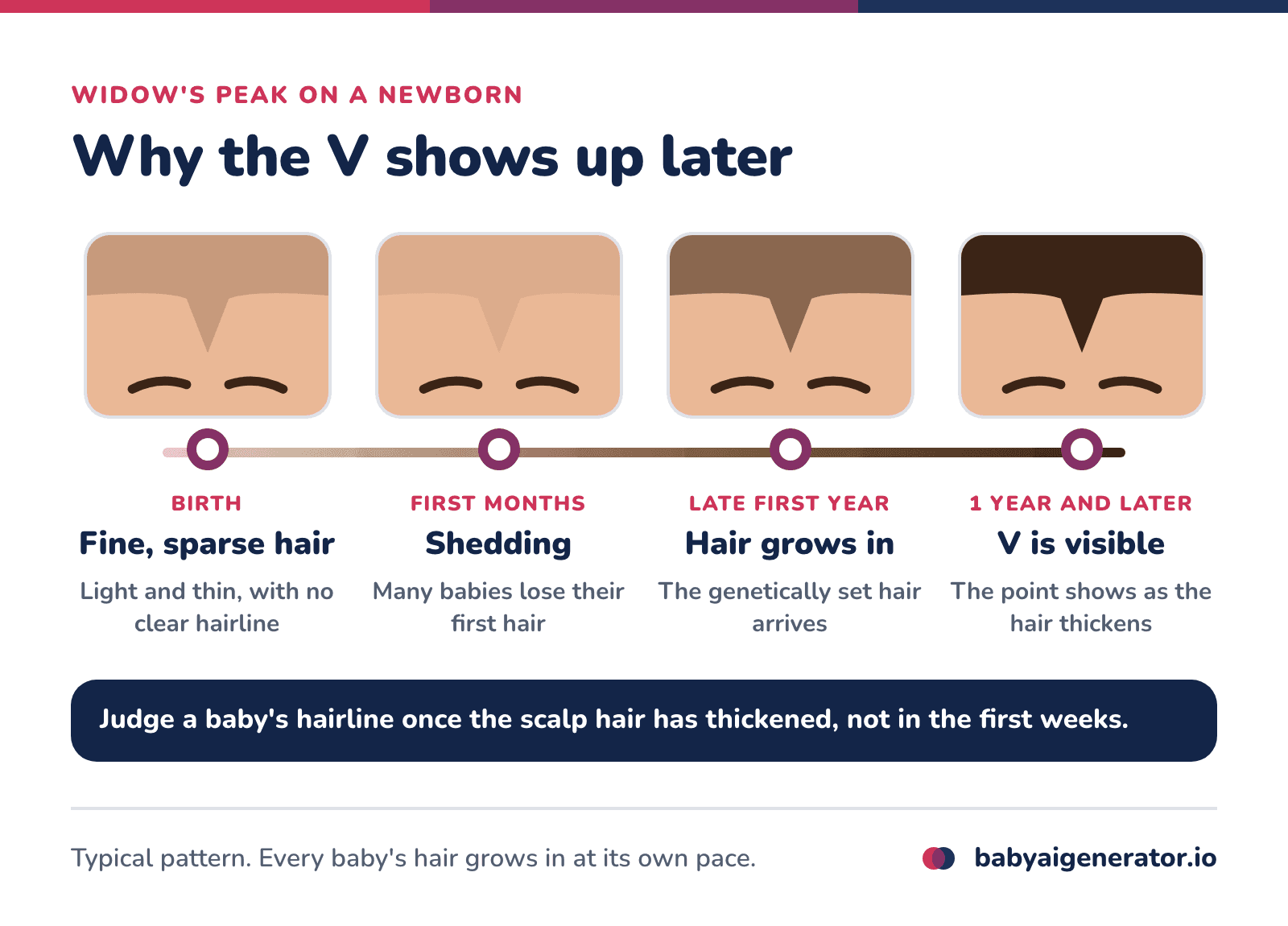
A widow's peak is hard to see on a newborn because infant hair is fine, sparse and lightly pigmented, without a defined growth pattern. Newborn hair does not always follow the permanent hairline, and many newborns shed their first hair in the first months before the genetically determined hair grows in. The hairline matures over the following months to more than a year, and the V-shaped point of a widow's peak becomes easier to see as the scalp hair thickens.
Which Other Hair Traits Do Babies Inherit With a Widow's Peak?
The other hair traits babies inherit with a widow's peak include hair texture, such as straight, wavy or curly hair, along with hair color, thickness and density. Each hair trait depends on several genes and follows its own inheritance pattern separate from the widow's peak, so a child can have a widow's peak with a hair color or texture unlike either parent, and a baby hair color calculator can estimate the color side.
Is Curly Hair Inherited Like a Widow's Peak?
No, curly hair is not inherited in the same way as a widow's peak. Curly hair is polygenic, resulting from the interaction of several genes such as TCHH, EDAR and WNT10A that shape the hair follicle and produce a spectrum from straight to curly hair. The genes behind hair texture differ from the genes behind hairline shape, and the wide variability of hair texture makes curly hair harder to predict.
Which Facial Traits Are Inherited Like a Widow's Peak?
The facial traits inherited like a widow's peak are the cleft chin and attached earlobes. Both traits were traditionally taught as simple dominant or recessive traits, but modern genetics shows each involves several genes, and both run in families much like a widow's peak and the other traits covered in facial feature inheritance.
Is a Cleft Chin Inherited Like a Widow's Peak?
Yes, a cleft chin is inherited in a similar way to a widow's peak. Both traits were long considered simple dominant traits controlled by one gene, and genetic research shows both are influenced by several genes. Neither trait follows a straightforward Mendelian dominance pattern, so both appear less predictably than the classic model suggests.
Are Attached Earlobes Inherited Like a Widow's Peak?
Yes, attached earlobes are inherited in a similar way to a widow's peak, since both are polygenic traits rather than simple dominant and recessive traits. Many genes contribute to earlobe attachment, while different genes shape the hairline, so the two traits share an inheritance style but not the same genes.
Is a Widow's Peak Really a Simple Dominant Trait?
No, a widow's peak is not a simple dominant trait. Early genetics teaching presented the widow's peak as a straightforward dominant trait, as it still appears on the classic list of dominant and recessive traits in humans, but research shows its inheritance involves several genes, which makes it a polygenic trait rather than one controlled by a single dominant gene. "Myths of Human Genetics" (2011), John H. McDonald's book from the University of Delaware, lists the widow's peak among the classroom traits that do not follow a simple one-gene pattern. Polygenic inheritance explains why children can have a widow's peak when neither parent shows one, and the interaction of several genes during fetal development shapes the V-shaped hairline, in line with the broader genetic consensus that a widow's peak depends on several genetic and developmental factors.
Written by The Baby AI Generator team. We build the generator on this site and write about what it can and can't tell you.