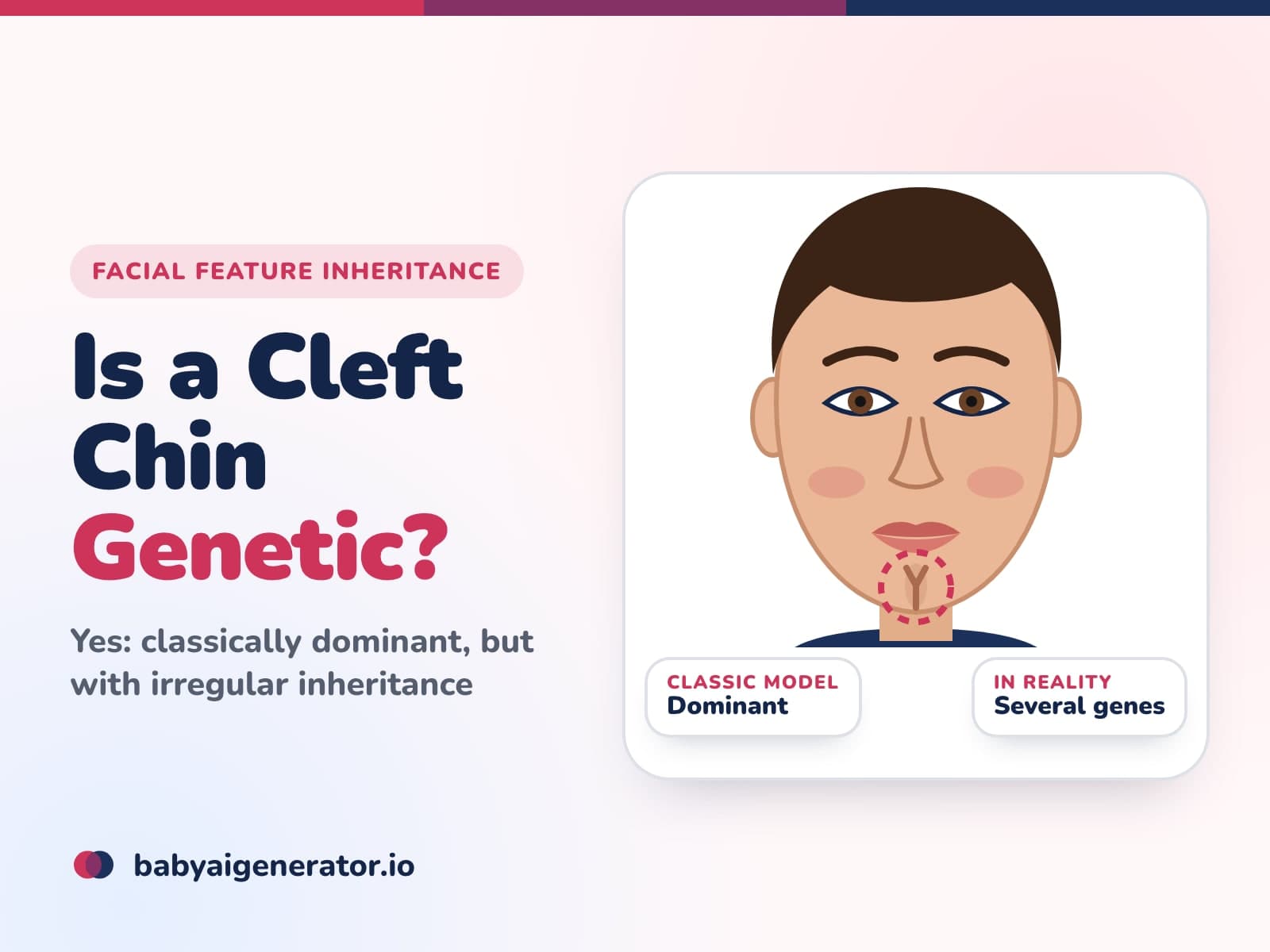
Yes, a cleft chin is genetic, traditionally considered a dominant trait but with irregular inheritance. A cleft chin is an indentation in the center of the chin, and cleft chin inheritance does not follow a straightforward dominant or recessive pattern. Family studies show that cleft-chinned parents often have cleft-chinned children, yet two parents without cleft chins can still have a child with one, because several genes are involved rather than a single dominant gene.
A cleft chin forms during fetal development when the left and right halves of the lower jaw do not fully fuse at the midline, and the attachment of the mentalis muscle adds to the cleft's appearance. Unlike a simple chin dimple, a cleft chin involves structural variation in bone and muscle. Cleft chins vary in prevalence between ethnic groups, often look more pronounced in men, and become more visible with age as skin elasticity and fat distribution change.
Predicting a cleft chin in a newborn is difficult, though the AI Baby Generator projects possible outcomes from chin landmarks in front-facing parent photos. Cleft chins are often hidden in newborns by baby fat and underdeveloped facial bones and become more visible as the child grows. Cleft chin inheritance connects to other chin, jaw and facial traits, and although once thought to be a simple dominant trait, the cleft chin follows a multifactorial pattern.
Is a Cleft Chin Hereditary?
Yes, a cleft chin is hereditary and passes from parents to children through genetic inheritance. Cleft chins run in families, but the inheritance pattern is not the simple Mendelian model, since several genes interact in ways that are not fully predictable. John H. McDonald of the University of Delaware notes in "Myths of Human Genetics: Cleft Chin" that cleft-chinned parents have more cleft-chinned children, which points to a strong genetic influence even though the single-gene model fails.
Family studies show that not every child of cleft-chinned parents inherits the feature, and that children of smooth-chinned parents sometimes do, because genetic and environmental factors both influence whether a cleft chin shows. The hereditary answer sets up two questions: whether a cleft chin is dominant or recessive and what the family evidence shows.
Is a Cleft Chin Dominant or Recessive?
A cleft chin is traditionally considered a dominant trait, but the classification is too simple. Cleft chin inheritance involves several genes rather than a single dominant gene, so a person can carry a cleft chin variant without showing the trait. The effect, known as variable penetrance, means other genetic and possibly environmental factors decide whether a cleft chin appears, so cleft chin inheritance does not fit the classic Mendelian dominant and recessive model.
What Do Family Studies Show About Cleft Chin Inheritance?
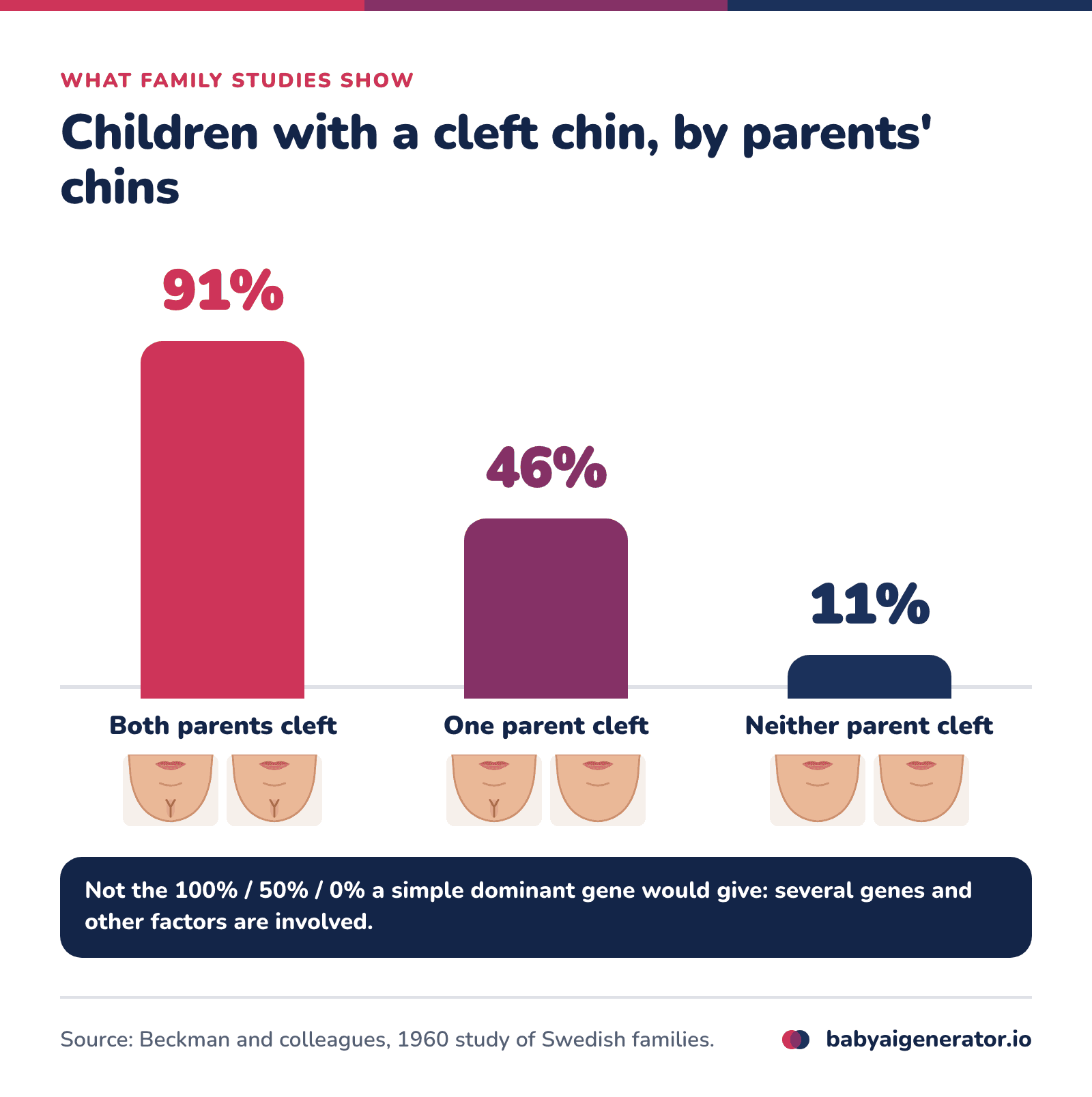
Family studies show that cleft chin inheritance is not strictly Mendelian. A 1960 study of Swedish families by Beckman and colleagues found that when both parents have cleft chins, about 91% of their children have cleft chins too, the share drops to 46% when one parent has a cleft chin, and about 11% of children have cleft chins when neither parent does. The family results do not fit a simple dominant and recessive pattern and point instead to several genes and environmental factors behind the cleft chin.
What Is a Cleft Chin?
A cleft chin is a facial feature with a visible indentation or groove at the center of the chin, often shaped as a vertical or Y-shaped crease. The cleft comes from how the lower jawbone, the mandible, and the paired mentalis muscles are arranged beneath the skin.
The depth and prominence of a cleft chin vary between people, from a subtle line to a pronounced groove. The cleft results from a depression or incomplete fusion at the midline of the mandible, or from a gap between the paired mentalis muscles.
A cleft chin is often called a chin dimple, but a cleft chin differs from the temporary puckering or orange-peel texture caused by muscle movement. A cleft chin is a stable, central indentation that stays the same regardless of muscle activity.
What Causes a Cleft Chin?
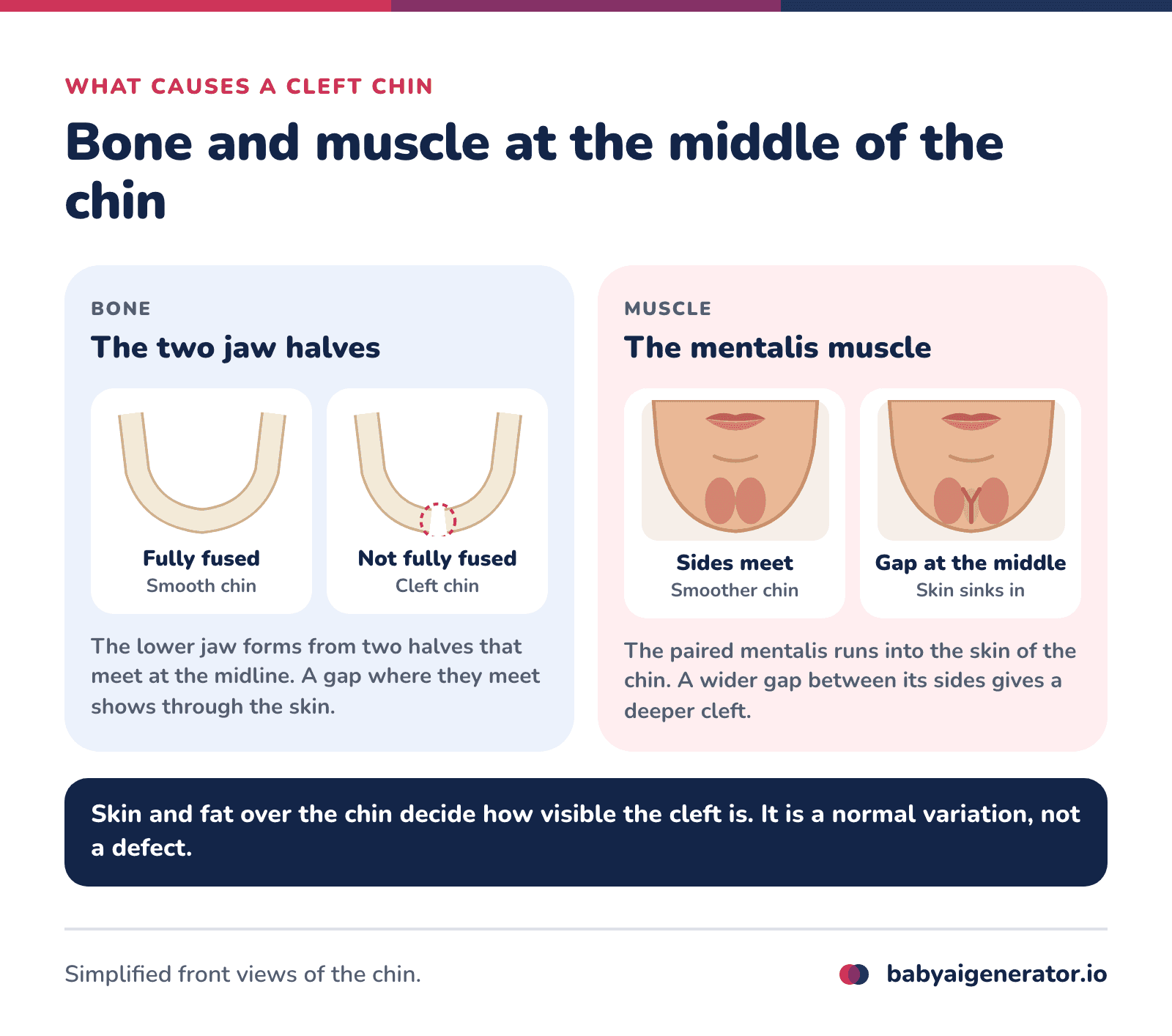
A cleft chin is caused by developmental factors during fetal growth. The main cause is incomplete fusion of the two halves of the mandible, the lower jawbone, during embryonic development, which leaves a small gap in the bone that shows as an indentation on the skin. The attachment pattern of the mentalis muscle at the tip of the chin influences the cleft too, and an attachment that accentuates the indentation makes the cleft more pronounced.
The thickness of the skin and fat over the chin affects how visible a cleft chin is. Mandible fusion and mentalis muscle attachment together decide whether a cleft chin exists and how prominent it is, as the two causes below explain.
Incomplete Mandible Fusion in the Womb
Incomplete mandible fusion in the womb is a developmental cause of a cleft chin. During fetal development, the mandible forms from two separate halves that move toward the center of the face and fuse at the midline. When the fusion is incomplete, an indentation or groove appears where the two halves meet at the mandibular symphysis. The degree of fusion sets the prominence of the cleft, with minimal fusion producing a pronounced cleft and near-complete fusion producing only a subtle dimple or line. Incomplete mandible fusion is a normal anatomical variation rather than a defect.
Mentalis Muscle Attachment
Mentalis muscle attachment is a muscular cause of a cleft chin. The mentalis is a paired muscle that runs from the mandible into the skin of the chin, and when the fibers of the two sides do not fully meet at the midline, a gap forms. The muscle-free gap lets the overlying skin and soft tissue sink inward into a visible cleft, which deepens when the mentalis contracts during lip movements. The arrangement of the mentalis varies between people, and a wider division produces a deeper cleft while a closer one leaves a smoother chin.
Is a Cleft Chin the Same as a Chin Dimple?
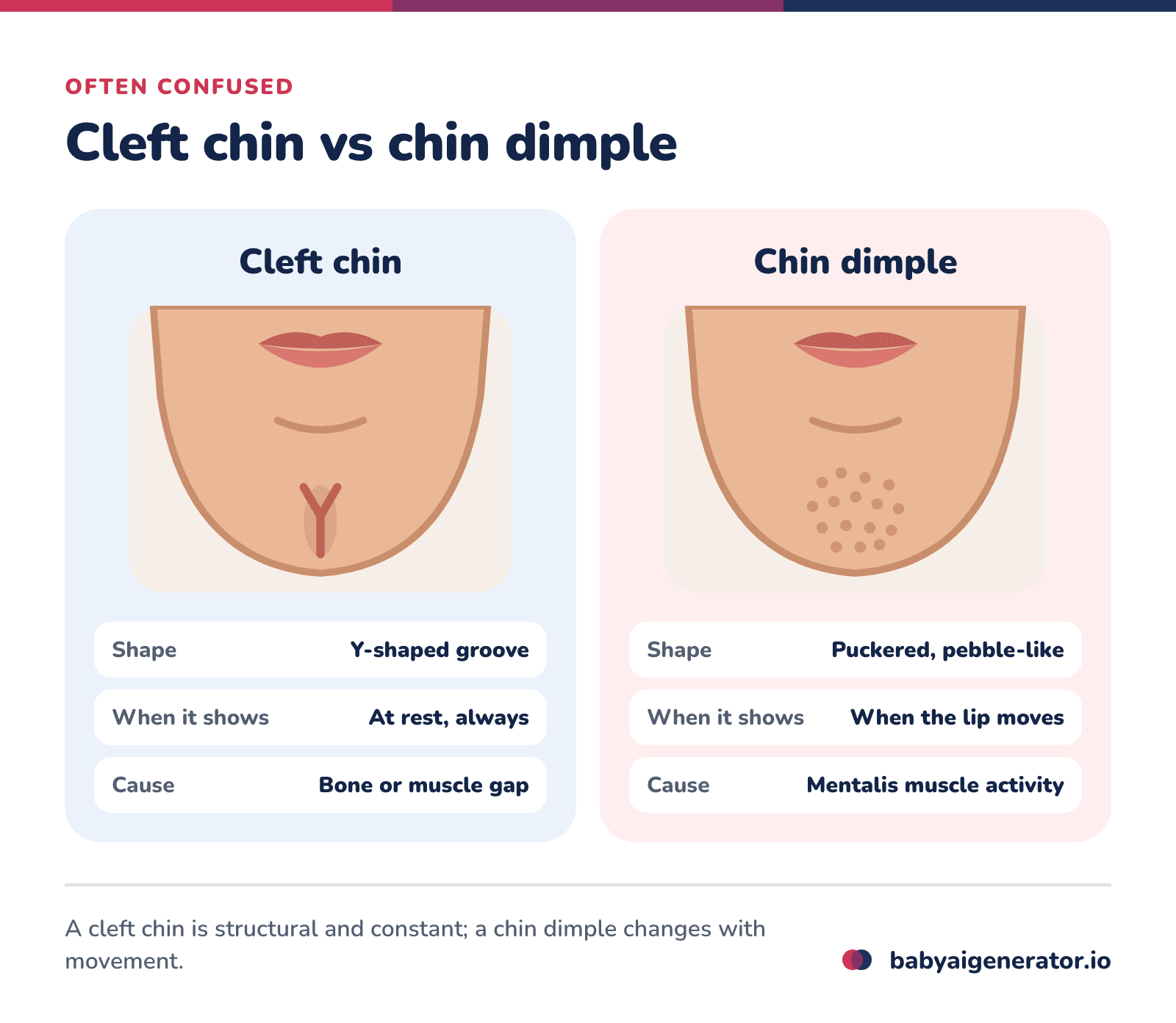
No, a cleft chin and a chin dimple are not the same, although the terms are often confused. A cleft chin is a permanent indentation or groove in the center of the chin, often caused by a separation in the underlying bone or muscle, and it shows at rest as a pronounced Y-shaped groove.
A chin dimple can appear as a subtle indentation or a puckered surface caused by mentalis muscle activity, and it becomes more visible when a person speaks, smiles or moves the lower lip, creating a textured pebble chin look.
A cleft chin is structural and constant, whereas a chin dimple is often movement-related and changes in appearance, which explains why the two terms are used interchangeably but describe different features.
How Rare Is a Cleft Chin?
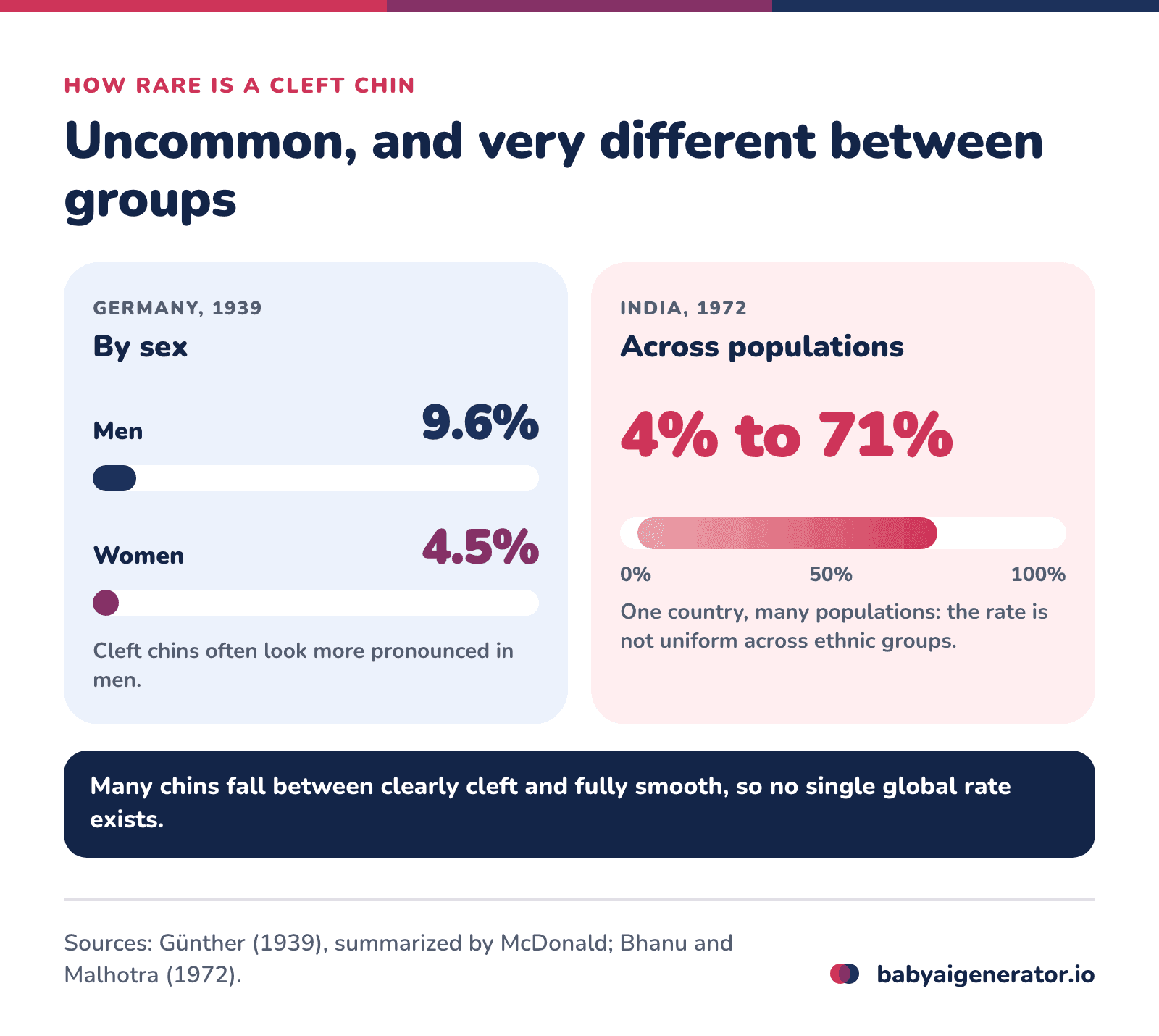
A cleft chin is an uncommon facial feature whose prevalence varies widely between populations. Prevalence differs by sex and population, and many chins fall between distinctly cleft and fully smooth, which makes a single global rate hard to set. A 1939 study by Günther, summarized in McDonald's "Myths of Human Genetics: Cleft Chin," found cleft chins in about 9.6% of German men and 4.5% of German women.
Genetic and environmental factors shape how often a cleft chin appears, and different ethnic groups show different frequencies. The depth and visibility of a cleft chin can change with age, fat distribution and skin elasticity, which adds to the difficulty of a universal prevalence rate.
Which Ethnicities Have Cleft Chins Most Often?
The ethnicities with cleft chins most often cannot be ranked with confidence, because data on cleft chin prevalence are scarce and inconsistent. Studies report wide differences between populations, and prevalence within a single country can range from rare to common, as Bhanu and Malhotra (1972) found when cleft chin frequency across Indian populations ranged from 4% to 71%, which shows that cleft chin frequency is not uniform across ethnic groups.
Do Cleft Chins Look Different in Women and Men?
Yes, cleft chins can look different in women and men. The difference comes from chin shape and facial proportions rather than a distinct type of cleft. In men, cleft chins often look more pronounced because men tend to have larger bone structures and more prominent jaw development, along with thicker skin and facial musculature that accentuate the cleft.
Women have softer facial contours and less prominent bone structure, so a cleft chin in a woman often shows as a gentle indentation rather than a pronounced groove. Individual variation means some women have very pronounced cleft chins and some men have subtle ones, since bone structure, soft tissue, muscle attachment and skin all shape how a cleft chin looks.
Can a Cleft Chin Appear or Fade Over Time?
Yes, a cleft chin can appear or fade over time, although the underlying structure stays the same. Facial anatomy changes with age, and lower facial fat and reduced skin elasticity make the bone and muscle beneath the chin more visible, so a cleft chin becomes more noticeable.
Weight gain adds soft tissue padding that can make a subtle cleft chin less visible or seem to disappear. In children, baby fat and fuller features can mask a cleft chin that becomes more visible as the face matures, and weight changes through life can make the cleft more or less prominent while the incomplete mandible fusion or mentalis attachment behind it remains.
Can Two Parents Without Cleft Chins Have a Child With One?
Yes, two parents without cleft chins can have a child with one. Cleft chin inheritance involves several genes rather than a simple dominant and recessive pattern, so parents can carry cleft chin variants without showing the trait, and the variants can combine in a child to produce a cleft chin.
Variable gene expression and developmental factors during fetal growth shape whether a cleft chin appears, so predicting a cleft chin from the parents' appearance alone is unreliable.
Can You Predict Whether a Baby Will Have a Cleft Chin?
No, you cannot reliably predict whether a baby will have a cleft chin. Several genes influence cleft chin inheritance, and variable penetrance affects whether the trait shows, so neither parental traits nor current genetic data give an accurate prediction. Parents with cleft chins raise the likelihood of a cleft-chinned child, but two smooth-chinned parents can still have a child with a cleft chin.
How Does the AI Baby Generator Show a Cleft Chin on Your Future Baby?
The AI Baby Creator can only suggest a cleft chin on a future baby, because a cleft chin is often hidden in a baby's face. The AI Baby Generator analyzes the chin shape in both parents' front-facing photos and examines chin landmarks such as the mentolabial sulcus, chin prominence and any visible vertical groove at the midline, but a baby's small, set-back chin and baby fat soften the midline, so the generated face often shows a smooth or faint chin rather than a clear cleft. Several genes and variable penetrance decide whether a cleft chin appears, so any chin in the generated face is a visual estimate of one possible outcome, not the chin the child will certainly have. The chin landmarks must show plainly in the parent photos for the result to reflect them.
Using Front-Facing Parent Photos for Chin Shape Predictions
Front-facing parent photos give the AI Baby Generator the clearest view of chin shape. Both parents should be photographed straight on, so the chin and jawline are unobstructed and any cleft or indentation is visible, with even lighting and a level angle that avoid shadows hiding the chin's features.
Why Is a Cleft Chin Hidden in Newborn Faces?
A cleft chin is hidden in newborn faces because a newborn's lower jaw and chin are small and set back, which makes the midline indentation less visible. Subcutaneous fat fills out the chin area and softens the underlying bone and muscle, which masks the cleft further.
As the infant grows, the mandible grows forward and downward and the facial proportions change, which reveals a cleft that was hidden. The loss of baby fat as the child ages lets the true contours of the chin emerge, so an inherited structure present from birth becomes visible only as the child matures.
Which Chin and Jaw Traits Do Babies Inherit?
The chin and jaw traits babies inherit, shaped by several genetic factors and environmental conditions, are listed below:
- Chin Prominence: How far the chin projects forward from the face.
- Chin Width: Whether the chin looks narrow or broad.
- Mandibular Length: The full length of the jawbone.
- Jaw Width: The broadness of the lower face.
- Jaw Angle: The angle where the jaw turns upward, which shapes the jawline.
- Lower Jaw Position: How the lower jaw aligns with the upper jaw, which affects the bite and facial balance.
Are Chin Dimples Inherited Like Cheek Dimples?
No, chin dimples are not inherited in exactly the same way as cheek dimples. Chin dimples, including cleft chins, come from incomplete fusion of the lower jaw and the positioning of the mentalis muscle, while cheek dimples come from variations in a cheek muscle. Both were once thought to follow simple dominant inheritance, and both now appear to involve several genes rather than a single dominant gene.
Which Facial Traits Are Inherited Like a Cleft Chin?
The facial traits inherited like a cleft chin include the widow's peak, cheek dimples, nose shape, lip shape, jaw structure, facial width, eye spacing and philtrum length. Each of the traits depends on several genes rather than a simple dominant or recessive model, so the traits can appear unpredictably in families, skip generations or show up when neither parent has them, like the rest of facial feature inheritance.
Is a Widow's Peak Inherited Like a Cleft Chin?
Yes, a widow's peak is inherited in a similar way to a cleft chin. Both traits were once believed to follow simple Mendelian inheritance through a single dominant gene, and genetic research shows both involve polygenic inheritance. Both traits show variable penetrance, so carrying the genes does not guarantee the visible trait.
Is a Cleft Chin Really a Simple Dominant Trait?
No, a cleft chin is not a simple dominant trait. A cleft chin is often taught as a classic example of Mendelian inheritance, as in the classic dominant and recessive traits chart, but research shows the trait depends on several genes rather than a single dominant gene, and McDonald's book "Myths of Human Genetics" (2011) lists the cleft chin among the classroom traits that do not follow a simple one-gene pattern. Variable penetrance means that even people carrying a cleft chin variant may not show the trait, which refutes the simple dominant model and places the cleft chin among inherited traits shaped by many genes.
Written by The Baby AI Generator team. We build the generator on this site and write about what it can and can't tell you.