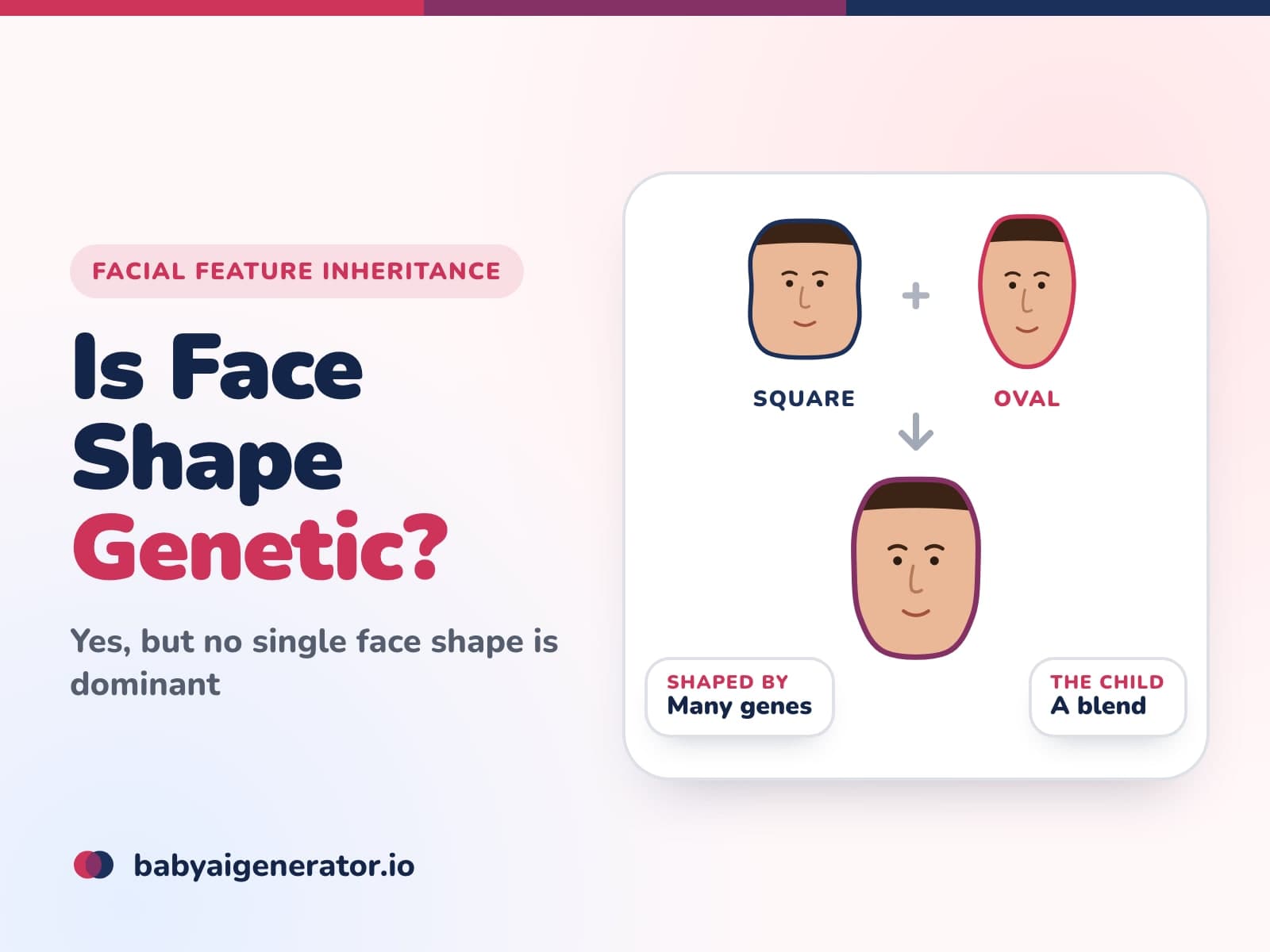
Yes, face shape is genetic, but no single face shape is dominant. Face shape results from many genes that blend the proportions inherited from both parents. Face shape is the outline set by the skull, the jaw and the facial soft tissue, which together decide the structure and look of the face.
Face shape is highly heritable, yet the interaction of many genes keeps any one shape from dominating. Skull and jaw bone structure, along with facial fat and soft tissue, set the face's outline, and the main categories are oval, round and square, though many people show a blend. Genes such as PAX3 influence facial features, but no single gene decides a whole face shape, and the rarest face shape has no scientific answer because frequency depends on how shapes are classified.
Predicting a baby's face shape is imprecise, though the AI Baby Generator estimates it by blending the parents' facial outlines from photos. A baby's face shape changes a great deal in the first year and keeps changing from toddler to teen, and traits such as nose shape and a cleft chin are inherited along with face shape. The absence of a single dominant face shape reflects the genetic blending that defines facial appearance.
Is Face Shape Inherited From Parents?
Yes, face shape is inherited from parents through genetic material from both the mother and the father. Many genes influence the skull, jaw and facial soft tissue that set face shape, and the inheritance pattern is polygenic, with many genes interacting rather than simple dominant and recessive rules.
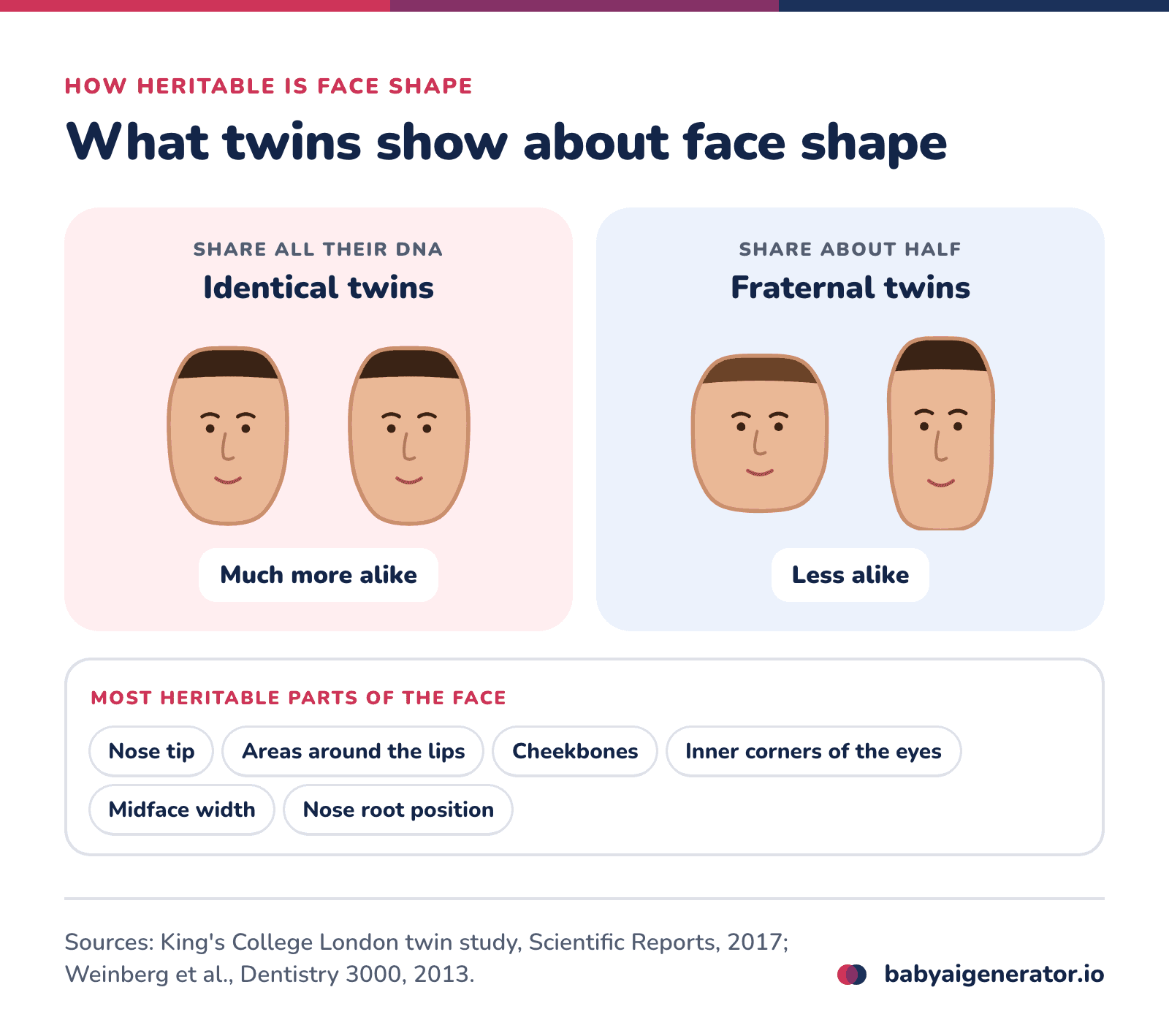
Twin studies show that facial features are highly heritable, and identical twins, who share the same genetic makeup, show strikingly similar facial structures. Genetic research has identified more than 200 regions of the genome linked to aspects of facial shape.
Children usually show a blend of facial characteristics from each parent rather than resembling one parent entirely. Family members therefore share familiar facial similarities while keeping individual features.
How Heritable Is Face Shape?
Face shape is moderately to highly heritable, with genetic factors shaping much of facial structure. Twin studies provide the strongest evidence, because identical twins, who share all their genetic material, show much more facial similarity than fraternal twins. A 2017 King's College London study of about 1,000 twins, "Heritability maps of human face morphology through large-scale automated three-dimensional phenotyping" (Scientific Reports), found the nose tip, the areas around the lips, the cheekbones and the inner corners of the eyes to be the most heritable parts of the face. Weinberg, Parsons, Marazita and Maher reported strong heritability for the width of the central midface and the position of the nose root in "Heritability of face shape in twins: a preliminary study using 3D stereophotogrammetry and geometric morphometrics" (Dentistry 3000, 2013). Genetic factors account for a large share of facial variation, while environmental influences contribute to the final appearance.
Which Face Shape Is Dominant?
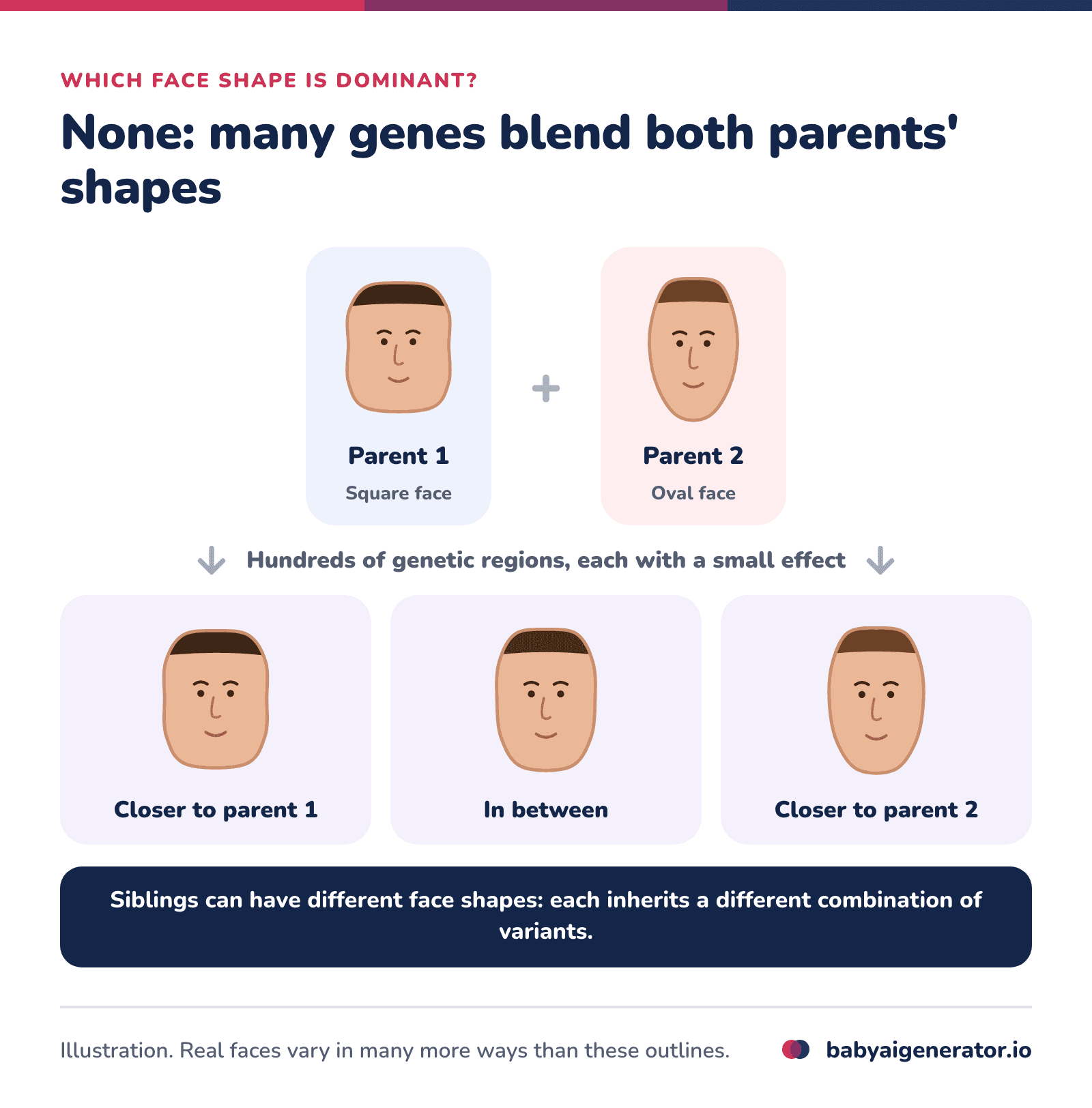
No face shape is dominant in genetic inheritance. Facial shape is a polygenic trait shaped by many genes rather than a single gene that sets an oval, round or square face. Hundreds of genetic regions each contribute small effects to normal facial variation, and together they create the range of face shapes. A 2023 study led by Qing Li at UCL, published in Communications Biology, added 33 new face-shape regions from more than 6,000 Latin American volunteers, which shows how many genes share in shaping a single face.
A child's facial features blend the genetic contributions of both parents, so neither parent's facial structure dominates. Siblings can have different face shapes because each inherits a different combination of variants, along with different environmental influences.
What Determines the Shape of Your Face?
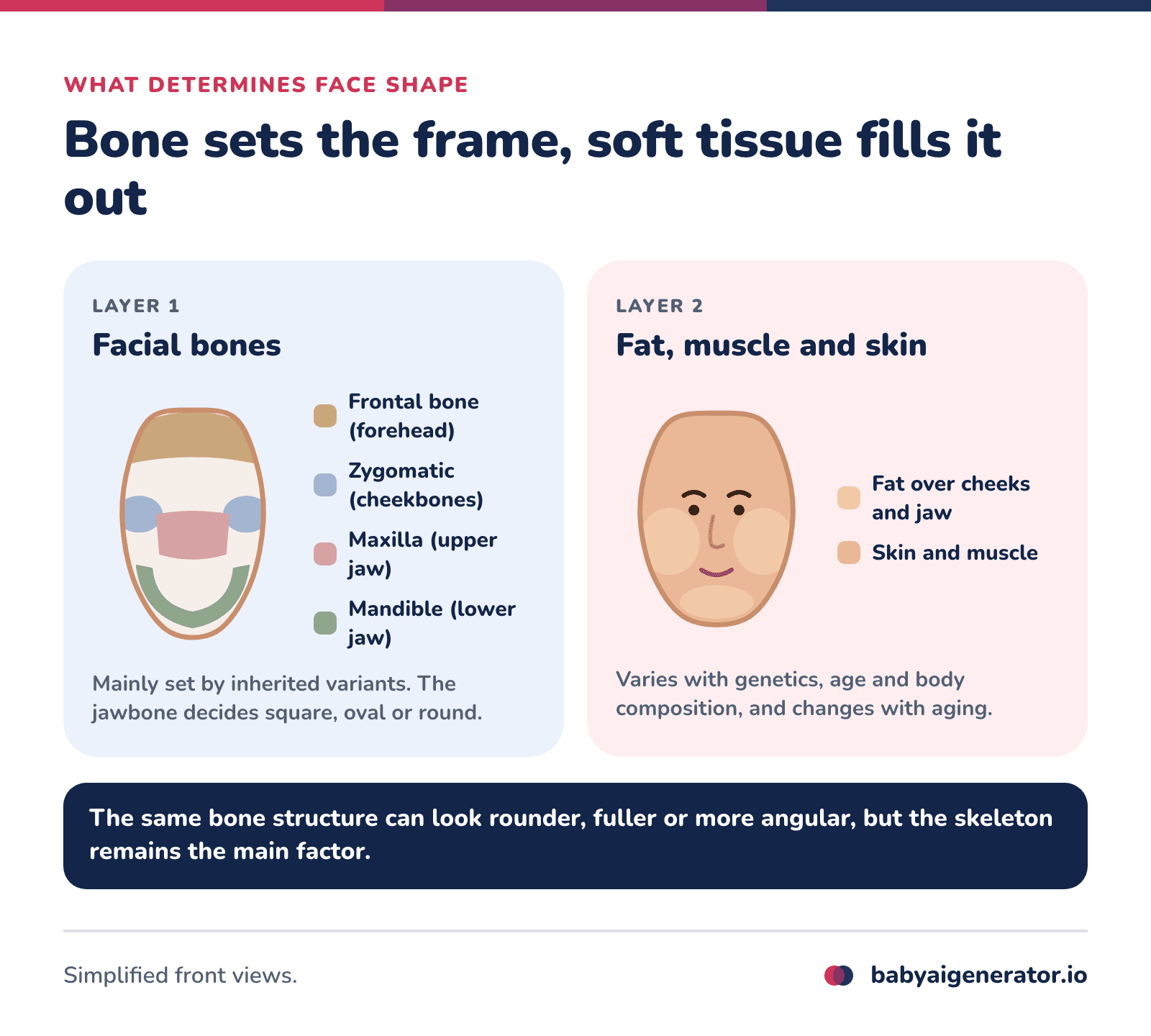
The shape of your face is determined by bone structure and soft tissue together. The skull and jaw bones form the framework that sets the basic proportions and contours, and the width of the cheekbones, the angle of the jaw and the proportions of the forehead establish the face's architecture.
Soft tissues, including facial fat, muscle, skin and connective tissue, add volume over the bone and refine the face's appearance. The amount and placement of fat in the cheeks and around the jaw make a face look fuller or more angular, while muscle tone and skin elasticity contribute too, though the skeleton remains the main factor. The bone and tissue layers are explained below.
Skull and Jaw Bone Structure
Skull and jaw bone structure is the foundation that sets the shape of the face. The maxilla (upper jaw), mandible (lower jaw), zygomatic bones (cheekbones) and frontal bone (forehead) each contribute to the face's width, length and projection. The size, shape and proportions of the facial bones, especially the mandible and maxilla, depend mainly on the genetic variants inherited from both parents.
The jawbone decides whether a face looks square, oval or round. A prominent, angular mandible with a wider jaw angle creates a square look, while a narrower, tapered jaw contributes to an oval or heart-shaped face. How the upper and lower jaws align affects facial proportions and profile, and genes behind normal facial bone development overlap with genes involved in facial malformations, so small genetic differences in bone structure create distinctive facial features.
Facial Fat and Soft Tissue
Facial fat and soft tissue shape the face's appearance over the bone. Skin, fat beneath the skin, facial muscles and connective tissue overlay the skull and jaw, and the distribution of facial fat varies with genetics, age and body composition, so identical bone structures can look rounder, fuller or more angular.
Facial soft tissue changes with age, as fat compartments lose volume or shift and skin elasticity and connective tissue support decline. Soft tissue aging softens facial angles, deepens folds and can create hollowing or sagging over time.
What Are the Main Face Shapes?
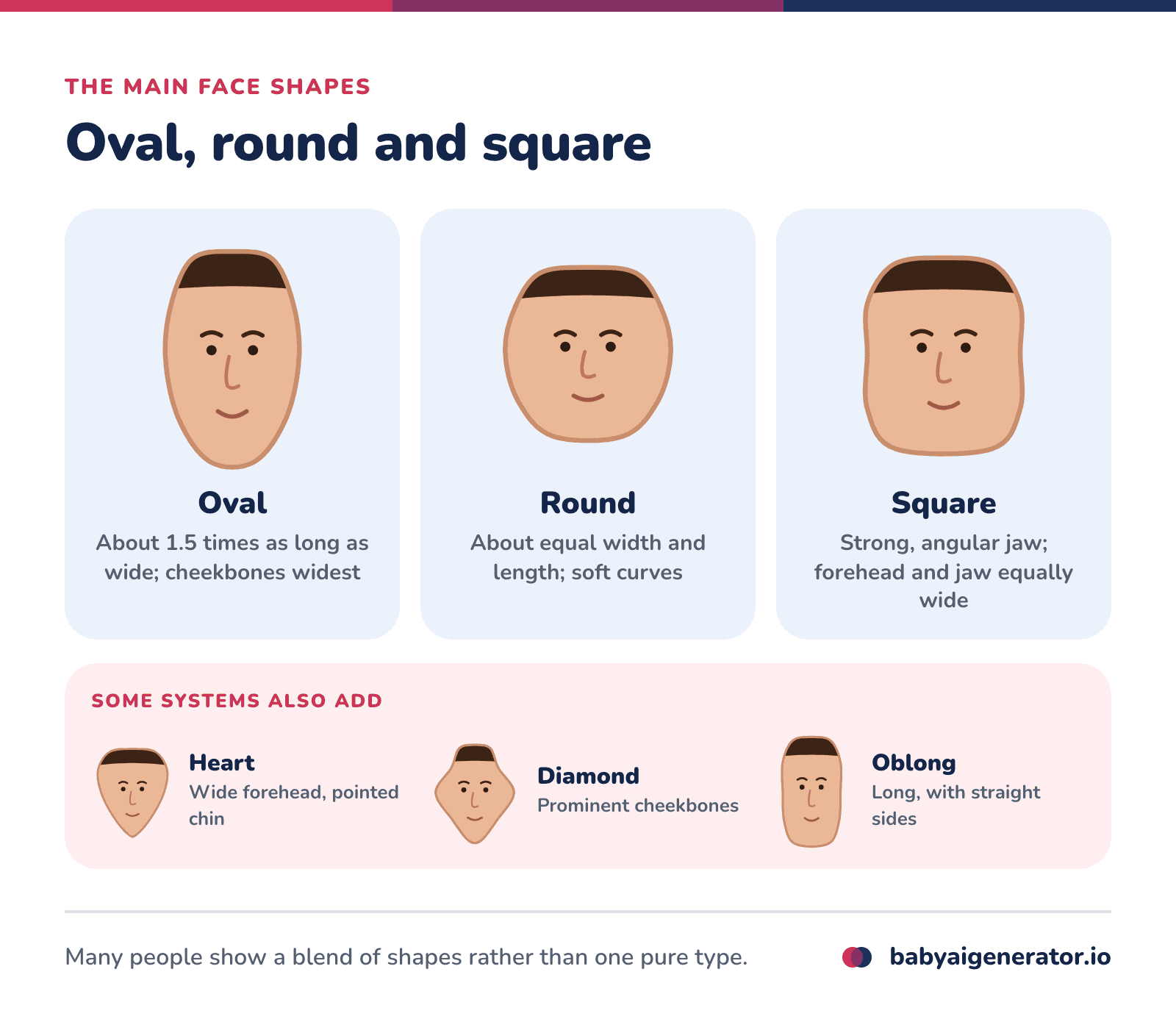
The main face shapes are oval, round and square, the best-known configurations based on the proportions and contours of the skull, jawline and facial soft tissue. Some systems add heart, diamond or oblong shapes, but oval, round and square remain the foundational categories, as described below.
Oval Face Shape
An oval face shape is a face that is longer than it is wide, with balanced, gently curved proportions and the cheekbones as the widest part. The forehead is slightly wider than the chin, and the jawline tapers smoothly to a softly rounded chin without sharp angles. An oval face is about one and a half times as long as it is wide, which gives it an egg-like outline.
Round Face Shape
A round face shape is a face with about equal width and length, giving a circular look. The cheeks are the fullest part of a round face, the forehead and jawline have similar widths, and the contours are soft and curved without sharp angles. The jawline is rounded and the chin is short rather than pointed, which gives round faces a youthful look.
Square Face Shape
A square face shape is a face with a strong, angular jawline and a broad forehead of about equal width. The length and width of a square face are proportionate, with straight sides from the temples down to the jaw and a flat rather than pointed chin.
In a square face, the cheekbones are not the widest part, since the forehead and jawline share similar measurements. The broad mandible and straight jaw angles create the squared-off look that makes the square face shape easy to spot.
Which Genes Shape the Face?
The genes that shape the face are many, with more than 200 regions of the genome contributing to facial development. White et al. identified 203 genome-wide-significant signals for normal facial variation in 8,246 people of European ancestry in "Insights into the genetic architecture of the human face" (Nature Genetics, 2021). Face shape genes affect the width, depth and structure of the face, and many of the genes involved in normal facial variation are active in the cranial neural crest cells that build the face in the embryo. Some of the same genes are involved in orofacial clefting, which shows the shared genetic pathways behind typical facial development and facial malformations.
What Is the Rarest Face Shape?
The rarest face shape is often described as the diamond shape in beauty classifications. A diamond face shape has a narrow forehead and jawline with prominent cheekbones, which gives it an angular look and makes it less common than oval, round or square faces in those classifications.
Face shapes result from many genetic regions working together, and particular combinations of variants from both parents can produce less common configurations such as the diamond shape. Beauty guides sometimes call heart-shaped faces the rarest instead, so the rarity of any face shape depends on population differences and on how researchers or stylists classify faces.
Does Face Shape Change as a Child Grows?
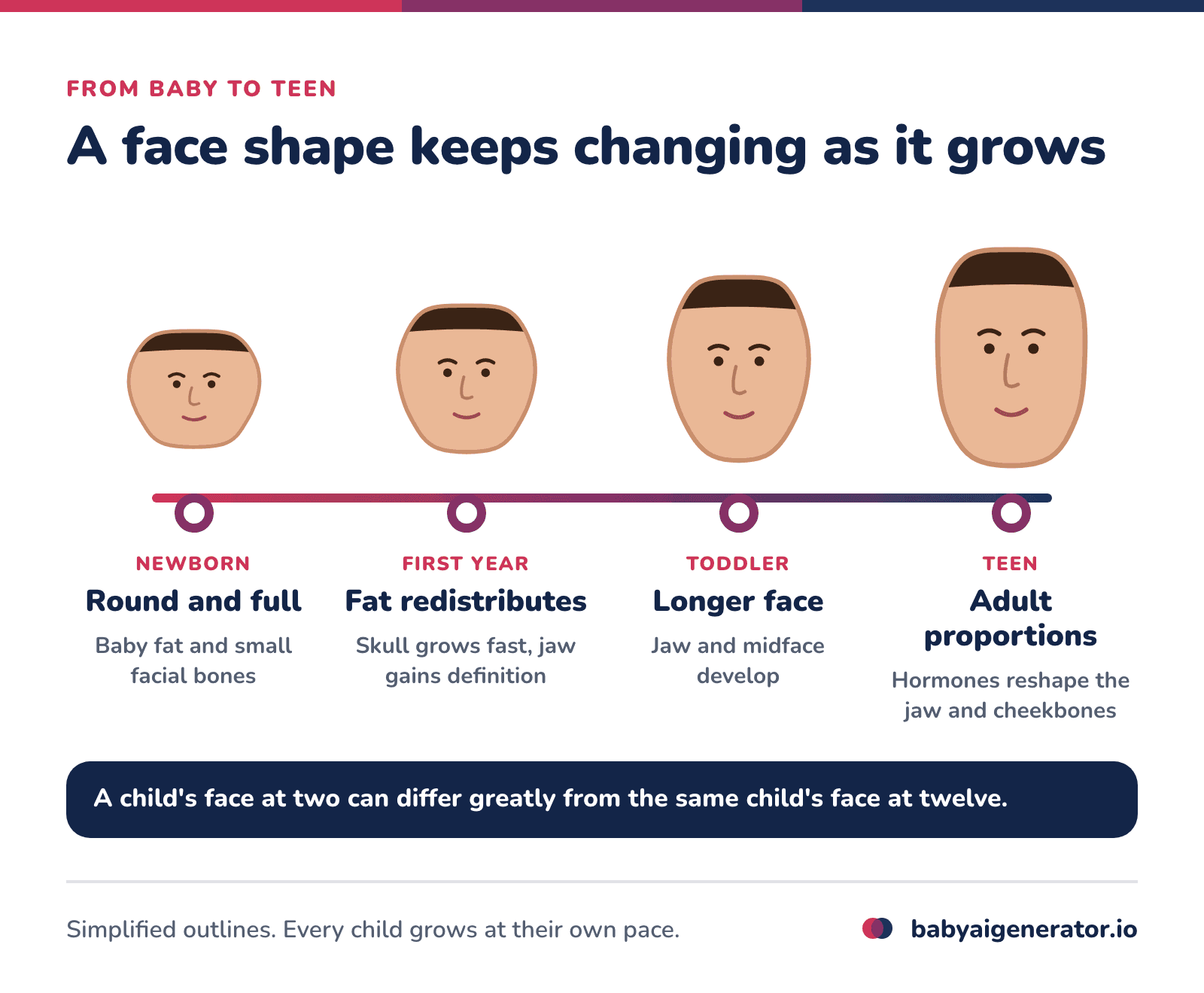
Yes, face shape changes as a child grows. The skull, jaw and facial tissues develop at different rates through childhood, so infants' rounder faces gradually lengthen as the midface and jawbone mature, and the jaw keeps growing forward and downward through adolescence, giving more defined features.
Facial fat shifts as children age, reducing the baby-fat look, and the midface, including the nose and cheekbones, becomes more prominent as the bones mature. The lower face lengthens and changes the balance between width and length, so a child's face shape at two can differ greatly from the same child's face shape at twelve, which raises the question of whether a baby's face shape can be predicted from the parents.
Can You Predict a Baby's Face Shape From the Parents?
No, you cannot precisely predict a baby's face shape from the parents. Face shape results from many genetic factors inherited from both parents, and while inheritance gives clues about jaw shape and forehead structure, more than 200 genetic regions combine in varied ways, producing a blend that can differ even among siblings. Genetic recombination and environmental factors make an exact prediction impossible.
How Does the AI Baby Generator Predict Your Baby's Face Shape?
The Future Baby Generator cannot predict a baby's exact face shape, but it gives a visual estimate by extracting the facial outlines from both parents' photos. The AI Baby Generator identifies structural features such as jaw contour, cheekbone placement and facial proportions in each parent's image and maps them as data points that describe each parent's face shape, whether oval, round, square or a different variation. A baby's face is round and full and keeps changing from the first year to the teen years, so the generated face shows one possible blend, not the face shape the child will grow into.
Once both parents' face outlines are captured, the AI Baby Generator combines the two facial structures into a single estimate that reflects the contribution of both the mother and the father.
Blending Both Parents' Face Shapes in One Prediction
The AI Baby Generator blends both parents' face shapes into one estimate by merging the facial landmarks from each parent's image into a single facial outline. The generated face combines structural features such as jaw width and cheekbone prominence from the mother and the father, reflecting the polygenic nature of facial inheritance, but it remains a visual estimate rather than a prediction of the child's final face shape.
How Does a Baby's Face Shape Change in the First Year?
A baby's face shape changes a great deal during the first year of life. Newborns have rounder, fuller faces with soft features from baby fat and underdeveloped facial bones, and as the infant grows, the skull expands quickly to fit the growing brain and the jawbone gains definition. The cheeks become less pronounced as baby fat redistributes, and the face starts to lengthen toward the child's eventual face shape.
The first-year changes are part of normal craniofacial development, guided by genetic programming and influenced by factors such as feeding. The fastest facial changes happen early in infancy, with more gradual changes through the rest of the first year, and Cook Children's Health Care System notes in "Your Newborn Head to Toe" that a newborn's puffy face changes a great deal during the first few days as fluid and the effects of birth fade.
How Do Children's Face Shapes Change From Toddler to Teen?
Children's face shapes change from toddler to teen through continuous growth. During the toddler years, the face becomes longer and more defined as the jaw and midface develop, and in adolescence, hormonal changes reshape facial structure further. Boys often develop more angular jaws and broader features, while girls' faces may keep softer contours, following the genetic blueprint inherited from both parents.
Which Facial Features Are Inherited Along With Face Shape?
The facial features inherited along with face shape, each controlled by many genes working together, are listed below:
- Nose Shape: The size and structure of the nose.
- Chin Structure: Features such as a cleft chin.
- Cheekbone Prominence: The height and definition of the cheekbones.
- Eye Shape and Spacing: The size of the eyes and the distance between them.
- Forehead Proportions: The height and width of the forehead.
- Lip Fullness and Width: The size and contour of the lips.
- Jaw Dimensions: The size and angle of the jawline.
Is Nose Shape Inherited Like Face Shape?
Yes, nose shape is inherited in a similar way to face shape, through many genes from both parents. Genetic variants influence nostril width and nose bridge prominence, and genes such as PAX3 and DCHS2 are linked to nasal features. Nose shape, like face shape, results from polygenic inheritance, so children's noses often blend features from both parents.
Is a Cleft Chin Part of Inherited Face Shape?
Yes, a cleft chin is part of inherited face shape. A cleft chin is a visible indentation in the chin that runs in families and passes down alongside general face shape. A cleft chin was traditionally thought to follow simple dominant inheritance, but genetic research shows several genes contribute, which places the cleft chin within the polygenic system that shapes all facial features.
Why Is There No Single Dominant Face Shape?
There is no single dominant face shape because facial structure is a polygenic trait shaped by many genes. Face shape genes contribute to width, height and jaw proportions, creating varied combinations, and face shape results from the interaction of many variants inherited from both parents rather than a single dominant gene.
Each parent contributes many variants that together shape the skull, jaw and soft tissue proportions, which explains why siblings can have different face shapes despite sharing the same parents. Face shape is therefore genetic but follows a polygenic inheritance pattern rather than a simple dominant and recessive rule.
Written by The Baby AI Generator team. We build the generator on this site and write about what it can and can't tell you.